From Feature Overload to Fit for Purpose: Finding the Capabilities that Matter Most to Your Organization

If you’ve sat through a finance system that only showed slide after slide of capabilities, somewhere around slide 40, you start wondering if any of it actually matters to your team.
The paradox that nonprofit CFOs live with every day is that your finance systems have more features than they’ve ever had, and your team is still buried in manual work. Month-end close still takes three weeks. Someone is still re-keying data between systems. The board still gets reports built by hand in Excel the night before the meeting.
The problem was never a lack of capability. It’s a mismatch between what your systems can do and what your organization actually uses. Finding a practical way to cut through the feature lists and figure out what genuinely moves the needle for your team can seem like an insurmountable task, but it’s a necessary one to truly move your organization forward.
Why “More Features” Isn’t the Same as “More Value”
Demos are built to prove the system. It’s not designed to actually diagnose what’s slowing your team down. It can be easy to walk away from a demo dazzled by a capability you’ll never touch, and in turn can leave you no closer to solving the problem that made you start shopping in the first place.
Feature bloat isn’t free, either. Every unused module is still something your team has to click past, get trained on, or pay for in your subscription tier. On top of the financial cost, you have the cognitive overhead of navigating a system that’s trying to be everything, when what your staff needed was a system that’s good at the three or four things they do every single day.
You also run into features leaving you behind because you aren’t using the core modules. Most systems have developed cutting-edge AI, but if your data isn’t running clean through the basic features, those add-ons that seem like miracles will never work.
A capability only matters if it closes a gap your team actually has. Everything else is noise dressed up as innovation. The last thing you want to do is sell your team on a dream and end up with an even more complex nightmare.
Start With Your Bottlenecks, Not the Vendor’s Brochure
Before you look at a single feature list, map your own workflows (or have someone else map them, because who has the time?). Where does data get re-entered by hand? Where do approvals stall out waiting on someone’s inbox? What reports take three days to build when they should take three minutes?
This is the “Centralize” step, and it’s the one teams skip because it’s less exciting than watching a demo and getting excited about AI, integrations, automation, widgets, motion capture, and ocular accounting (I made the last few up, but they sound cool, right?). But it’s the only way to walk into an evaluation with a real scorecard instead of a gut feeling.
Come prepared with a list of things you need to see done. Don’t take a salesperson’s word for it. Do this with the people actually doing the work, not just the people who’ll be signing the contract. The staff running AP every week knows exactly where the friction lives. The CFO signing off on the purchase usually doesn’t.
Don’t Get Sold on Bells and Whistles. Evaluate on Core Fit.
Once you’re in the room with vendors, the same dynamic that drove the feature bloat in the first place shows up again. Demos are designed to dazzle, not diagnose. The AI add-on. The flashy dashboard. The “innovative” module that sounds incredible and has nothing to do with your actual bottlenecks.
Bring your accounting bottleneck list into every single demo. Score vendors against it, not against how impressive the pitch was. Ask to see the boring stuff first: how core AP actually works, how reconciliation actually flows, how a standard report actually gets built.
If a rep pivots to a shiny feature the moment you ask a hard question about a core workflow gap, that’s not a coincidence, it’s a tell. Build your evaluation scorecard so that core functionality has to earn its points before any extras get counted at all. If a system can’t nail the basics, the extras don’t matter.
A Simple Framework for Evaluating Fit
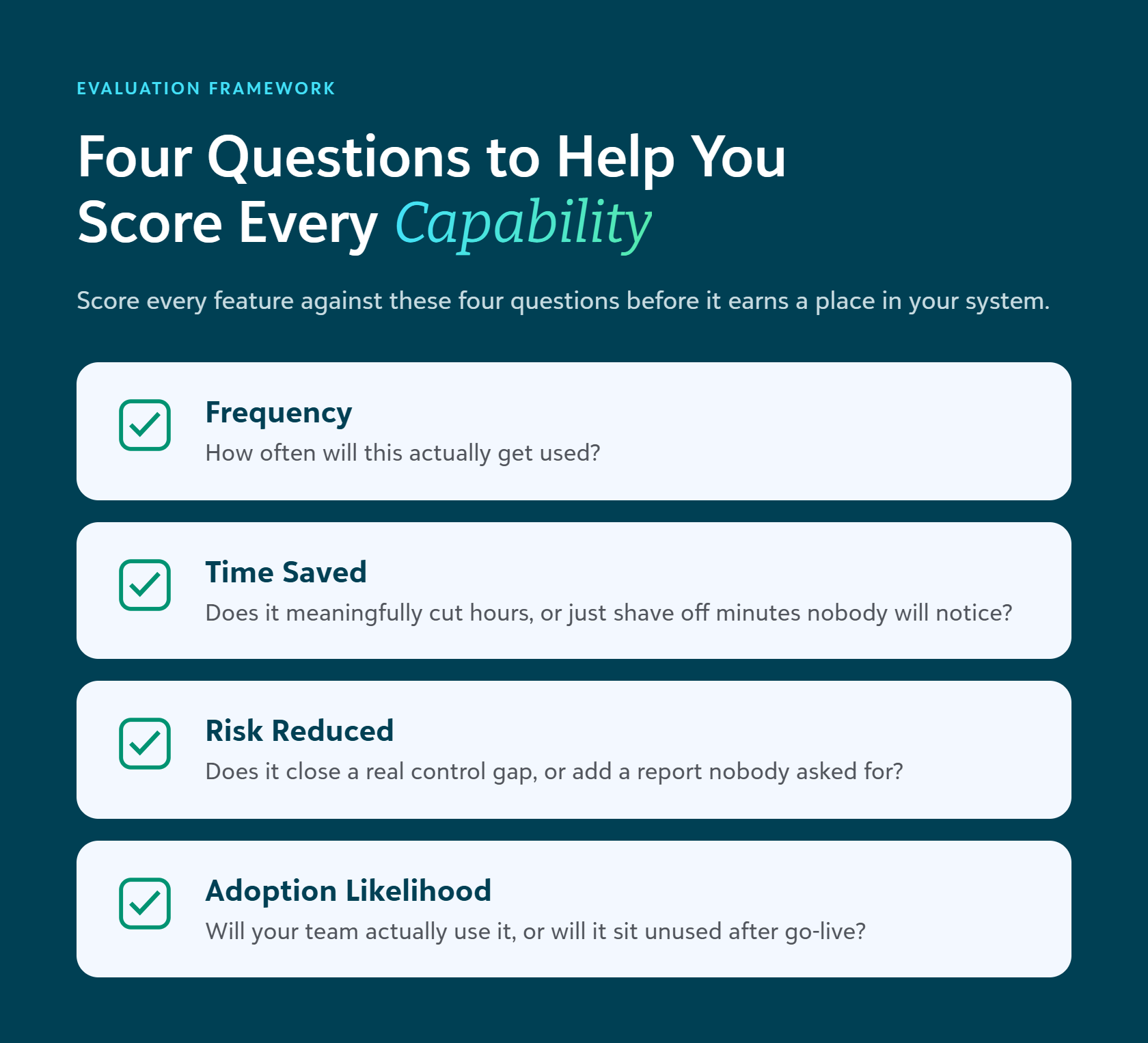
Score every capability, yours or a vendor’s, against four questions:
- Frequency: How often will this actually get used?
- Time saved: Does this meaningfully cut hours, or shave off minutes nobody will notice?
- Risk reduced: Does it close a control gap, or just add a report nobody asked for?
- Adoption likelihood: Will your team actually use it, or will it sit there unused after go-live?
Watch for “shiny object” capabilities, the ones that look incredible in a demo and are forgotten by month six. And remember that fit is relative to size. The right system for a $5M organization looks nothing like the right system for a $50M one. Bigger isn’t better. Matched is better.
What “Fit for Purpose” Looks Like in Practice
Picture two organizations shopping for the same category of system.
The first does the work up front. It maps its bottlenecks, brings a scorecard to every demo, and walks away with a system that has exactly the capabilities it needs. Three or four core features, well implemented, solve 80% of the team’s pain. Staff adopt it because it actually fits how they work.
The second buys the platform with the longest feature list, assuming more will mean better. A year later, half the modules sit untouched, staff still work around the system instead of in it, and the finance team is no closer to a faster close than they were before the purchase.
Same budget range. Very different outcomes. The difference wasn’t the system. It was the discipline of evaluating for fit instead of for feature count.
Want to dig more into identifying the features and functionality that means the most to your organization? Check out the webinar, How to Build a Fit-for-Purpose Finance Systems.