Joy as a Resilience Strategy: Building Stronger Grantmaking Infrastructure through Joy

I’ve been thinking a lot about a recent conversation I had with a colleague. As we were catching up, she shared more about her work and the frustration she had been facing.
At her foundation, they not only were in the process of changing grants management systems, but also were doing a strategic restructuring internally with a few team roles. Also, they claimed to be an organization committed to social justice, but the organization had been quiet about many of the injustices happening in our broader society. They hadn’t shifted their grantmaking or practices to reflect the urgency at hand.
As a team leader, she saw how this was affecting teammates. Everyone seemed frustrated, burnt out, and drained. She felt like she had been yelling into the void, and didn’t have answers for all the uncertainty, change, and fear.
I know this example is not unique to my colleague and her foundation. Across the social impact sector, funders and grantees alike are under significant stress and pressure. We are facing rising political and social unrest, market volatility, and in response, funding shifts and scarcity.
Joy Is the Antidote
To be able to sustain through the ebbs and flows of what grantmaking organizations do on a daily basis, we need joy—as resilience, to ground in our humanity, to continue meaningful work, and to enjoy the seasons of uncertainty as we navigate through them.
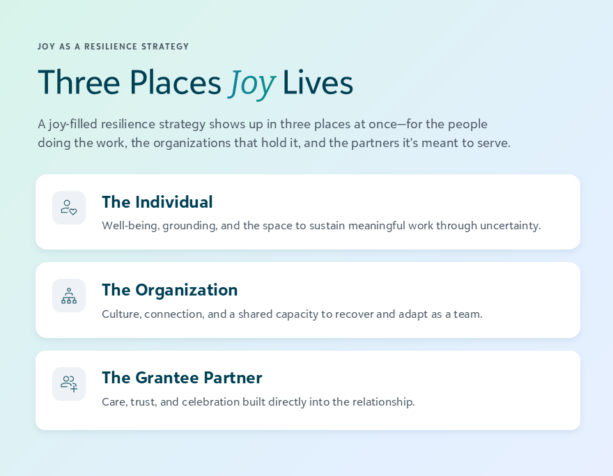
Joy is a state of well-being, deep pleasure, and happiness. In philanthropy, the opportunity for joy is threefold—joy for the individual philanthropy professional, joy for the grantmaking organization, and joy for the grantee partner.
In action, prioritizing philanthropy joy looks like grantmaking teams having joyful reflection sessions at the end of a big project. It looks like a post-grant award party where grantees can celebrate, reflect, connect, and be appreciated. It looks like major philanthropy conferences full of joyful connection spaces. It looks like restorative joyful retreats funded by philanthropy investments. It looks like spaciousness to plan ahead, to ideate, to dream, from a place of abundance and not fear.
It also looks like directly addressing the roadblocks getting in the way of joy. It looks like having honest conversations and doing the reparative work to get back to authentic joy.
Oftentimes, when we think about joy, we characterize it as a nice perk to have after a job well done, rather than a core strategic function to get to greater impact and resiliency. When we focus on the latter, there are so many benefits, both for the work and for the people doing it.
At PhilanthroJoy, I’ve been speaking with funders about what it looks like to navigate these uncertainties with greater clarity, grounding, and joy. Some have been exploring what it looks like to create a resilience strategy—what do we do when every assumption in the theory of change is disproved? Or when every condition in our strategic planning has shifted?
The capacity to repair, recover, adapt, and bounce back quickly from adversity, trauma, and significant stress is paramount, particularly so we can keep supporting the frontline organizations and organizers on the ground caring for communities when they most need it.
As a philanthropic sector, building out a resilience strategy helps us to navigate. A resilience strategy can have a methodical plan for if things go wrong, but it falls short if it doesn’t address the human side of the work—centering well-being, care, and overall joy.
Joy in the Interpersonal
Cultivating joy for a more resilient grantmaking organization can take a variety of forms and practices. As philanthropy is relational work, focusing on people-power as a joy asset is a great launching point.
Building deep relational partnerships is a strong way to sustain joy in the interpersonal. This includes spending time connecting, learning about one another, sharing laughter and lighthearted moments, and showing that you truly care about the person beyond the work.
In practice, this has often looked like the five minutes of joyful small talk at the start of a check-in call, but there is an opportunity to sustain deeper relationships through genuine connection, concern, and following up after the conversation.
There are various ways to embed joy in the interpersonal, both internally in teams and externally between grantee partners.
Supporting joy with your colleagues:
- Seeing and valuing your teammates for their unique contributions, the ways they show up, how they help move the work forward. Deep appreciation and acknowledgement are ways to foster a culture of interpersonal joy. One team shared how much they love their virtual chat group with the entire staff where anyone can go in and give a shout-out to another colleague. This space to share big wins, give props, and acknowledge the big and small wins made a huge difference for team morale and overall joy.
- Understanding what brings your team joy, individually and collectively. When you know what brings your team joy, you can prioritize it, whether it’s the way you work or how you encourage everyone to make time for wellness, self-care, rest, and enjoyment. In the onboarding process, some teams create a “get to know you” profile with things like workstyles, feedback preferences, personality types, hobbies, sources of joy, and other pertinent details. These personal manuals not only help teammates work together more smoothly, but also help teams to celebrate each other uniquely.
Supporting joy with your grantees:
- Show up as a true partner and lean in with care and concern, not judgement and critique. Be proactive about ways to serve and support the people behind the work. In practice, this could be the funder who comes to the site visit with authentic care and a strategic mindset to lean in and problem solve, or the program officer who stays after a grantee program to help straighten up and encourage them for a job well done.
- Inquire with grantees about what brings them joy, both in your relationship with them and in the work in general. Rather than focusing solely on metrics and data, see their faces light up as they share the components that most excite them, or the ways they’ve appreciated how you engage differently. And those stories are data as well. In working with funders who have shifted their evaluations from being solely written reports to alternative methods, such as conversational reviews, video compilations, or slide decks, many have noticed they get much richer insights from the stories their grantees tell, especially if they’ve created a psychologically safe space for them to share.
Joy looks different for each individual, so consider different perspectives. And if you’re not sure, don’t be afraid to ask. Simply naming your priority around joy will help you and those around you to better prioritize and foster joy.
Joy in the Infrastructure
While the interpersonal is important, joy shouldn’t only live in relational work. Your foundation infrastructure can also be a conduit for joy. By exploring your foundation’s operations, culture, systems, and overall technology, you can build more joy.
Building joy through your infrastructure takes a mixture of thoughtfulness, intentionality, explicitness, and empathy. As you think about ways to increase organizational resiliency, it takes a holistic strategy for maximum effectiveness.
Technology usage can be joyful, and not just for those with technology management as a core function of their role. Across the organization, technology can be used to streamline, build efficiency, encourage clarity, and make things easier for teammates and grantees. You prioritize joy when you design your technology in a people-centered way–not just centered around the end goal of efficiency, for example, but explicitly for user ease, and to reduce burden and frustration.
From your website, email, grants management system, customer relationship management software, knowledge management system, artificial intelligence usage, we rely heavily on technology to do our work. Challenges in technology infrastructure can be a significant joy barrier.
Here are ways to embed joy into your infrastructure:
Internally Facing Recommendations
- Create and encourage spaces of exploration around the technology usage. Understand how people use the technology, what are the pain points and challenges, and build a culture of learning and exploration around the tech usage—no judgement, no burdensome requirements, just helpful community learning.
- Design technology usage policies and protocols for greater clarity and awareness.
Externally Facing Recommendations
- Understanding the common technology pain points for grantseekers, including not being able to see the full grant application, having forms you can’t save and return to, and having a lack of formatting capabilities. Fix the Form by GrantAdvisor highlights data to reflect these common challenges. Ideally, taking the time to understand the specific challenges your grantee partners and applicants are facing and can address them. Many times these are small fixes on the funder’s side that produce a lot of relief and joy for the grantseeker.
Joyful Resilience Strategy
A joy-filled resilience strategy is a great roadmap to navigate uncertainty. While a standard resilience strategy would include operational procedure to include governance, legal, human resources, financial management, and technology protocol for uncertainty and challenges, a joy-filled resilience strategy includes the outcome of sustained joy while weathering uncertainty.
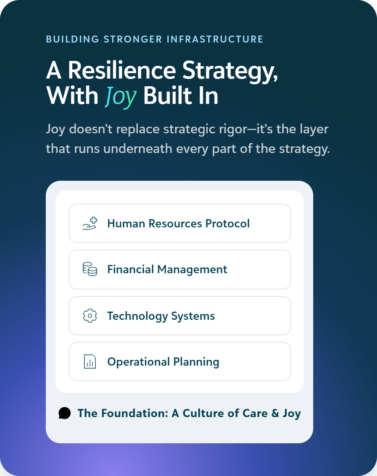
While this can be translated for a team-specific or even individual strategy, committing to an organization-wide joy resilience strategy is ideal because all staff hold responsibility for culture-building and cultivating. In the design, it is ideal to have input from all staff contributors because joy and resilience can both be individualistic, and leadership can hold the development and execution of the strategy, with support from outside partners to help you guide the process.
Here are some components for a thoughtful strategy:
- Your why: Why do you want and need to build more resiliency as an organization? Consider some of the challenges you’ve been experiencing as an organization and the ways this strategy will address and alleviate those challenges.
- Resilience challenges: What hurdles and specific circumstances are you aiming for your organization to be able to navigate joyfully and smoothly? Perhaps it’s civil unrest, political uprisings, financial uncertainty, staff transitions, natural disasters, or pandemics.
- Joyful resilience destination: What is the end goal you’re aiming to achieve, at what set time. It could be the end of an era or event, such as the conclusion of a relevant court case, or it could be specifically timebound, such as by the end of the year.
- Your current status: Where are we currently fostering a joyful environment? Where are we seeing a lot of joy internally and externally? Is it in specific teams, at particular points in the grant lifecycle, with certain grantee partners? What are the circumstances that may or may not be contributing to the joy we are seeking? Are there areas where our values are not aligned with our actions?
- Capacity, resources, and limitations: What capacity, resources, and limitations—people, capital, technology, partners—do we have in embedding more joy in our infrastructure?
- Protocol to get to the destination: What steps will we take to embed more joy in our organization infrastructure?
- Evaluation plan: How will we evaluate the success of our strategy? What metrics will we use to determine our success or failure? What benchmarks will we use to measure progress? How will we design our learning and reflection process throughout? Who will the learnings affect or benefit, and how will we deliver those learnings?
There is plenty to consider, but with so many varying challenges, strong leadership calls for us to be thoughtful about how we navigate instability.
If we’re going to make it through continued volatility, we need to build a resilience that allows us to weather various changes and challenges. We can do this with joy as a priority. Let’s build a more joyful philanthropic sector together.
To learn more about using joy as a resilience strategy in your grantmaking organization, check out the webinar, Building Stronger Infrastructure Through Joy.