Signs Your Systems Are Broken (And You’ve Just Learned to Live with It)

We all know that CFO. Sharp, experienced, good at their job, and the crown jewel of their department is a 47-tab Excel workbook built from blood, sweat, and tears to compensate for something their accounting system couldn’t do natively (or so they think). They’ve been maintaining it for three years. When asked about it, they shrug and say, “It works.”
That’s the problem. It works. Barely. With significant effort. On a good month.
Broken systems rarely announce themselves. There’s no error message, no blinking red light, and no red ring of death. Instead, they just slowly become the job. The workaround becomes institutional knowledge. The patch becomes the process.
At some point, you stop asking whether things could be better because you’re too busy managing the way things are.
The Slow Boil
Nonprofit finance leaders are uniquely good at adapting. You inherit systems mid-cycle. You’re understaffed. You’re juggling compliance requirements, grant restrictions, and an audit that’s always either just finished or about to start. Accounting is unfortunately very cyclical. So, when something doesn’t work quite right, you fix it the fastest way you can and move on.
The problem is that those fixes accumulate. A spreadsheet here. A manual step there. A workaround that only one person knows how to run. Over time, the distance between how your systems should work and how they actually work becomes so normal that you don’t notice it anymore.
And good luck documenting the Frankenstein process.
A system that is more workaround than process is expensive. Not just in staff hours, but in the decisions you’re making on incomplete or delayed information. When your ED asks for a cash position and the honest answer is “give me a few days,” that’s not a bandwidth problem. That’s a systems problem.
Five Signs Your Systems Are Broken
You don’t need an outside consultant to tell you whether something’s off, although fresh eyes never hurt. Here’s a short list to identify whether you might be compensating for broken systems.
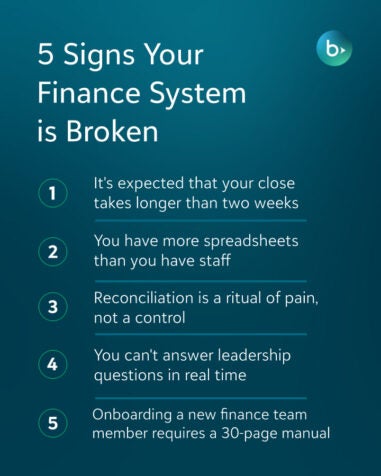
1. Your close takes longer than two weeks, and everyone’s accepted that. Two weeks isn’t a law. But if it’s consistently longer, something in the workflow is broken. The question is whether you’re actively trying to fix it or just planning around it. Take a step back and examine where the bottleneck actually is. Are you waiting on something external, or is it the two days it takes to format and double-check a spreadsheet that’s eating the time?
2. You have more spreadsheets than you have staff. Spreadsheets aren’t inherently bad. But if your team is using them to compensate for processes your system should be doing, such as reporting, allocations, tracking, reconciliation, that’s a signal worth paying attention to. The minute you export something to Excel, you’ve opened the door to human error. And as good as all of us are, with the crunch of a close bearing down, mistakes happen.
3. Reconciliation is a ritual of pain, not a control. A reconciliation should confirm that everything is working. If it feels like detective work every single month, the source of truth isn’t reliable enough to build on. What corrections are you making every single month? Try to trace why things aren’t being booked correctly in the first place. That’s often the fastest path to actually fixing something.
4. Your ED or board asks a question and you can’t answer it in real time. Leadership needs visibility. If you’re regularly building reports from scratch to answer basic operational questions, the system isn’t serving the organization—you’re serving the system. If your month-end reports are landing 30 days after month-end, the data is already stale. That’s not reporting. That’s history.
5. Onboarding a new staff accountant requires a 30-page manual you wrote yourself. If the knowledge lives in a document—or worse, in someone’s head—rather than in the workflow itself, the workflow isn’t built right. If system training can’t provide the framework for a new hire, something is seriously broken and needs to be rebuilt from the ground up, not patched again.
The Ask
I’m not telling you to go buy new software, though that’s sometimes the right answer. But new software on top of broken processes doesn’t fix anything. It just gives the dysfunction a shinier interface.
Stop for ten minutes and actually look at how your team operates. Most nonprofit CFOs haven’t genuinely audited their own processes since they inherited them. You’ve been too busy executing to step back and evaluate.
So, here’s the exercise: pick one sign from the list above. Just one. Ask yourself how long it’s been broken. Then ask yourself why you stopped trying to fix it.
If you can answer both questions quickly and honestly, you probably already know what needs to change. If the answers are “I’m not sure” and “I don’t know,” that’s worth sitting with.
Want to learn more about how to identify and tackle unnecessary workarounds in your accounting processes? Check out the webinar, A CFO’s Guide to Identifying Broken Systems (and Fixable Ones).