A Framework for Evaluating Nonprofit Revenue Streams and Expenses

Nonprofits are navigating constant change, with shifting funder priorities, rising costs, and increasing demand. In her recent webinar on future-proofing finances, Stephanie Skryzowski, Founder and CFO at 100 Degrees Consulting, discussed how organizations can stay adaptive only when they understand how money is coming in, where it’s going, and whether both sides are truly serving the mission.
That clarity comes from evaluating revenue streams and expenses with intention—not once a year, but as part of a regular rhythm. And to make those decisions easier, Stephanie shared two simple but powerful tools: the Revenue Matrix and the Expense Matrix.
This blog post walks through why this evaluation matters, how the matrices work, and the questions every finance leader should ask when assessing sustainability.
Why Evaluating Revenue and Expenses Matters
When Stephanie works with nonprofit teams, one of the most common concerns she hears is, “We’re afraid we don’t know what we don’t know, and that we are missing something.”
It’s understandable. Without the right visibility, it’s hard to know:
- Which revenue streams are stable
- Which ones drain staff capacity
- Whether your organization is overly reliant on one source
- Which costs are truly investments versus financial leaks
- Where you can confidently grow and what needs to be cut
Regular evaluation strengthens your financial strategy. It also helps leaders tell a clearer story to their staff, their board, and their funders. When you can translate your numbers into insights, you make decisions with confidence instead of gut instinct.
Evaluating Nonprofit Revenue Streams
Revenue evaluation is both quantitative and qualitative. Stephanie encourages organizations to review financial metrics and ask strategic questions that reflect the lived reality of fundraising and program delivery.
- How predictable is it year over year?
- What’s the ROI once you factor in staff time and direct costs?
- Does it have capacity to grow with the organization?
- Is this revenue source creating mission drift?
- Does it diversify or concentrate our revenue mix?
For example, maybe an annual gala raises a large amount on paper, but the staff hours, vendor costs, and stress load make the true net revenue surprisingly low. On the other hand, a government contract may be reliable but may become too restrictive for emerging program needs.
This is where Stephanie’s Revenue Matrix comes in. Plotting Your Revenue Streams: The Revenue Matrix
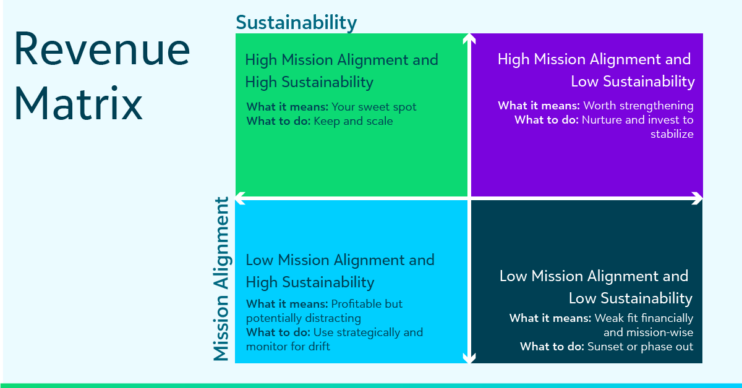
High Mission Alignment / High Sustainability: These are the revenue streams that feel like they were built for your organization. They’re deeply connected to your purpose, and they show up reliably year after year. This could look like grants from long‑term partners, a donor program with strong retention, or an earned revenue offering that naturally flows from your work. When a stream lands here, it’s financially healthy and it reinforces your impact. These are the areas where scaling doesn’t stretch your team thin or push you off‑mission. Instead, growth here tends to energize staff, strengthen outcomes, and improve long‑term stability.
High Mission Alignment / Low Sustainability: These streams are mission-driven but unpredictable. Maybe you have a program-aligned event that resonates with your community but never quite reaches budget expectations, or a grant that perfectly matches your work but fluctuates year to year. These are worth nurturing because they support your core purpose, but they need attention. Investing in infrastructure, stewarding funders more intentionally, or tightening up the model may help shift them into the “sweet spot” quadrant over time.
Low Mission Alignment / High Sustainability: This category often creates tension. These streams reliably bring in money—sometimes a significant amount—but they sit on the periphery of what your organization is truly about. Maybe it’s a legacy fundraiser that no longer connects to your story or a partnership that brings in funds each year but doesn’t quite advance your strategic priorities. These can be valuable tools, but they require vigilance. Teams should regularly ask whether the revenue is worth the tradeoffs, and if there’s a way to realign the stream, so it supports—not distracts from—your mission.
Low Mission Alignment / Low Sustainability: These are the streams that strain your team and deliver little in return. Perhaps they were launched with optimism but never gained traction, or they drifted from your mission as organizational priorities evolved. They absorb staff time, create stress, and rarely build momentum. When a revenue source falls here, it’s usually a signal to sunset or redesign it. Letting go of underperforming work frees capacity for the programs and fundraising efforts that truly strengthen your financial foundation.
Evaluating Nonprofit Expenses
Just like revenue, expenses need to be examined through both a financial and mission‑focused lens. Stephanie encourages teams to ask:
- Does this expense directly advance the mission?
- Is it draining resources without meaningful return?
- Is this cost actually an investment in long‑term strength, like staff capacity, software, or fundraising infrastructure?
- Is it essential, optional, or outdated?
This assessment becomes clearer with her second tool: the Expense Matrix.
Plotting Your Spending: The Expense Matrix
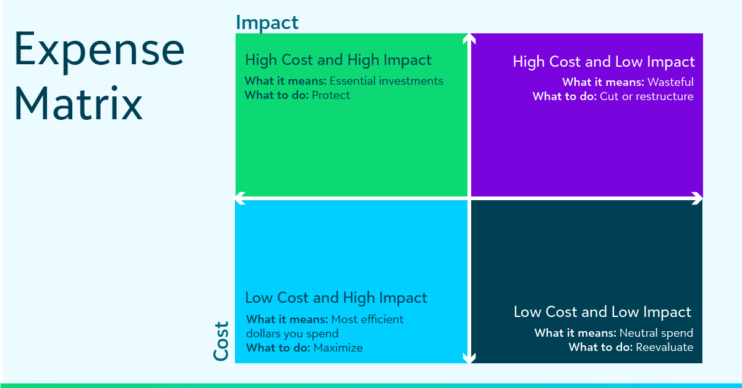
Low Cost / High Impact: These are the expenses that punch well above their weight. They’re inexpensive compared to the value they generate, and they tend to support mission delivery in ways that are clearly visible. Think targeted supplies that make programs run smoothly, volunteer-support materials, or low-cost digital tools that significantly improve internal workflows. Dollars spent here feel satisfying because the payoff is immediate and meaningful. When you find items in this quadrant, protect them and look for opportunities to replicate their efficiency elsewhere.
High Cost / High Impact: These expenses are investments—big ones. They might include specialized staff positions, critical program materials, or enterprise-level systems that enable your organization to operate at scale. They often require thoughtful budgeting and board communication, but they’re essential because the mission simply cannot be delivered without them. Organizations sometimes hesitate to spend here because the price tag is significant, but these are usually the costs that fuel long-term stability and high-quality outcomes. Prioritize them and revisit regularly to ensure they’re still delivering the impact you expect.
Low Cost / Low Impact: These are the “meh” expenses. They don’t cost much, but they also don’t move the needle. Sometimes they’re legacy purchases, like subscriptions someone signed up for years ago, supplies that get ordered out of habit, or small activities that once served a purpose but no longer do. Because the financial footprint is small, they often escape scrutiny. But taken together, these little costs can build up and quietly erode your budget. Reevaluate them regularly and confirm whether they still deserve their spot.
High Cost / Low Impact: Expenses in this quadrant are the red flags. They consume significant resources—budget, staff time, or both—without generating meaningful impact. This might be outdated software that no longer supports operations, recurring vendor contracts that aren’t delivering value, or events that require tremendous effort but produce limited results. These expenses tend to persist because they feel too big or too embedded to question, but this is exactly why they need attention. When something lands here, it’s a prime candidate for reduction, renegotiation, restructuring, or elimination altogether.
Make Data Your Decision-Making Superpower
A strong financial foundation doesn’t come from perfect forecasts or flawless budgeting. It comes from consistent habits: reviewing clean data, asking hard questions about the return on effort, and being willing to reallocate time and resources toward what delivers the most value. These matrices offer a simple starting point, but the real power comes from applying them regularly.
Choose one revenue stream and one expense and plot them on their respective matrices. Even that small step can reveal insights that shape your next budgeting discussion or strategic decision. Over time, those insights compound and help build the resilience every mission-driven organization deserves.
Ready to go deeper? Watch the full webinar, Future-Proofing Your Organization’s Finances, to learn how to use these matrices in action. Also check out the guide, Aligning on a Revenue-Wise Strategy: A Conversation Guide for Nonprofit Finance Leaders.