Your Legacy Workflows Have an Invoice. You Just Haven’t Seen It Yet.

Every accounting professional has lost a day in a spreadsheet and walked away with little to show for it. It is almost a rite of passage in nonprofit accounting and legacy workflows. But when that happens, there is no account code for the hours spent re-entering data, no invoice for a month-end close that drags into the third week, and no budget variance report showing the opportunities missed because the numbers were not ready when decisions had to be made.
And those costs are very real.
In many organizations, leaders may spend hours debating a $5,000 software expense while overlooking a manual process that quietly consumes far more than that in staff capacity each year. One cost is visible, and the other is buried in daily operations.
The most expensive process in your finance department is often the one no one is measuring.
Where the Money, and Time, Really Leaks
Most finance teams recognize these challenges immediately.
Manual data entry between systems
Data moves from accounts payable to the general ledger, from the general ledger to budget reports, and then into board presentations. Too often, the same information is entered multiple times by different people.
Each handoff creates two costs: time and risk. Teams spend time on work that technology could handle, while simple errors like mis-keying an invoice amount can lead to hours of investigation later.
Reconciliation that becomes monthly reconstruction
Reconciliation should confirm that information is accurate. Instead, many teams spend significant time forcing systems to agree because data does not flow cleanly between platforms. What should be a quick validation becomes a recurring manual project.
The never-ending close process
When closing the books takes up the first half of every month, the organization is always looking backward. By the time reports are shared, key decisions may already have been made without current information, creating risk in a rapidly changing environment.
Spreadsheet version chaos
Nearly every finance professional has opened a file named something like Budget_FY27_FINAL_v3_REVISED_USE_THIS.xlsx. When no one is sure which version is correct, the team wastes time and everyone’s confidence in the numbers begins to erode. Version confusion can also cause finance teams to control information too tightly, limiting transparency and collaboration.
Audit preparation mode
In a well-designed process, audit preparation is mostly about retrieval. In a poorly designed process, it becomes a scavenger hunt. Teams spend weeks tracking down support, rebuilding documentation, and answering questions they should not have to answer twice. An audit should reinforce the work done throughout the year, not require teams to recreate it from scratch.
The Costs That Matter Even More
Most leaders focus on labor hours because they are the easiest costs to calculate. But labor hours rarely tell the full story. The time buried in legacy workflows can become one of the biggest obstacles to helping a nonprofit meet its mission.
Slower decision making
When leadership is working from information that is weeks old, they make decisions with limited visibility. The cost is not just delayed reporting. It is missed opportunities, delayed course corrections, and reduced confidence in organizational planning. Timely, reliable data gives organizations the footing they need to make decisions with clarity.
Key person risk
Many finance workflows depend heavily on institutional knowledge. There is often one person who knows which report to pull, which spreadsheet drives the final numbers, or what adjustment needs to happen before a report goes out. That may feel efficient until that person takes extended leave or moves on. Rebuilding workflows before the team is forced to can protect the organization from avoidable disruption.
Burnout and turnover
Most finance professionals did not build their careers to become highly paid data-entry specialists. The most capable team members are often the first to become frustrated by repetitive manual work because they know their skills could be creating far more value elsewhere.
When talented employees leave, organizations pay twice, once in turnover costs and again in lost expertise. The goal should be to put people to their highest and best use. The real question is whether your workflows were designed to let them do that.
Opportunity cost
This may be the largest cost of all. When analysts spend time gathering data instead of analyzing it, organizations lose access to the very insight they hired those people to provide.
The question is not simply, “How much does this process cost?” It is also, “What are we not getting because our people are stuck maintaining it?”
Why Change Is So Hard
Most teams know where the inefficiencies are. The real issue is that organizations underestimate the cost while employees understandably worry about what change means for them.
From an organizational perspective, the costs feel hidden because they are already embedded in payroll. From an employee perspective, the existing process often represents years of accumulated knowledge and expertise. People know the shortcuts, the workarounds, and the unwritten rules that keep things moving.
So when leaders talk about automation or modernization, employees do not always hear, “We are eliminating repetitive work.” Sometimes they hear, “The expertise I have spent years building may no longer matter.”
That is a very human concern, and it is one leaders need to acknowledge directly.
Successful change management starts by making two things clear:
- The goal is not to eliminate people.
- The goal is to eliminate unnecessary work.
Successful transformations do not replace talented employees. They free those employees to contribute at a higher level.
Putting a Number on the Problem
The easiest place to start is with a simple calculation: Hours spent on a recurring process × fully loaded hourly cost × 12 months
Example: 60 hours per month × $55 per hour × 12 months = $39,600 annually.
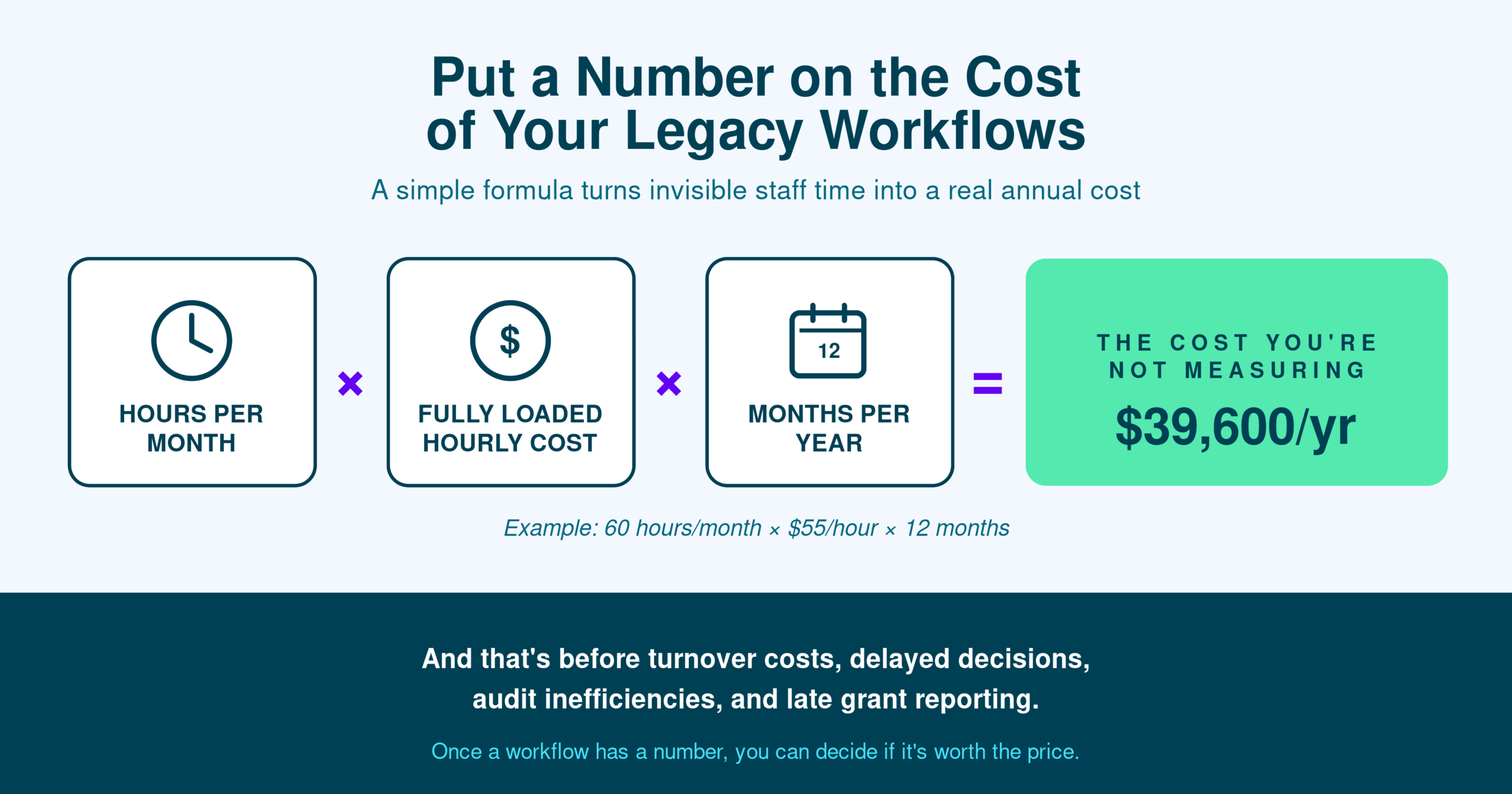
And that is before accounting for:
- Turnover costs
- Delayed decisions
- Audit inefficiencies
- Late grant reporting
- Leadership time spent tracking down information
You don’t need a precise estimate, but you do need to make the invisible visible. Once a workflow has a number attached to it, it becomes much easier to have an informed conversation about improvement.
A Better Path Forward
Transformation does not require replacing everything at once. Most organizations can make meaningful progress by focusing on four practical moves:
- Centralize information. Create a single source of truth.
- Automate repetitive work. Eliminate manual re-entry wherever possible.
- Improve visibility. Give leaders timely access to reliable financial information.
- Elevate the team. Shift staff from processing transactions to analyzing results.
The organizations that do this well are not necessarily spending more on technology. They are simply spending less energy compensating for outdated processes.
Create an Invoice for Legacy Workflows
Legacy workflows are not a one-time expense. They are a recurring charge that shows up every month in staff time, delayed decisions, employee frustration, and missed opportunities.
The challenge is that the invoice never arrives.
That is exactly why it is worth taking the time to calculate what those processes are really costing your organization. Because once you can see the cost, you can finally decide whether it is worth continuing to pay it.
Want to dig deeper into putting a price on your legacy workflows? Check out the webinar, The Hidden Cost of Legacy Workflows.