Why AI Maturity Matters More Than AI Adoption in Financial Reporting

Artificial intelligence has quickly moved from a future-focused conversation to a practical reality for many nonprofit organizations. According to new research from the Blackbaud Institute, 85% of social impact professionals are already using AI at work. Yet only about 10% of organizations have reached what the report defines as an AI-Adaptive stage, where AI is delivering meaningful organizational impact.
That gap raises an important question for nonprofit finance leaders. If so many organizations are using AI, why are so few seeing transformative results? The answer may have less to do with the AI tools themselves and more to do with the foundation supporting them.
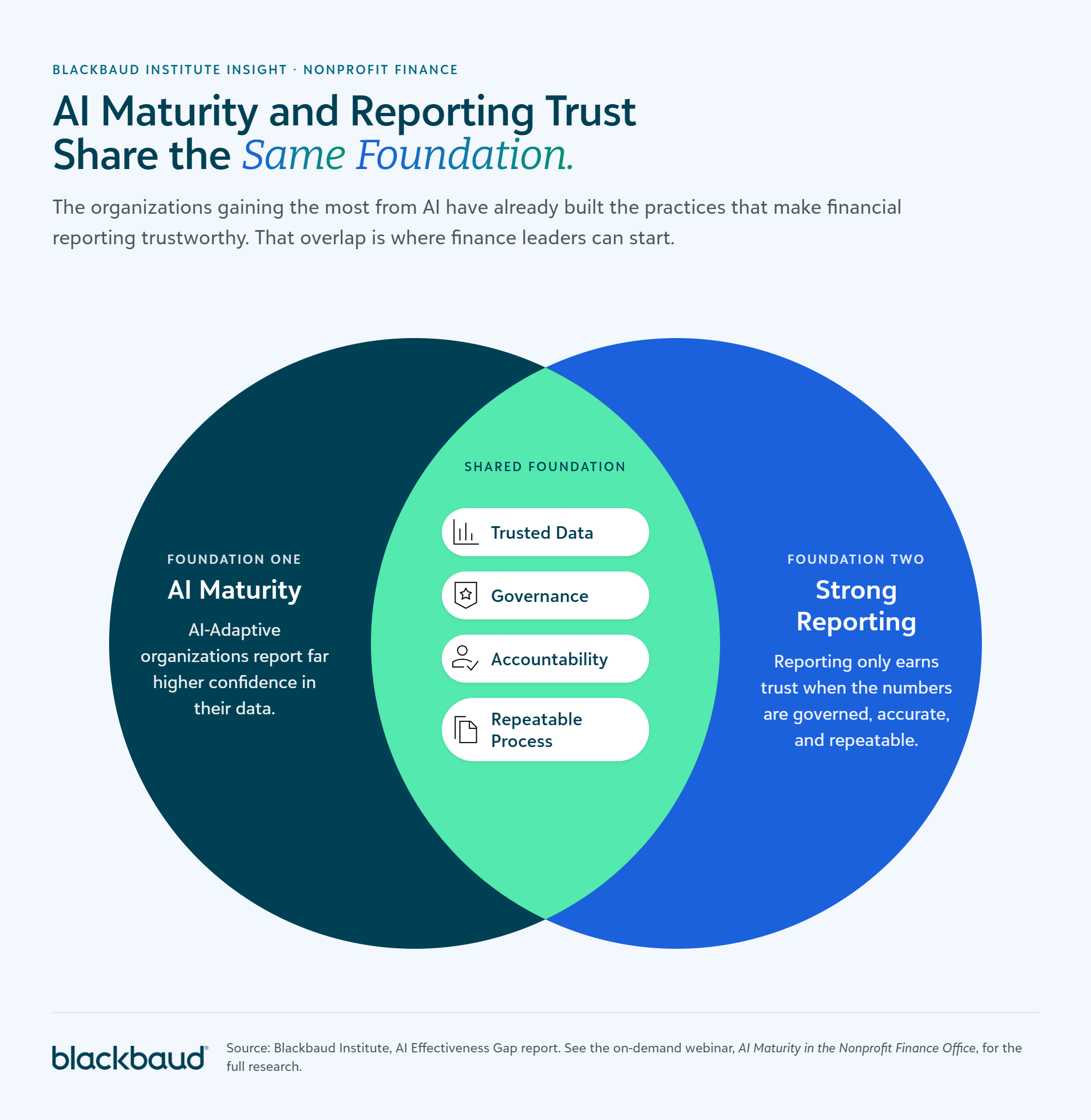
According to the research, organizations seeing the greatest gains with AI-powered tools have built the same foundations that support trustworthy financial reporting, including reliable data, governance, accountability, transparency, and repeatable processes. When those foundations are in place, AI helps finance teams spend less time assembling reports and more time helping leadership make decisions. When they aren’t, AI can amplify the same reporting challenges that already slow teams down.
For nonprofit finance offices, improving AI maturity often starts in a familiar place—building trust in the numbers. From data quality and reporting processes to governance and human oversight, the practices that strengthen financial reporting are the same ones that help organizations turn AI adoption into meaningful results.
The AI Effectiveness Gap in Nonprofit Finance Is Really a Reporting Trust Gap
The Blackbaud Institute report describes two distinct groups: AI-Adaptive organizations, which have integrated AI into their workflows and decision-making processes, and AI-Emerging organizations, which are still experimenting with AI in more fragmented ways. Many organizations use AI for drafting content, summarizing information, or completing administrative tasks, but far fewer have embedded it into the governed processes that support critical business functions.
For finance teams, the difference comes down to trust. Finance leaders know that having data is not the same as having confidence in it. A financial report only becomes useful when decisionmakers trust the numbers, understand where they came from, and feel confident acting on them. The same principle applies to AI-generated insights.
The research found that fewer than one in five respondents rated their organization’s data health as excellent, while data confidence was significantly higher among AI-Adaptive organizations. That makes sense because AI can only work with the data and processes already in place.
During our webinar, AI Maturity in the Nonprofit Finance Office, Eric Johnson from Your Part-Time Controller, LLC, noted that new technology doesn’t automatically fix broken processes. In many cases, it exposes them. If reporting still depends on spreadsheet exports, manual reconciliations, or last-minute data cleanup before leaders can trust the results, AI won’t solve those challenges. It will simply help organizations surface them faster.
That’s why the AI effectiveness gap is, in many ways, a reporting trust gap. Organizations seeing the greatest gains from AI have already built the foundations that make financial reporting reliable—trustworthy data, clear processes, governance, and accountability.
Governance and Accountability Matter More Than the AI Tool
When it comes to AI maturity, it’s easy to focus on the technology. But having more advanced tools doesn’t always equate to better outcomes. If you don’t have strong guardrails in place, it won’t matter how shiny the new AI functionality is.
For nonprofit finance leaders, that concept should feel familiar. Every day, finance teams work within controls designed to protect the integrity of financial information. Documentation requirements, review processes, approval workflows, and accountability structures all exist to ensure people can trust the outcome.
The same discipline is essential for AI-powered tools. During the webinar, Eric shared an example of an AI-generated memo that correctly identified $4,000 in cash and $2,000 in investments, but somehow concluded the total was $10,000. The memo looked polished, but the math was wrong. The important lesson wasn’t that AI made a mistake. It was that accountability for the final output still belonged to the person reviewing it.
Organizations move toward AI maturity when they establish approved use cases, define ownership, document review standards, and create clear expectations around how AI-generated outputs will be evaluated and used. In many ways, these practices mirror the controls finance leaders have relied on for years.
What Changes When Finance Teams Become More AI Mature?
Ask most finance professionals where their time goes, and many will point to work that happens before analysis ever begins. Data has to be gathered from multiple sources, reconciled, checked for accuracy, and prepared for reporting. By the time the numbers are ready for review, a significant amount of effort has already been spent getting everyone to the same starting point.
When your finance team has strong data practices, you create a different experience. Because information is collected and managed more consistently, finance teams spend less time tracking down discrepancies and verifying numbers. Board reports, nonprofit financial statements, and other recurring deliverables become easier to produce because the underlying data is already trusted.
That trust changes the conversation. Instead of explaining why numbers don’t match or investigating whether a report is accurate, finance leaders can focus on what the information reveals. Trends become easier to spot, and potential risks surface earlier. Questions from leadership can be answered with greater confidence because the team has confidence in the data.
As reporting becomes more consistent and repeatable, finance spends less time serving as a data gatekeeper and more time helping stakeholders understand what the numbers mean. That’s where many organizations begin to see the real value of AI maturity—not in producing more reports, but in creating more capacity for analysis, planning, and informed decision-making.
Start with Reporting, Not AI, to Improve AI Maturity for Your Finance Team
Improving AI maturity begins with understanding the reporting processes already in place. Here are three practical starting points.
1. Identify high-friction reporting processes
A good starting point is to identify the reporting activities that create the most friction. Month-end close, board reporting, grant reporting, and budget preparation are common areas where manual effort accumulates over time. Look for places where data is exported into spreadsheets, reports require extensive cleanup before they can be shared, or lack of confidence in the numbers slows decision-making. Those pain points often reveal opportunities to strengthen the foundation that AI will rely on.
2. Improve data consistency
Finance leaders already understand the value of a well-maintained chart of accounts, clear coding structures, and documented governance standards. When data is entered and managed consistently, reporting becomes more reliable, and teams spend less time reconciling differences or validating results. Strong data practices improve the quality of insights generated from that data.
3. Define human ownership
Finally, establish clear ownership and expectations for AI-assisted work. Determine where AI can support productivity, what information requires validation, and who is accountable for final outputs. Roles and review processes that are clear in financial reporting should be just as clear when AI is involved.
As these foundations become stronger, AI capabilities embedded within purpose-built financial systems can help automate routine tasks, surface insights, and support more efficient reporting workflows. The value comes from pairing AI with trusted data, reliable processes, and sound governance, not simply adding another technology to the stack.
AI Maturity Is a Finance Leadership Opportunity
The conversation around AI often focuses on tools. For finance leaders, the bigger opportunity lies in building the foundation that allows those tools to deliver meaningful value.
According to the Blackbaud Institute, organizations that are seeing the greatest gains from AI aren’t necessarily adopting the most technology. They’re strengthening the disciplines that support reliable financial reporting, like trusted data, consistent processes, clear governance, and accountability. Those same practices create the conditions for more effective AI adoption.
That’s encouraging for nonprofit finance teams because much of this work is already familiar. As data quality improves and reporting becomes more consistent, teams can spend less time reconciling information and more time helping leaders understand what the numbers mean for their mission, strategy, and future planning.
By creating the confidence, processes, and oversight needed to use AI effectively, your finance team will be better positioned to turn AI from an interesting technology into a practical tool for stronger decision-making.
For a deeper dive into the Blackbaud Institute research and what it means for finance teams, check out the on-demand webinar, AI Maturity in the Nonprofit Finance Office.