Cleared for Takeoff: When Customers Get a Seat in the Cockpit
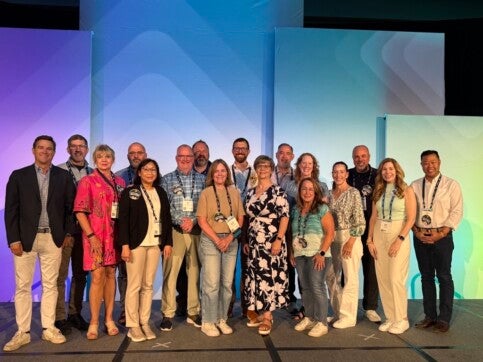
There’s a specific kind of energy that happens when a room full of people who haven’t physically gathered in years all show up at once, genuinely joyful about it. That was Blackbaud’s K–12 User Conference (UC) in Boston this July—the first in-person UC in seven years. Old friends caught up in hallways. New faces navigated various rooms for the first time. Folks I’d only met over a webcam were now gathered in Beantown from across the country.
UC has always been the Goldilocks of conferences: big enough to matter, small enough to actually know the person seated next to you. This year felt less like a conference and more like a reunion.
It was different for me in another way, too. For the first time I wasn’t just a UC attendee. I arrived as a leader—and that meant I had two missions on my plate before the conference even opened to the public.
The Ready Room
The day before the general sessions kicked off, sixteen of us from schools all over the country gathered for something most attendees never experience: a meeting of Blackbaud’s K–12 Executive Advisory Board, a standing group of customers whose job is to question, push back on, and occasionally argue with the company’s product roadmap in exchange for a real hand in shaping it.
As the board’s executive director, I was tasked with running a Q&A between the board and Blackbaud’s executive team and then delivering a closing message as an inspiring send-off into the conference itself. No pressure—just sixteen opinionated advisors and a room full of executives watching to see if I’d stick the landing.
But before I could take the flight deck, Mark Davis, GM of Education Products at Blackbaud, shared a preview of the biggest innovation announcements across the K–12 portfolio. Then seven subcommittees—each a group of peers paired with a Blackbaud product manager covering one aspect of Blackbaud’s Total School Solution, from SIS and LMS to enrollment to fundraising to finance—reported back on months of effort.
Honestly, this is where the real advisory work gets done. For me, it’s like different chapters in a book—each group telling its own story but only combined do they become a cohesive plot. It’s truly a two-way relationship between company and customer, one where both sides benefit and build together.
Executive Team Jeopardy
Then came the part that had me equal parts excited and nervous: a live Q&A between the board and serious Blackbaud brass, including Carrie Cobb, Page Bullington, Todd Lant, Miguel Alfaro, Paul Goldstein and the aforementioned Mark Davis. This kind of direct, structured access to a software company’s leadership is rare. Most customers get a survey. We got the room.
I had polled the board ahead of time for questions and sorted them into categories. Yours truly got elected—or maybe voluntold—to run the session. And because I wasn’t going to let a room full of nervous executives and equally nervous advisors sit in awkward silence, I did what I do best: I morphed it into a game show. The Q&A was about to go down, Jeopardy-style!
I unveiled a blue Jeopardy board with five categories—“Help Me Help You” (support), “All Things Blackbaud” (corporate), “The Crystal Ball” (what’s next), “What’s in Your Wallet” (cost and value), and “Me, Me, Me, Me, Me!” (all things K–12).
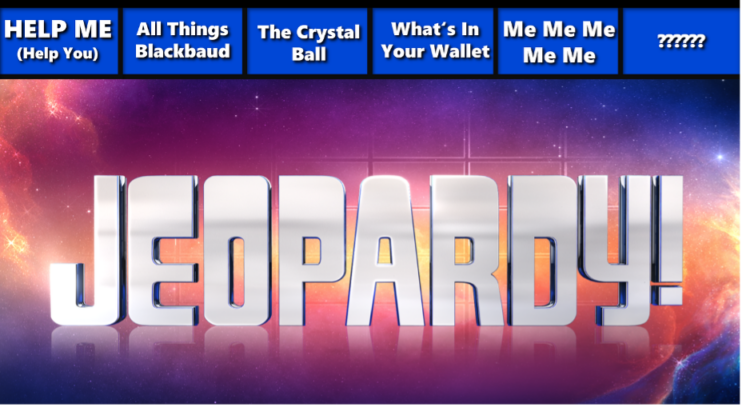
Countdown timers included, I channeled my best Alex Trebek and, for once, answers didn’t have to come in the form of a question. The relief on people’s faces when they realized they were allowed to laugh a little was worth the effort on its own.
What followed were candid answers to genuinely hard questions—the kind you don’t get from a press release. I’m sure all this falls under a safe-harbor agreement of some sort and I can’t share trade secrets on this blog post‚ but I will tell you how it ended.
The final question, from the “Crystal Ball” category, came from fellow board member John Yen of Polytechnic School in Pasadena, aimed at Page Bullington, VP and Global Managing Director of Customer Success: “Where does Blackbaud and the nonprofit world see itself in ten years?”
As Page looked up to answer, the door at the back of the room creaked open. Standing there was Mike Gianoni, Blackbaud’s CEO.
“The technology will undoubtedly look different in 10 years, but what won’t change is our focus on our customers and the missions they serve,” Page said. “We see a future where nonprofits and schools can spend less time navigating complexity and more time advancing their missions. Our role is to be the trusted partner on that journey.”
The timing was perfect. Mike had walked in just in time to catch his own team field such a powerful question, live.
You could hear a pin drop.
Cleared for Takeoff
For the day’s close, I’d built a short talk called “Cleared for Takeoff,” leaning hard into the Top Gun: Mavericktheme the board had adopted at our December retreat. (Stick with me and my beloved metaphors.)
The UC had been grounded for seven years. Now it was finally back on the runway.
I shared a short history of the UC as I remembered it—tracing its roots back to a Boston Seaport ballroom in 2006, a year before the iPhone was even revealed. I’d been a last-minute fill-in that year because a coworker couldn’t make it, and that happy accident is where my “UC Story” begins.
Then I asked the room a simple question: how many of you have been to a UC before? Half the hands shot up. Reflexively, I asked the inverse — for how many is this your first? The other half responded. A perfect fifty-fifty split, customers and Blackbaud staff alike—one half with a “UC Story” already written, the other about to start theirs, right there in Boston. Cleared for takeoff. This time, as navigators.
That’s where the badges came into play—garish, four inches across, styled like a fighter pilot’s helmet visor, stamped with “UC 26,” the American flag, and “K–12 Advisory Board.” I’d made them in secret.
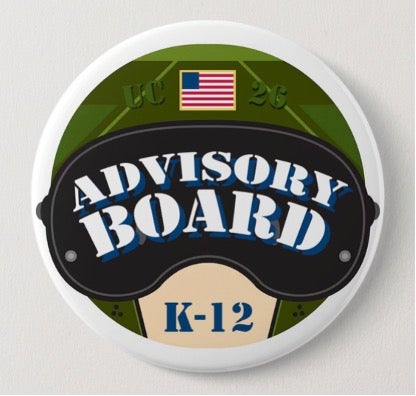
I framed the souvenir as three things: a badge of honor to proudly wear when mingling with other attendees; a badge of courage to use as a conversation starter; and a badge of belonging—a way to tell people that customers have a real say here and always have. “Whether it is your first ‘UC Story’ or your twelfth,” I told them. “Wear it all week. Let it be the insignia that this conference is back, we are together again and cleared hot for takeoff.”
Why This Matters Beyond One Conference
It’s easy to read all this as one company’s version of a good time—a game show, a themed pep talk, some novelty buttons. But strip away my theatrics, and what’s left is a structural choice: a standing customer advisory board with real working groups, a direct line to the executive team, and a closing ritual that tells new members they’re not just attending, they’re navigating.
That’s not customer engagement as a marketing line. It’s customer engagement as an operating model—one that demonstrates how advisory boards can help shape better software.

Every company says it listens to its customers. Fewer put them in a room with the CEO.
Every company says it listens to its customers. Fewer put them in a room with the CEO. Fewer still bring customers together in person twice a year to challenge the product roadmap and then turn that feedback into action. If there’s a lesson here for anyone building a community around a product—software or otherwise—it’s that a seat in the cockpit is only worth what you’re willing to let people say and do once they’re sitting in it.
I think back to that 2006 version of me—a shy newbie, traveling alone for work for the first time, in a city I barely knew. I walked through those hallways and attended sessions, not knowing where it could lead me. It turns out my “UC Story” was born that day. This July, I got to hand that same feeling to a room full of people who’ll write their own.
Let’s fly.