Changemaker Spotlight Q&A: Donna Albaum, Donna Klein Jewish Academy
This Q&A series aims to provide readers with valuable insights from changemakers across the social impact community.
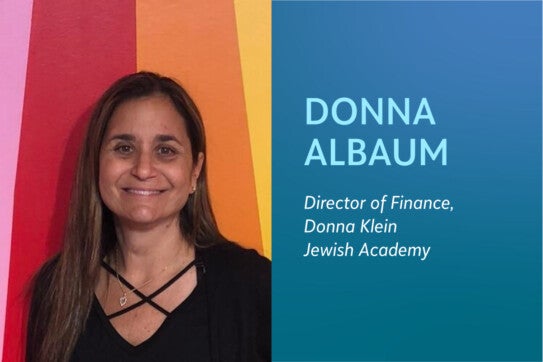
Donna is the Director of Finance at Donna Klein Jewish Academy (DKJA), bringing decades of experience in nonprofit accounting. Since 1994, she has built deep expertise in the unique financial needs and opportunities within mission-driven organizations. Today, she leverages her perspective to optimize financial operations and drive strategic impact at DKJA.
1. What first drew you to an accounting and finance career in K-12 education?
I initially attended college with the goal of becoming a teacher, but later changed my major to accounting and business. School finance ultimately became the perfect combination of my interests. I loved being part of an educational environment, surrounded by students and educators, while applying my financial and analytical skills. I’ve always been drawn to nonprofit organizations because I value work that makes a meaningful difference in people’s lives. Working in K–12 education allows me to support a mission I deeply believe in while doing work I genuinely enjoy.
2. You’ve worked for Donna Klein Jewish Academy for a number of years, but actually had a stint at Blackbaud as a solutions consultant about four years ago before boomeranging back to DKJA. How did that experience as an advisor to other customers shape the way you approach your work?
My time as a solutions consultant at Blackbaud had a tremendous impact on how I think about both technology and leadership. It gave me confidence in discussing technology strategy and showed me just how powerful the platform can be when organizations fully leverage its capabilities.
One of the biggest lessons I learned was that many organizations only use a small portion of the tools available to them. Working with a wide variety of nonprofit organizations exposed me to innovative approaches, creative problem-solving, and different ways technology can support organizational goals.
When I returned to DKJA, I brought those insights with me. I was able to identify opportunities to improve processes, increase efficiency, and streamline workflows across departments. I also focused on sharing that knowledge with colleagues by training team members on best practices and helping them become more confident users of our systems. Ultimately, the experience helped me think more strategically about how technology can support not just finance, but the broader mission of the school.
3. DKJA is in a remarkable moment—surging enrollment, a capital campaign exceeding expectations, an endowment launch, campus expansion. What does it actually take to be a true strategic partner to school leadership during a chapter like this, rather than just a steward of the numbers? And how does technology support your ability to be strategic?
Being a true strategic partner means looking beyond the numbers and helping leadership understand how all the moving pieces of the organization connect. At DKJA, we’ve experienced significant enrollment growth, launched a transformative capital campaign, established an endowment, and are expanding our campus to meet the needs of our growing community. Each of those initiatives is exciting on its own, but they are also deeply interconnected and require careful planning to ensure long-term success.
My role is to help leadership evaluate opportunities through both a financial and strategic lens. It’s not simply about asking whether we can afford something today—it’s about understanding how decisions made now will impact enrollment, staffing, facilities, fundraising, and the student experience years into the future. As the school has grown, the conversations have become increasingly forward-looking, focusing on sustainability, scalability, and positioning DKJA for continued success.
Technology is a critical part of that process. Blackbaud provides us with real-time access to information across finance, enrollment, tuition management, and fundraising, giving us a more complete picture of the health of the organization. Instead of spending time gathering data from multiple sources, we can focus on analyzing trends, identifying opportunities, and providing leadership with meaningful insights.
Ultimately, technology helps transform data into actionable information. It allows us to move beyond reporting what happened and spend more time helping shape what comes next. That’s where finance can have the greatest impact—not just recording the story, but helping write the next chapter.
4. Looking back over your finance career, what’s one move you made that really accelerated your growth?
Without question, my move to Blackbaud as a solutions consultant was the experience that accelerated my growth the most. It expanded my perspective beyond traditional finance and exposed me to the technology side of organizational management.
I gained valuable experience working with a wide range of nonprofit organizations, each with unique challenges and goals. That broadened my understanding of how systems, processes, and data can drive better decision-making. The role also strengthened my communication, leadership, and problem-solving skills.
When I returned to DKJA, I brought back a more strategic mindset and a deeper appreciation for the role technology plays in achieving organizational success. Today, I am able to blend financial expertise with a technology-focused approach to support the school’s growth and long-term vision.
5. DKJA’s institutional theme is “Rooted in Tradition, Driven by Innovation.” That balance between honoring deep values and embracing change resonates well beyond the classroom. How does that show up in your work, and how do you bring your colleagues along when change is necessary but not comfortable?
That theme resonates strongly with me because it reflects how I approach my work every day. In finance and operations, it’s important to respect the systems, processes, and practices that have helped the organization succeed, while also remaining open to improvements that can make us more efficient and effective.
I am always looking for ways to leverage data and technology to improve workflows, but I believe change is most successful when people understand the purpose behind it. When new processes or technologies are introduced, I focus on explaining the “why,” listening to concerns, and demonstrating how the change supports both individual teams and the broader mission of the school.
Building trust, communicating openly, and implementing change thoughtfully helps people feel more comfortable and invested in the process.
6. When you think about what DKJA has built—the enrollment growth, the financial sustainability, the community trust—what’s the outcome or moment you’re most proud of that people outside the institution might never see or know about?
I am most proud of helping build the financial foundation that allows the school to focus on its mission and students. The community sees the visible outcomes—enrollment growth, campus improvements, new programs, and successful fundraising efforts—but much of the work that makes those accomplishments possible happens behind the scenes.
Over the years, we have worked hard to establish strong financial practices, maintain discipline in our planning, and make decisions that support long-term sustainability. Knowing that those efforts help create stability for our students, faculty, and future generations of families is incredibly rewarding.
7. How do you like to partner with non-finance colleagues (teachers, administrators, department leads) so budgeting and purchasing feel collaborative—not restrictive?
I view budgeting as a partnership, not a control function. The best financial decisions happen when there is open communication and collaboration from the beginning of the process.
I encourage departments to share their goals, needs, and priorities early so we can work together to identify solutions that support their objectives while also aligning with the school’s overall financial strategy. My goal is never to simply say “no,” but rather to help find the best path forward.
When people understand the broader context and feel included in the process, budgeting becomes a collaborative tool for achieving shared goals rather than a restriction.
8. What are a few habits that help you keep things clean and audit-ready without making the team feel like they’re living in “audit season” year-round?
The key is making good documentation and accountability part of everyday operations rather than something that only happens when an audit is approaching.
For example, we use Expense Management in Blackbaud Financial Edge NXT®, which requires supporting documentation to be attached to purchases and includes approval workflows that ensure appropriate oversight. These processes are built directly into our daily routines.
We also leverage Blackbaud’s reporting capabilities and audit trails to maintain transparency and provide clear records of financial activity. By incorporating these practices into our normal workflows, we remain audit-ready throughout the year without creating unnecessary stress or extra work when audit season arrives.
9. The role of a finance leader at a mission-driven school has expanded well beyond the ledger. You’re now managing data flows across enrollment, tuition, fundraising, and operations—essentially serving as connective tissue across the institution. How has your definition of what great finance leadership looks like evolved over your career, and what skills or mindsets do you think are most important for the next generation of school finance professionals to develop?
Finance leadership today is far more interconnected than it was when I began my career. Success is no longer measured solely by balanced budgets and accurate financial reports. Great finance leaders help connect information across enrollment, tuition, fundraising, operations, and advancement to provide insights that support better decision-making throughout the institution.
As my career has evolved, I have come to see finance as both a strategic and collaborative function. Strong relationships, clear communication, and a willingness to partner across departments are just as important as technical expertise.
For the next generation of finance professionals, adaptability, data literacy, problem-solving, and communication skills will be essential. Most importantly, they must understand the mission of the organization they serve and use financial stewardship to help advance that mission over the long term.
10. If you could switch roles with someone at your school for one day, who would it be and why?
If I could switch roles with anyone at DKJA for a day, I would choose a kindergarten teacher. Much of my work takes place behind the scenes, focused on budgets, planning, systems, and operations. Spending a day in a kindergarten classroom would provide a firsthand view of the impact our work has on students every day.
It would also serve as a powerful reminder of why we do what we do. Every financial decision ultimately supports our mission of helping children learn, grow, and thrive.
11. Fun one to end: when you’re off the clock—boating, beach time, family time—what’s your perfect day look like?
My perfect day starts with a walk on the beach with my husband, followed by a boat ride with my family. Living near the water, we spend a lot of our free time outdoors, and I enjoy any opportunity to be outside, relax, and enjoy the sunshine. Time with family, fresh air, and being on the water is the perfect way for me to recharge.