What a Complete Nonprofit Agentic Finance System Could Look Like on an Ordinary Tuesday

I asked our team what a fully agentic finance system would actually feel like day to day, and the first answer I got back was about coffee. Not a metaphor about speed or efficiency. An actual cup of coffee, made while your system does the thing you used to have to sit down and do yourself.
With an agentic finance system, your day starts with a summary already waiting for you when you log in. It includes a recap of what happened yesterday, the actions your system took, and a full audit trail behind every one of them. You didn’t have to open five different tabs to piece it together. It was delivered. Some of what’s on that list needs your sign off. Some of it, once you’ve built enough trust in the workflow, just needs your eyes.
Your hands are free to hold your coffee because the work in front of you is reading and reviewing, not keying and chasing.
That’s the promise of a complete agentic system. Not automating individual tasks here and there, but connecting them so the whole system runs as one. I sat down with Heather Johnson, Director of Financials and Grantmaking Products at Blackbaud, to talk through what that looks like in practice, what it changes for the humans still running the show, and where an organization interested in building a complete agentic system should start.
The Day Begins with Information, Not Data Entry
A complete agentic system changes the point where a person enters the workflow. Right now, most finance professionals start their day by going into the system or spreadsheet and getting what they need. In an agentic system, the information comes to them.
Heather put it into terms that every controller will recognize. “You think about a controller who sits down and has a stack of invoices at their desk that they start keying in,” she said. “But it’s already emailed and coded. You skip all of that. You’re literally looking at the audit trail and reviewing exceptions or anomalies.”
That shift, from entering to reviewing, is the whole point. Routine transactions move through established workflows on their own. People monitor performance through checks, scoring, and audit trails instead of retyping what’s already sitting in front of them. Over time, as a workflow proves itself, smaller or lower risk actions can proceed without a person stopping to approve each one, based on thresholds your team sets and evidence that the system is meeting your expectations.
Manual entry stops being the foundation of the job and becomes the exception to it.
Finally Get to the Not Urgent but Important Items on Your List
At the end of the week, do you feel like you got everything done that you needed to?
Nobody in nonprofit finance says yes. Most people, if they’re honest, will tell you they got to a fraction of it. Maybe a productive day means you cleared some real things off the list, but the list is never empty. That’s the reality that agentic finance systems can change. And that’s why “saving time” sounds vague until you see what happens with the time you get back.
Heather has seen it firsthand with a controller she works with. He used to spend the first week of every month chasing down reconciliations, matching AP reports to the general ledger, and cleaning up coding errors before he could even start the actual close. With that work handled automatically, he’s reviewing a finished report in minutes instead of building one from scratch. That’s time he can put toward a real 12-month rolling forecast, or a conversation with program staff about how funds could be used, instead of explaining after the fact why something went over budget.
That’s the difference between getting 10% of your to-do list completed and something closer to 60%. Not because the job got smaller, but because the parts of it that don’t need a human anymore aren’t taking up your day.
Close the Effectiveness Gap by Changing How You Think About AI
The Blackbaud Institute found that only 10% of organizations surveyed are running systemic or transformational AI workflows. Those organizations are saving an average of $621 per employee per week. Organizations using AI tools without connecting them into a workflow are saving about $503, roughly $100 less per employee, every week.
The effectiveness gap has nothing to do with which tools you can access and everything to do with how they are being used. “People are still learning and figuring out how to use AI,” Heather told me. “Organizations that aren’t saving as much money are using it more like a calculator. Write this email, summarize this report, versus actually treating it like a teammate that can help complete the task the way a human normally would.”
I still use it like a calculator for plenty of things myself. Getting past that takes building trust in specific workflows, one at a time, and not deciding to trust AI in general. The breakthrough for me was letting it accept meetings on my calendar when I have open blocks. It’s a small thing, but I don’t have to go click accept anymore.
We have that same idea built into Blackbaud Financial Edge NXT®, where the system runs the math on something the moment it comes in and sets it up for you. That’s Blackbaud’s job in this transition. We’re not asking finance teams to become AI developers. We’re trying to smooth that learning curve by building the trusted workflows in for you, instead of leaving every organization to figure out how to build its own agents from scratch.
And none of that works without healthy data underneath it. AI is only as good as what you feed it, so a clean chart of accounts and current reconciliations are the foundation everything else sits on.
Trust Grows Through Evidence
Every finance leader I’ve talked to about this comes back to the same questions. Is it accurate, and can I prove it? That’s the right instinct. Trust should be earned through accuracy and backed by an audit trail.
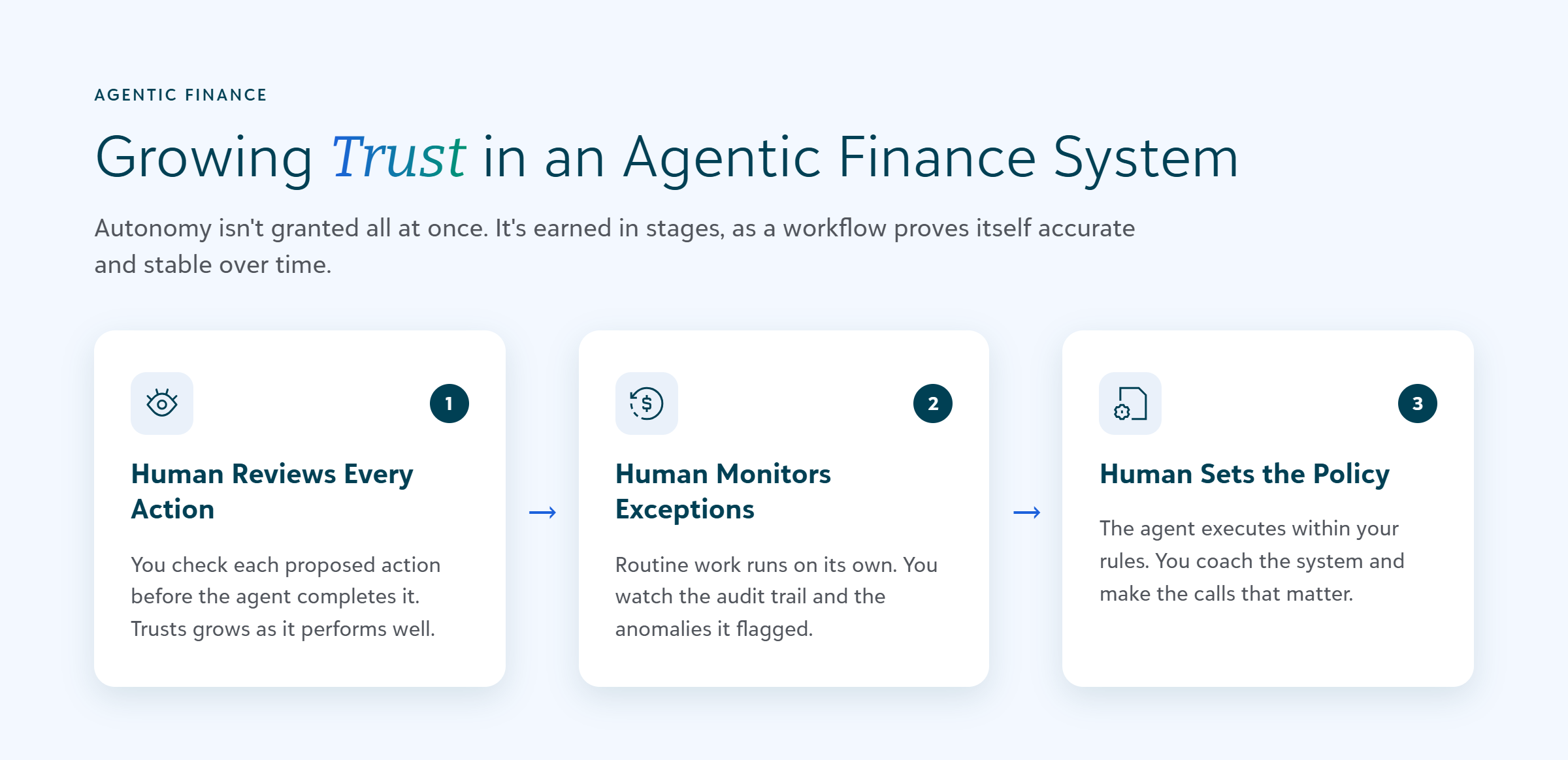
And it should be built gradually. At first, a human reviews the proposed action before the agent completes it. As the output stays consistent, the review shifts from watching each transaction to monitoring the audit trail and the exceptions that get flagged. If a workflow’s performance slips, you narrow what it’s allowed to do, coach it, rebuild it, or take the work back yourself.
That progression shouldn’t happen overnight, and honestly, I wouldn’t want it to. I’d rather our teams prove a workflow is accurate and stable over time before we open the gates further.
That trust building is oddly human. Agents forget things, the same way people do. I’ve told my own AI assistant that I don’t want em dashes in my writing more times than I can count, and it still slips them in. So, I go back and remind it, again, to write more direct sentences instead.
Separation of duties applies to agents, too. An effective system doesn’t hand one agent the entire process from coding an invoice through approving and paying it. It works more like a real accounting team, with one agent coding, another checking, another approving, each with its own audit trail. It’s also, as it turns out, more efficient. A single agent trying to handle everything at once takes longer and uses more resources than several agents each doing one job well.
Humans Keep the Judgment, Coaching, and Accountability
The agentic system does not replace the person. But it does change what the person spends their day doing.
Heather compared the relationship to helping her family’s robot vacuum relearn her house after a recent update. She had to go back into the app and redraw the boundaries. Don’t go in there, that’s off limits, here’s the map. “The human is still coaching the AI,” she said. “You’re feeding it your policies, you’re still making the judgment calls, and for the critical things, like signing off when money is moving, a human still has to click yes, this looks right, pay it.The AI is the execution. The judgment and the accountability stay with the person.”

The AI is the execution. The judgment and the accountability stay with the person.
Heather Johnson
Director of Financials and Grantmaking Products at Blackbaud
And sometimes coaching doesn’t work. I’ve hit that point myself, where I’m working with a workflow and realize it’s just not getting there, and the answer is to do it myself for now. That’s fine. You can come back and rebuild it later once you understand better what went wrong.
Build a Finance Office That Starts Before You Do
If all of this sounds worth doing, the next question is where to actually begin.
Heather’s advice starts with understanding the condition of your data. Are your fiscal years closed? Are your reconciliations current? Have you cleaned up your chart of accounts? You want to start an agentic system on a healthy foundation, not layer automation on top of problems you haven’t fixed yet. From there, pick one contained pain point where you can prove real return and build trust before expanding. Then think through your own organization’s policies, where you already separate duties among people, and design your agents to follow that same structure rather than inventing a new one.
Once you’ve laid that foundation, the next step is building confidence in the system itself. We’re approaching that challenge in Financial Edge NXT by releasing these capabilities in stages. You shouldn’t have to build a full agentic finance system yourself, piece by piece, from the ground up. Instead, you can watch the pieces connect and build trust in the system as it grows, without needing your own team of AI developers.
If you want to start experimenting on your own in the meantime, start with something low stakes like email or scheduling. Those workflows are simpler to build, and they’ll teach you what these agents can actually do before you turn that understanding toward your finance systems.
Finance teams won’t have less work to do. They’ll have more time for the work that deserves their expertise. Setting policy, coaching the system, making the call on what’s unusual, and putting the hours that used to go into chasing information toward the decisions that shape where the organization goes next.
Want to dig into getting your team ready for AI agents? Check out our guide on preparing for AI agents in mission-driven work.