Federal Grant Compliance Landscape: Current Rules to Future Shifts

Federal grant compliance is no longer a matter of learning one rulebook and applying it indefinitely. Organizations now face a layered environment.
The 2024 revisions to the Uniform Guidance are active and shaping day-to-day award administration, while the Office of Management and Budget’s (OMB) May 29, 2026, proposed rule signals another potentially significant shift. The practical challenge organizations face is how to execute today’s requirements consistently while ensuring systems are nimble enough to adapt to future changes.
That challenge also creates an opportunity. Organizations that treat regulatory change as an ongoing governance process—not a one-time policy update—can strengthen internal controls, improve audit readiness, and reduce disruption when final rules arrive. The first step is distinguishing what is enforceable now from what is still proposed.
What Is Active Now: The 2024 Uniform Guidance Revisions
OMB’s 2024 revisions to the Guidance for Federal Financial Assistance, formerly known as Uniform Guidance, became effective October 1, 2024. In general, the revised requirements apply to awards issued on or after that date, while the audit provisions apply to fiscal years beginning on or after October 1, 2024. Agency implementation and award-specific terms still matter, so recipients should identify which regulatory version governs each award rather than assume that every open award is administered under the same rules.
There were several important changes in that 2024 update. The Single Audit threshold increased from $750,000 to $1 million, as did the Type A program threshold. The de minimis indirect cost rate increased from 10% to 15% of modified total direct costs for eligible recipients and subrecipients without a current federally negotiated indirect cost rate (NICRA). The equipment threshold and the threshold for unused supplies at closeout increased to as much as $10,000, subject to the recipient’s capitalization policy and other applicable requirements. OMB also increased certain procurement thresholds and emphasized plain-language notices of funding opportunity.
The revisions reach beyond thresholds. Recipients must maintain effective internal controls, including reasonable cybersecurity and other safeguards for information and systems used in administering federal awards. Closeout documentation is generally due within 120 days after the period of performance, and administrative costs incurred during closeout may be allowable when permitted by the awarding agency. Requirements involving prior approval, cost sharing, program income, subrecipient monitoring, and termination were also clarified or reorganized.
For compliance teams, the lesson is simple. Implementing these and future changes requires more than revising a policy manual. They need to plan for ongoing consideration, risk assessment, and response. Organizations should map each active award to its governing terms, update accounting and procurement policies, align subaward templates, educate and train program and finance personnel, and maintain evidence that the revised internal controls are operating. Auditors will look not only for written policies, but also for evidence of approvals, reconciliations, monitoring records, corrective actions, and consistent treatment across awards.
What May Be Next: OMB’s May 2026 Proposed Rule
On May 29, 2026, OMB and participating federal agencies published a proposed rule titled “Regulation for Federal Financial Assistance.” The proposal is not a final rule, and its provisions should not be treated as current requirements. Its direction, however, is clear. OMB is considering a more centralized, expressly regulatory framework with expanded oversight across the federal award lifecycle.
One foundational change would recast the current “Uniform Guidance” as binding government-wide regulations. Participating agencies would rely on a common regulatory structure, allowing future OMB amendments adopted through government-wide rulemaking to apply more consistently. For recipients, that could reduce some agency-by-agency variation, and it could make new requirements take effect more broadly and quickly.
The proposal would also strengthen pre-award and post-award oversight. Areas highlighted in the proposal and subsequent analyses include revised merit and risk review, expanded disclosure and conflict-of-interest expectations, greater scrutiny of organizational affiliations and subrecipients, more detailed payment justification, additional screening, and broader tools for suspension or termination of discretionary awards. The proposal also addresses procurement, allowable costs, foreign collaborations, workforce verification, and policy-based restrictions.
These changes could affect the entire operating model for grant administration. Program teams may need to document how activities remain aligned with award purposes and agency priorities. Finance teams may face more prescriptive payment support and cost review. Pass-through entities may need stronger pre-award due diligence and evidence-based monitoring of subrecipients. Legal, human resources, procurement, research administration, and information security functions may all have new roles in the compliance process.
Because the rule remains proposed, organizations should avoid prematurely rewriting policies as though every provision will be finalized unchanged. A better approach is to identify the systems, contracts, data, and controls that would be affected, then prepare scalable response options. This preserves flexibility while shortening the implementation timeline once OMB publishes a final rule and agencies issue award-specific instructions.
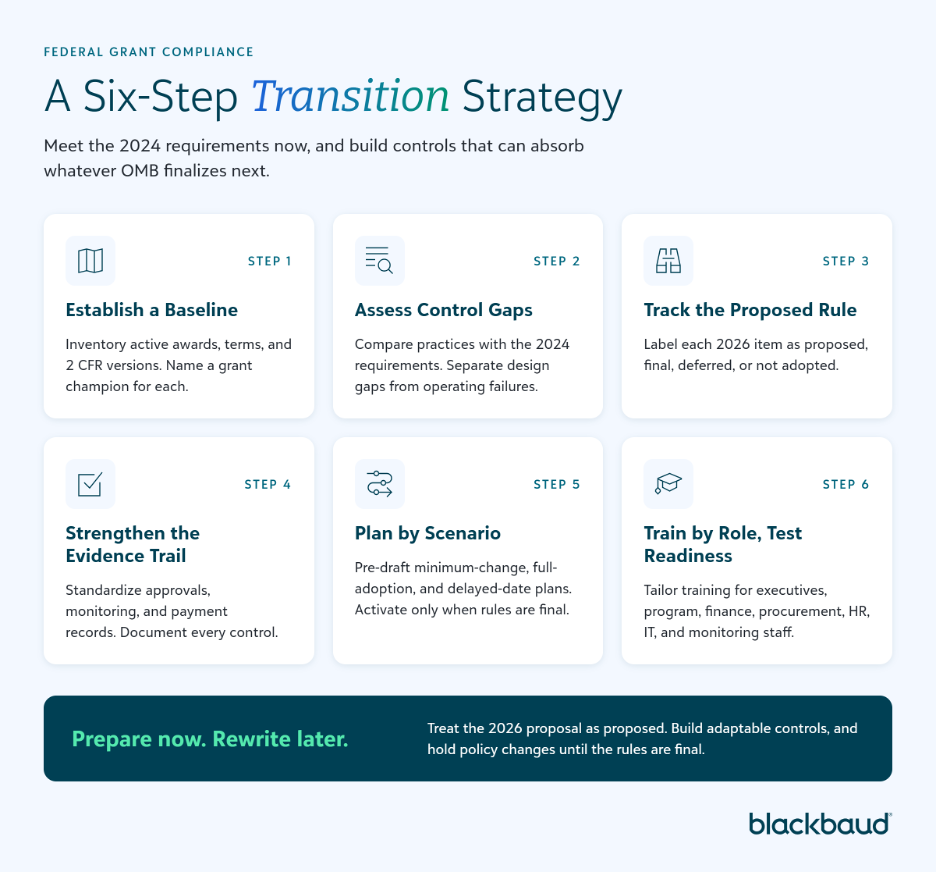
A Practical Transition Strategy
Establish a regulatory baseline. Create an inventory of active awards, effective dates, agency-specific terms, subawards, audit periods, and applicable versions of 2 CFR. Assign a “grant champion” for each award and document the source used to determine the governing requirements.
Perform a control-by-control gap assessment. Compare current practices with the 2024 requirements in procurement, indirect costs, prior approvals, cybersecurity, closeout, subrecipient monitoring, and audit preparation. Separate design gaps from operating failures.
Create a proposed-rule tracking tool. Track each material 2026 federal grant proposal, the function it affects, the likely policy or system change, dependencies, lead time, and responsible executive. Label each item clearly as proposed, final, deferred, or not adopted.
Strengthen the evidence trail. Standardize approval records, risk assessments, monitoring files, payment support, conflict disclosures, and corrective-action documentation. If a control cannot be evidenced, it may not suffice for audit purposes.
Use scenario-based implementation plans. Develop a minimum-change scenario, a full-adoption scenario, and a delayed-effective-date scenario. Pre-draft policy language and contract clauses, but activate them only when final requirements and award terms support the change.
Finally, train by role and test readiness. Tailor training for executives, program managers, finance, procurement, human resources, information technology, and subrecipient-monitoring staff so everyone understands the role they play in the new compliance landscape.
From Transition to Compliance Confidence
The strongest response to regulatory uncertainty is readiness. If they haven’t already, organizations should fully implement the active 2024 requirements. They should also monitor the 2026 rulemaking without treating proposals as final and build adaptable controls that can absorb change. A well-maintained award inventory, clear accountability, evidence-based monitoring, and tested documentation practices will remain valuable regardless of the final wording.
Want to learn more? Check out the webinar, Federal Grant Compliance Landscape: Current Rules to Future Shifts (2024 to 2026), which helps attendees analyze the requirements in force today, evaluate the most consequential elements of OMB’s May 2026 proposal, and formulate a transition strategy that supports both operational alignment and audit preparedness.