Survival in the New Age of Successful Grant Management

Over the past two years, I feel like I am constantly playing catch up. As soon as I get a handle on a new regulation, Executive Order, or program rescission, something changes, and then a new challenge unfolds.
Just when nonprofits, higher education institutions, and other federal award recipients settled into the routines built around the 2020 and 2024 updates to the Uniform Guidance, the federal government has proposed the most sweeping overhaul of federal grants management in over a decade.
Successful grant management for your nonprofit, foundation, higher education institution, or federal grant recipient still depends on doing the small tasks well, including internal controls, risk management, and subrecipient monitoring, while also understanding what opportunities and threats are on the horizon.
This guide will walk you through what’s changed, what it means if you’re a recipient, a pass-through entity, or a subrecipient, and how generative AI can be a useful tool when used effectively.
The New Age of Accountability Just Got Newer
On May 29, 2026, the Office of Management and Budget (OMB), joined by more than 40 federal grantmaking agencies, published a proposed rule that would substantially rewrite 2 CFR Part 200, the Uniform Guidance that has governed federal grants, cooperative agreements, and other financial assistance since 2013. In practice, the more than 400-page Uniform Guidance (now referred to as the Uniform Grants Regulations) touches nearly every phase of the award lifecycle.
OMB has targeted an effective date of October 1, 2026, to align with the start of the federal fiscal year 2027, meaning the requirements would apply to new awards and modifications issued after that date. Some of the most consequential proposed changes include:
- Uniform Guidance becomes a binding regulation. Rather than functioning as guidance that individual agencies separately adopt, the 2 CFR text would carry regulatory effect, with future OMB updates applying government-wide automatically, without a separate agency-level rulemaking or comment period.
- Discretionary termination authority. Agencies and pass-through entities would gain broad new authority to terminate an award, in whole or in part, whenever they determine that a project no longer aligns with national interests. There is also a provision that can include suspension on similar grounds.
- Pre-issuance review. New discretionary awards would go through a review process involving senior political appointees before funds are obligated, a shift from the more decentralized, program-office-driven process many recipients are used to. This is further outlined in Executive Order 14332.
- Expanded pre-award risk factors. Proposed changes to the risk-assessment provisions would allow agencies to weigh an applicant’s affiliations with organizations tied to unlawful activity and other risk indicators beyond standard internal controls metrics.
- Payment and cash-flow changes. Agencies will shift from advance payments to reimbursement during the period of performance and will require non-state recipients to submit written justification tied to activities or milestones for each payment request, along with Treasury Do Not Pay verification.
- Narrower cost and eligibility rules. Proposed changes touch on cost allowability (including new restrictions tied to meetings, conferences, subscriptions, printing costs, and a narrower definition of personally identifiable information), restrictions on collaboration with certain foreign countries and entities, and the elimination of fixed-price awards and subawards.
Please note that as of the date of this article, there has been some Congressional pushback on many of these provisions, so the outcome of the final rule is still taking shape.
Enforcement Is Getting Sharper, Too
The proposed rulemaking isn’t happening in isolation. In May 2026, the Department of Health and Human Services announced a new Audit Enforcement and Risk Oversight initiative that uses AI-driven analytics to review Single Audit data across all 50 states, flagging grantees with unresolved audit findings or chronic delays in submitting required audits. Potential consequences can include withholding payments, disallowing costs, and suspending or terminating awards. It’s a clear signal that funding agencies are using new methods for identifying these issues more quickly and expeditiously.
What This Means for Recipients, Pass-Through Entities, and Subrecipients
There are some specific actions that you can take before October 1.
If you’re a direct recipient
- Revisit cash-flow assumptions. If your agency or organization moves toward reimbursement rather than advance payment, you’ll need to consider your cash flow forecasts to confirm financial solvency as you bridge the gap between spending and being repaid.
- Build a termination playbook. Know what a discretionary termination clause would mean for your budget, your staffing commitments, and your obligations to partners if an award ends earlier than planned.
- Tighten documentation habits now. Written justifications tied to milestones, evidence supporting risk-factor disclosures, and audit-ready recordkeeping will matter more, not less.
If you’re a pass-through entity
- Update subrecipient risk assessment tools. These should reflect any new or expanded risk factors your funding agency adopts and be ready to flow down new award terms, including termination and reporting provisions, to your subrecipients.
- Revisit subrecipient monitoring plans. Formalized monitoring has been a priority since the last major Uniform Guidance update, and the proposed changes raise the stakes further, since pass-through entities remain fully accountable for subrecipient compliance, even when they don’t control day-to-day subrecipient operations.
- Communicate early and often. Subrecipients need lead time to adjust their own systems. Waiting until a final rule drops to start the conversation will leave everyone scrambling.
If you’re a subrecipient
- Expect new or revised terms and conditions. These will arrive from your pass-through entity, sometimes with limited notice. These updates will require subrecipients to adapt and entrust that they will build the internal flexibility to absorb them mid-project.
- Strengthen your own internal controls and financial management systems. When a pass-through entity or auditor asks for support, you’re not reconstructing records after the fact.
- Ask questions. If a new subaward agreement includes unfamiliar termination or reporting language, ask the pass-through entity to clarify how and when it applies before you sign the final award. You don’t want to be bound to an award whose terms are beyond your ability to manage.
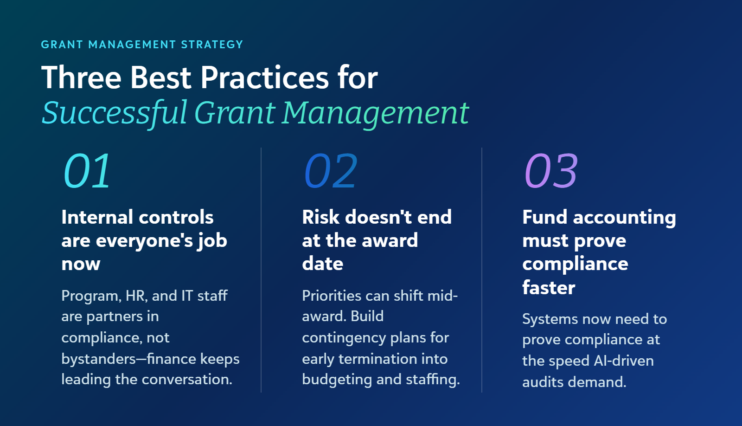
Three Best Practices for Successful Grant Management in 2026
Here are three themes to keep in mind as you update your grant management strategy.
1. Internal controls are not just for finance people anymore
Federal grant regulations have shifted internal controls from audit guidance to administrative requirements over the past decade, and this trend continues by tying documentation and risk evidence more directly to ongoing eligibility for funding.
Internal controls aren’t a stack of policy documents gathering dust on a shared drive. They’re a living process that establishes a framework and series of systems to ensure robust financial, programmatic, and administrative actions are taking place, and that deviations are caught and corrected. All those functional roles that are involved in the administration of grant awards—program, human resources, and IT staff—all need to be partners in this, not bystanders. Finance professionals need to keep leading that conversation across the organization.
2. Risk management doesn’t stop at the award date
The 2024 Uniform Guidance update formalized pre-award risk and integrity review along with subrecipient monitoring plans. The 2026 proposed updates take this further. With discretionary termination on the table and pre-issuance review by political appointees added to the front end, risk isn’t just something you manage before the first dollar goes out the door. It’s something that can change mid-award, based on shifting agency priorities you may not control. That means you need contingency plans for early termination built into your budgeting and staffing decisions, not just your pre-award due diligence.
3. Fund accounting systems must do double duty: compliance and speed
Auditors have always looked at whether you can track funds by individual award, provide assurance that money went to eligible activities, and screen out unallowable costs. What’s changed is the volume and pace of the documentation required to prove it, especially as funding agencies now use AI-driven analytics to flag noncompliance. Whether you run sophisticated software to manage your incoming grants or a spreadsheet, the question is the same: does your system meet the new bar to capture the information needed?
How AI Can Help You Prepare
If the 2013 Uniform Guidance was about consolidating the rules, and the 2020 and 2024 updates were about refining them, the defining feature of the 2026 environment is volume—more documentation, more risk factors to evaluate, more reporting cadence to manage, and less room for error.
This is exactly the kind of repetitive, document-heavy, pattern-matching work that AI tools are well suited to support, provided they’re used as an aid to human judgment rather than a replacement for it. Additionally, some systems you are already using to manage your grant awards may incorporate AI components. A few concrete ways organizations are putting AI to work:
- Subrecipient risk assessment: Organizations are using AI tools to apply a consistent scoring framework across submissions, flag risk indicators and discrepancies, and generate a first-draft risk memo that program staff can review and refine. This doesn’t replace the judgment call or review of different risk assessment factors, but it standardizes the starting point and frees staff to focus on the harder mission-alignment questions.
- Compliance monitoring and anomaly detection: AI tools can scan transaction data, budget-to-actual reports, and time-and-effort records for the kinds of patterns auditors look for, helping recipients and pass-through entities catch unallowable costs or documentation gaps before an auditor does.
- Tracking regulatory change: With the Uniform Guidance potentially becoming a living regulation that updates automatically going forward, AI-powered monitoring tools can help your compliance team keep a running, organized log of what’s changed, when it takes effect, and which of your active awards it touches, rather than relying on someone remembering to check the Federal Register.
- Subrecipient communication and onboarding: AI-assisted tools and automation can help standardize how subrecipients submit required documentation, automatically catch incomplete submissions, and route straightforward questions, freeing your monitoring staff for the substantive conversations that reduce risk.
A word of caution: funding agencies are now using AI to scrutinize your compliance data, which raises the bar for the accuracy and consistency of your submissions. Any AI tool your organization adopts should go through the same due diligence you’d apply to other new systems: understand what data it touches, how it’s secured, and where a human still needs to review and sign off before something goes out the door. AI is a tool for managing volume and consistency, not a substitute for internal controls and judgment that ultimately keep your organization accountable.
How to Prepare for Survival: A Grant Management Checklist
Whether you’ve been managing federal grants for years or earned your first award this year, here are a few steps to make sure your processes can evolve with the regulatory changes.
Step one: What resources do you already have?
When you find yourself in a difficult situation, start by assessing your available resources. The first step in preparing for these changes is to take stock of what you already have in place and prioritize the most pressing issues.
- What processes and policies are currently in place, and were they built for advance payment funding, reimbursement funding, or both?
- How well does your organization currently understand the terms and conditions in your existing awards, and how quickly could you absorb new or revised terms mid-project?
- Do upper management and program staff have real involvement and oversight in grant administration, or does that responsibility sit with one or two finance or grant staff?
- Is the tone at the top aligned with the direction federal oversight is heading, including more documentation, more risk evidence, faster turnaround, and less tolerance for unresolved audit findings?
Step two: Where are the greatest opportunities and threats?
Conduct a SWOT analysis of strengths, weaknesses, opportunities, and threats specific to the 2026 changes. This will tell you where new risks are concentrated and where you might be positioned to move quickly and efficiently.
- What does your organization already do well when it comes to documentation, cash-flow management, and subrecipient communication?
- Where are the gaps, such as cash reserves for a reimbursement model, staff capacity for faster reporting, or systems that can’t yet flag risk in real time?
- Where might new funding opportunities emerge as some organizations pull back from federal funding altogether?
- What’s your exposure if an active award were terminated for convenience with limited notice?
Step three: How will you thrive?
Now that you’ve assessed your starting point and identified threats and opportunities, it’s time to build the systems that match the environment you’re operating in, not the one you were operating in three years ago. Increasingly, that means a combination of clear internal controls, disciplined subrecipient monitoring, and thoughtfully deployed AI tools that handle volume so your people can focus on judgment.
- How will you fund the transition, particularly if payment timing shifts against you?
- How will you get the information you need from subrecipients or provide it to your pass-through entity without overburdening either side?
- What reporting and analytics capabilities do you have, or need, to make sense of the data federal agencies now expect in near real time?
Some organizations will resist these changes or hope the comment period and ongoing legal challenges soften them. Given the pace of change and the reality that federal grant compliance requirements have only grown more demanding with each Uniform Guidance revision since 2013, waiting is itself a risk.
Surviving (and Thriving) Through Preparation
The future of federal grant funding belongs to the prepared. The key to not feeling like you are constantly being rocked, and even thriving, in this new age of grants management is to understand your environment and be ready for what you might encounter. Organizations that pair strong internal controls with the smart use of technology, including AI, for efficiency and oversight will be best positioned to keep their funding streams alive and put those dollars to work.
Are you ready to bring more accountability and speed to your federal grant management, but aren’t sure you have the systems or the staff capacity to keep up? Check out the guide, How Having the Right Policies in Place Reduces Grant Compliance Risk—and Where to Start.
Free White Paper
Future-Proofing Your Organization’s Finances: Proactive Steps to Ensure Stability and Growth