How to Improve Transparency and Accuracy in Your 990 Filing

Earlier this year, the US Treasury announced the IRS plans to update Form 990. Framing the update as a transparency initiative, the IRS’ focus will be on 501(c)(3) organizations with government contracts, government grants, and fiscal sponsorships. The Treasury writes, “The changes are intended to detect misconduct and hold wrongdoers accountable.”
While the IRS has not yet proposed specific changes to the Form, the Tax-Exempt Community is actively working to ready themselves. With heightened scrutiny and stakeholder expectations, tax exempt organizations must re-think their Form 990, moving from framing the form as a compliance burden and into a strategic communication tool that demonstrates transparency, accountability, and impact.
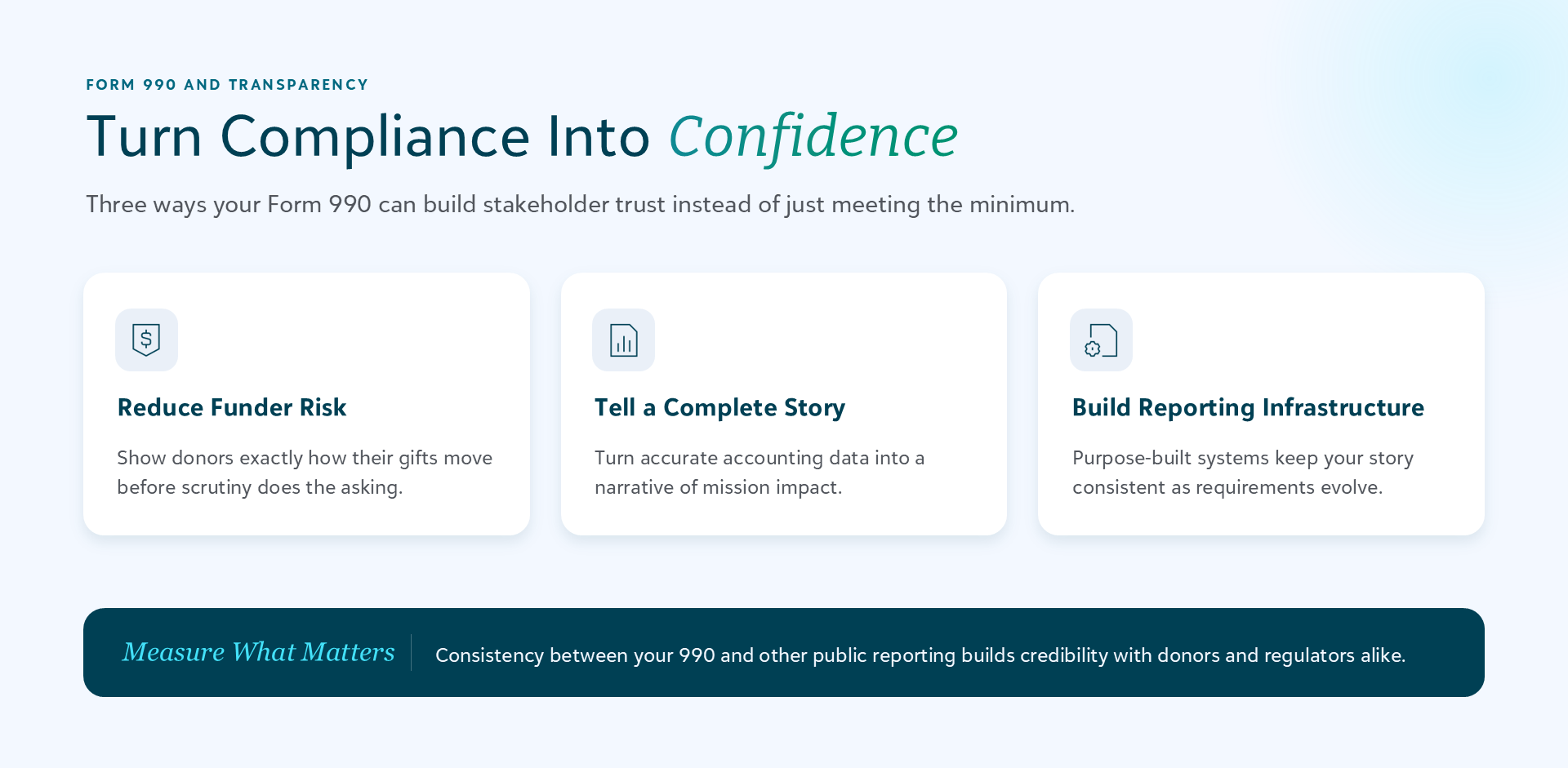
How Your Form 990 Can Reduce Funder Risk
The annual information form for tax exempt organizations, Form 990, is unique in that it is required to be made available to the public. Currently composed of 12 pages and 16 schedules, the Form presents a comprehensive look at a tax-exempt organization’s operations. Form 990 includes a full set of financial statements and provides schedules that report detailed compensation information for named officers, directors, key employees, and others. It also includes transactions with related persons, donor information, lobbying and political activities, complex public support calculations, and information on related organizations, among other topics.
The expansive information in the form is used by a variety of stakeholders. The government uses it as a compliance tool. Donors use it to make philanthropic funding decisions. Potential employees, creditors, journalists, and state attorney generals all avail themselves of the information available in Form 990 to inform their interactions with the organization. The transparency initiative reveals that, despite all of the information already in the Form, stakeholders do not feel like they receive enough information. There is an appetite for even more rigorous reporting.
To respond to the public and maintain their trust, even before the IRS announces formal changes to the Form, exempt organizations should be asking, “How can we better use Form 990 to meet the needs of our stakeholders”? Utilizing Form 990 to show donors not just the mechanical accounting usage of their funds, but also the impact of those funds through powerful narratives helps an organization make their mission real and tangible to external stakeholders, and keeps your funders engaged. Conversely, a poorly filled out Form, or even a technically correct but lifeless delivery, or numbers presented without context, can drain enthusiasm from supporters, obscure meaningful accomplishments, and even open an organization up to unwanted scrutiny.
How to Use Your 990 to Tell a Complete Story
A strong 990 is not merely complete and correct from a compliance standpoint. It tells a cohesive and compelling story. A holistic view of Form 990 recognizes its potential as both a communication tool and risk mitigator. Organizations going beyond meeting IRS minimum requirements can leverage the Form for tremendous public relations opportunities.
Form 990 offers latitude to go into great detail about your organization’s impact and accomplishments. Organizations looking to be proactively transparent begin on page two, Part III of the form. Here, you describe your mission and program service accomplishments. This section is often significantly underutilized. Organizations have virtually unlimited space to provide narratives on their annual program accomplishments. You should be giving specific information, updated each year, about your activities. This section is front and center on the return, so it’s important to capitalize on this part. If you gave scholarships to 53 students, shout it out! If you hosted an impactful conference, share the details! The instructions for the form requires specifics about the programs. The IRS is not looking for sterile, bare-bone descriptions, and neither are your stakeholders.

The IRS is not looking for sterile, bare-bone descriptions, and neither are your stakeholders.
Andrew Hassler
Manager, Johnson Lambert, LLP
Make sure you have foundational accounting best practice in place
Financial disclosures are the backbone of Form 990. Even smaller organizations who do not receive audits must present complete and accurate financial data to the IRS. Poorly maintained books make transparency difficult because presenting the organization’s accomplishments and accurately completing the schedules are reliant on quality accounting data.
Your organization should document and monitor the types of revenues it earns to ensure no unexpected unrelated business income occurs. You should have strong expense tracking procedures in place to ensure you are accurately tracking your programs and allocating expenses properly between the program, management and general, and fundraising categories.
Importantly, your accounting data should be in sync with your program data. Your grant expenses should be matched with your grant tracking software. Your restricted funds should be documented and updated throughout the year. Strong accounting practices enable your organization to confidently report the information required of them.
Demonstrate responsibility
To promote transparency, organizations should demonstrate strong commitment to good governance. Part VI, Section B is where a nonprofit describes their governance policies. Indicating that your organization’s full board is provided a copy of Form 990 demonstrates institutional ownership. Showing that you have and are enforcing compliance with a conflict-of-interest policy, written whistleblower policy, and document retention and destruction policy all show institutional care, and anecdotally, help keep IRS auditors at bay. In the age of AI, nonprofit leaders need to be governing AI responsibly, and Form 990 can be used to communicate that commitment.
Finally, your organization should have authorized persons without conflicts of interest review and approve compensation decisions and document their decisions. Giving appropriate context to how compensation decisions are made and reviewed helps those both inside and outside your organization trust that such decisions are made responsibly and helps build stakeholder confidence in the Organization.
Form 990 as Part of Your External Stakeholder Communication Suite
Your Form 990 is one part of your organization’s external stakeholder communication ecosystem, and your organization’s message should be consistent across platforms. Your Form 990 should cohesively relate to your Audited Financial Statements (AFS) and other public facing information. You should be able to crosswalk the numbers in your return to your audited financials—and have documented any book-to-tax differences. The Statement of Functional Expenses on the 990 should be in harmony with your AFS. The programs described in Part III of the 990 should be aligned with those broken out in your audit and described on your website. The mission statement in your tax form should be the mission statement you are using on public facing materials. Your Form 990 should be thought of as part of your organization’s brand and reflect that treatment.
Tips for Using Your Form 990 to Promote Transparency
Promoting transparency through your Form 990 starts long before you submit the return. By creating strong processes, involving the right stakeholders, and providing meaningful context alongside your financial data, you can use the form to build trust and tell a more complete story about your organization’s impact.
Here are a few tips to make sure your 990 is telling the right story about your organization.
- Your Form 990 is a group project. Collaborate with your marketing team on the narratives, especially those describing your programs. If someone other than your accounting team maintains grant recipient information, establish information gathering procedures ahead of return preparation time to help things go smoothly.
- Ensure you are meeting all the requirements for any government funding you receive, including fee-for-service arrangements. Track information meticulously, and stay in compliance with any Single Audit requirements. The government is very interested in NGO compliance with funding standards, and the IRS transparency initiative will be focusing heavily on this area. Establishing healthy systems now will be pay dividends in the future.
- Evaluate fiscal sponsorships arrangements. Make certain your organization has a clear and documented understanding of their arrangements, including who retains custody and responsibility for funds and who bears responsibility for project supervision. As a best practice, your organization should be able to fully report all activities of the sponsored project as if the project had to file its own tax return, and your organization were required to sign it.
- Do not fear the extension. The IRS does not penalize or look suspiciously at organizations when they file an extension for Form 990. If you need time to do it right, it is available to you.
- Lean into Schedule O. Schedule O allows unlimited space for you to speak directly to stakeholders. You can use it to elaborate on, or give context to, other areas of the return. It is also the place to share information that is important to you. If you have a green energy policy or anti-corruption policy you are proud of, Schedule O is the place to speak about it.
Be Prepared for 990 Changes with Strong Reporting Infrastructure
Regardless of how the regulations change, it will always be crucial for tax-exempt organizations to proactively communicate with your stakeholders and strengthen your relationships. The 990 can be a powerful bridge-building tool.
Unlike most discretionary marketing expenditures, Form 990 is a fixed cost. You have to file it every year regardless of how you utilize it. Shifting from thinking about the 990 as a compliance burden to an investment in relationship building with stakeholders leverages the tools your organization already has, provides the transparency regulators and the public desire, and simultaneously builds up and protects your organization.
With new requirements on the horizon, now is the time to invest in deep compliance, compelling narratives, and robust data gathering procedures to meet the demands of today’s stakeholders head on.
Still relying on spreadsheets to track restricted funds and support 990 reporting? Explore how Blackbaud Financial Edge NXT® can simplify the process in this on-demand product tour.