From Requirements to Relationships: Rethinking Grant Reporting to Strengthen Funder-Grantee Partnerships

When funders ask grantees for financial reports, the goal is usually straightforward. They want to understand how resources are being managed. But too often, the process creates something else: administrative burden.
That burden matters, especially now. Many funders and nonprofit leaders are familiar with the strains facing the sector, such as increasing demand for services, funding uncertainty, staffing challenges, and leadership burnout. At the same time, many grantees are still navigating age-old challenges, like managing multiple funders with different reporting requirements and translating information into different formats. The result is that nonprofits are directing their limited resources toward administration and reporting instead of the work those resources are meant to support.
For funders, this creates an opportunity to rethink financial reporting requirements so they can reduce unnecessary burden, produce information that is truly useful, and strengthen relationships with grantee partners.
Every Reporting Requirement Should Earn Its Keep
Many reporting requirements begin with a reasonable purpose, like a question a board member asked, a detail that helped with a past decision, or a format that once made review easier. Over time, though, those requirements can accumulate and outlast their original usefulness.
Each requirement costs staff time on the grantee side. That cost is why funders need to periodically review their reporting requirements. A requirement that once helped answer a specific question may no longer be necessary if no one uses the information to make decisions.
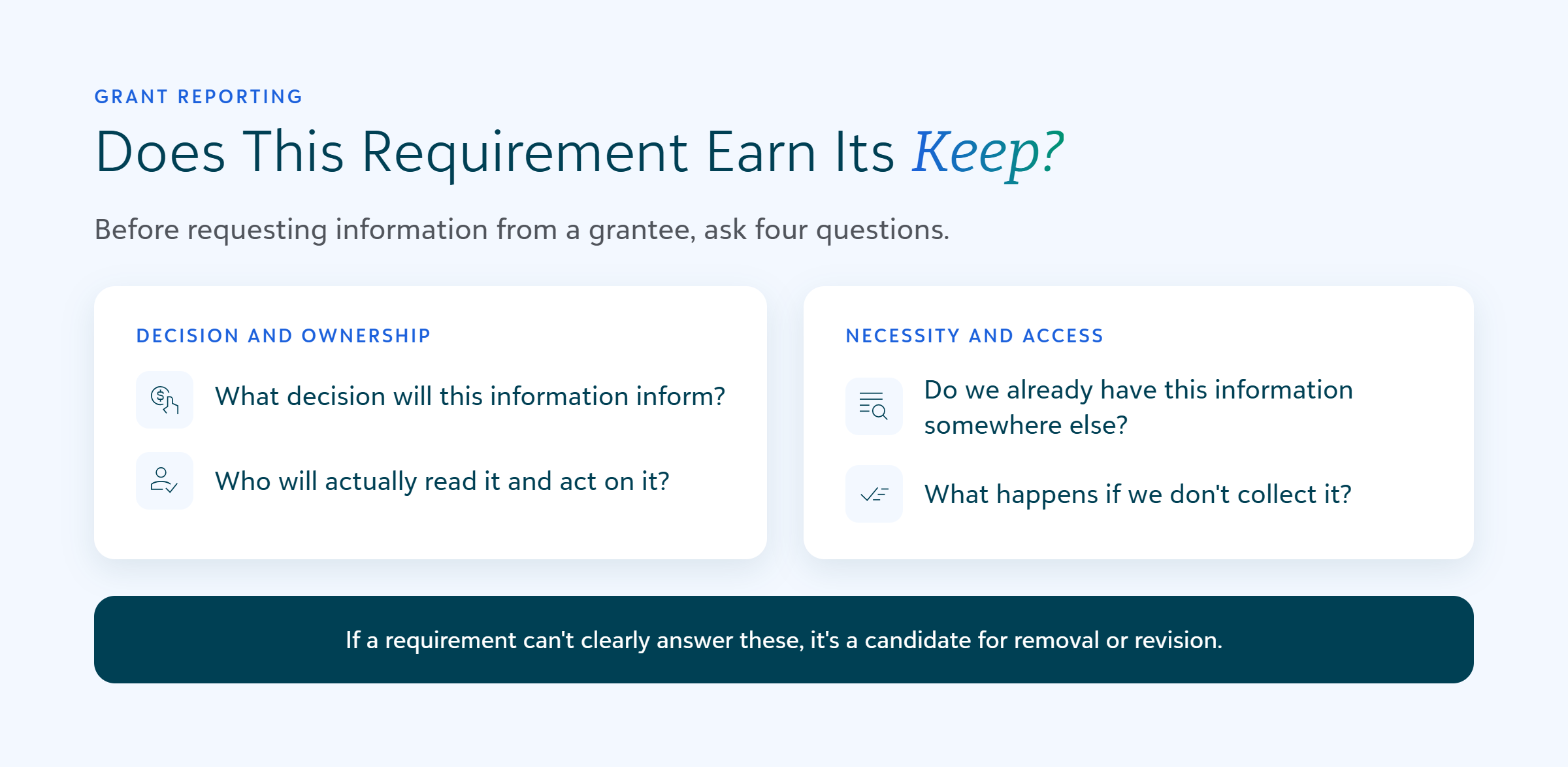
Before requesting information from a grantee, consider four simple questions:
- What decision will this information inform?
- Who will actually read it and act on it?
- Do we already have this information somewhere else?
- What happens if we don’t collect it?
If a reporting requirement cannot clearly answer those questions, it is a good candidate for removal or revision.
The Information You Need May Already Exist
One of the most effective ways to reduce reporting burden is to recognize how much information nonprofits already produce and be open to accepting formats the grantee already has available. Nonprofits already generate financial information for a variety of purposes, including:
- Internal management and department leader review
- Board and finance committee review
- Annual financial statement audits
- Form 990 preparation
- Government grant compliance
- Bank or lender reporting
- Annual reports and donor communications
These documents often contain much of the information funders are requesting through separate reporting processes.
For example, audited financial statements and Form 990 filings can be helpful tools for understanding an organization’s financial position, revenue sources, functional expenses, governance practices, and significant commitments or risks. These documents are often publicly available and can be a useful starting point for funders as they consider what additional information would be most helpful to request. Annual reports, board materials, and existing grant reports may also offer valuable context about priorities, outcomes, and financial performance.
When appropriate, accepting a report prepared for another funder can be a practical way for funders to get the information they need for review and decision-making without requiring additional work from the grantee.
When Numbers Don’t Match, Start with Curiosity
Funders frequently encounter situations where financial figures differ across reports, especially when those reports were prepared for different audiences or purposes.
A grant report may not match audited financial statements. A Form 990 may show different figures than an internal financial report. Most of the time, these discrepancies are not a sign of a problem. They often result from:
- Different reporting periods
- Cash versus accrual accounting
- Program-level versus organization-wide reporting
- Timing of donor-restricted funding
- Preliminary versus finalized numbers
Instead of assuming a discrepancy represents an issue, consider approaching it as a conversation. A simple question such as, “Can you help me understand the difference between these figures?” often leads to valuable context and a stronger understanding of the organization’s operations.
In many cases, these conversations provide funders with greater insight than the numbers themselves.
Finding the Right Balance
Every funder brings a different set of goals, practices, and internal considerations to grantee financial reporting requirements. Their requests typically fall somewhere along a reporting complexity spectrum.
At one end are highly customized templates designed to standardize information across grantees. These formats can improve consistency for funders but often require nonprofits to spend significant time reclassifying and reformatting data.
At the other end is a reliance on existing grantee reports, which reduces burden for nonprofits but may require more interpretation from the funder.
In the most collaborative approach, funders start with information the grantee already prepares and then request only what is truly needed to fill any remaining gaps.
For some funders, that may mean accepting existing reports with a few follow-up questions. For others, especially those navigating board expectations or a long-standing grantee reporting process, it may mean simplifying templates so they align more closely with information nonprofits already track and report. For example, budget categories that mirror Form 990 functional expense classifications are often easier for nonprofits to complete and easier for funders to review.
The goal is for funders to obtain meaningful information with the least amount of unnecessary effort.
Reporting Is a Reflection of Partnership
Every reporting requirement communicates something to a grantee. When funders accept information a nonprofit already maintains, they communicate trust. When reporting requests are concise and purposeful, they communicate respect for a nonprofit’s time and capacity. When funders use reporting conversations to learn, clarify, and understand context, they communicate partnership. And when foundations invest in grantee capacity, they help create the conditions that lead to stronger reporting in the first place.
Organizations can build better reports when they have the systems, staffing, and support they need to produce useful financial information. Grantees that struggle to provide requested financial information may be navigating larger capacity needs, not simply reporting challenges.
Nonprofits at different stages of maturity face different operational realities. For example, a start-up may still be building financial systems and processes, while a growing organization may be working to scale financial infrastructure fast enough to keep pace with accounting and reporting demand. In those cases, funders can strengthen reporting by supporting the underlying capacity that makes useful financial information possible.
That support might include:
- Training on financial management topics
- Peer-to-peer learning opportunities
- Financial management coaching or technical assistance
- Technology and systems investments
When funders invest in grantee finance capacity, they help build the infrastructure that leads to better financial information for the nonprofit itself, stronger decision-making, and greater long-term impact.
Where to Start
Grantmakers do not need to redesign their reporting requirements overnight if they want to be more intentional with their reporting requests. Small changes can have a meaningful impact.
- Accept one report that a grantee already prepares.
- Eliminate one question that no longer informs a decision.
- Replace one written response with a conversation.
- Align one reporting template with categories nonprofits already track.
When reporting is purposeful, focused, and aligned with information nonprofits already produce, funders receive more useful insights, nonprofits spend less time on administrative work, and both sides can focus more energy on the outcomes the grant supports. Ultimately, reporting is not just a process. It is part of the funder-grantee relationship. How can your reporting process help build the kind of partnership your grantmaking values?
While these steps offer a practical starting point, funders may benefit from reviewing their reporting requirements with input from nonprofit finance professionals. An experienced nonprofit accountant can help funders determine which financial information is useful, which requests may be duplicative, and how reporting can better support funder-grantee conversations.
To explore this topic further, check out the webinar, From Requirements to Relationships: Rethinking Grant Reporting to Strengthen Funder-Grantee Partnerships.