7 Data Horror Stories that Could Haunt Your Organization

The shadows are getting longer. A chill hangs in the air. Somewhere in your database, a duplicate record has returned from the dead.
You don’t encounter vampires or werewolves at your organization, but you’ve probably met errors that can be just as unsettling, such as incomplete supporter profiles, mysterious spreadsheet versions, and gifts that seem to change as they move from fundraising to finance.
These problems rarely happen because someone doesn’t care. More often, staff members are working around systems that don’t communicate, processes that have not kept pace, or data rules that aren’t clear. A small inconsistency slips through, then silently multiplies until it becomes a much bigger problem.
Here are seven data horror stories that could haunt almost any nonprofit, foundation, or educational institution. The stories are fictional, but the risks are frighteningly familiar.
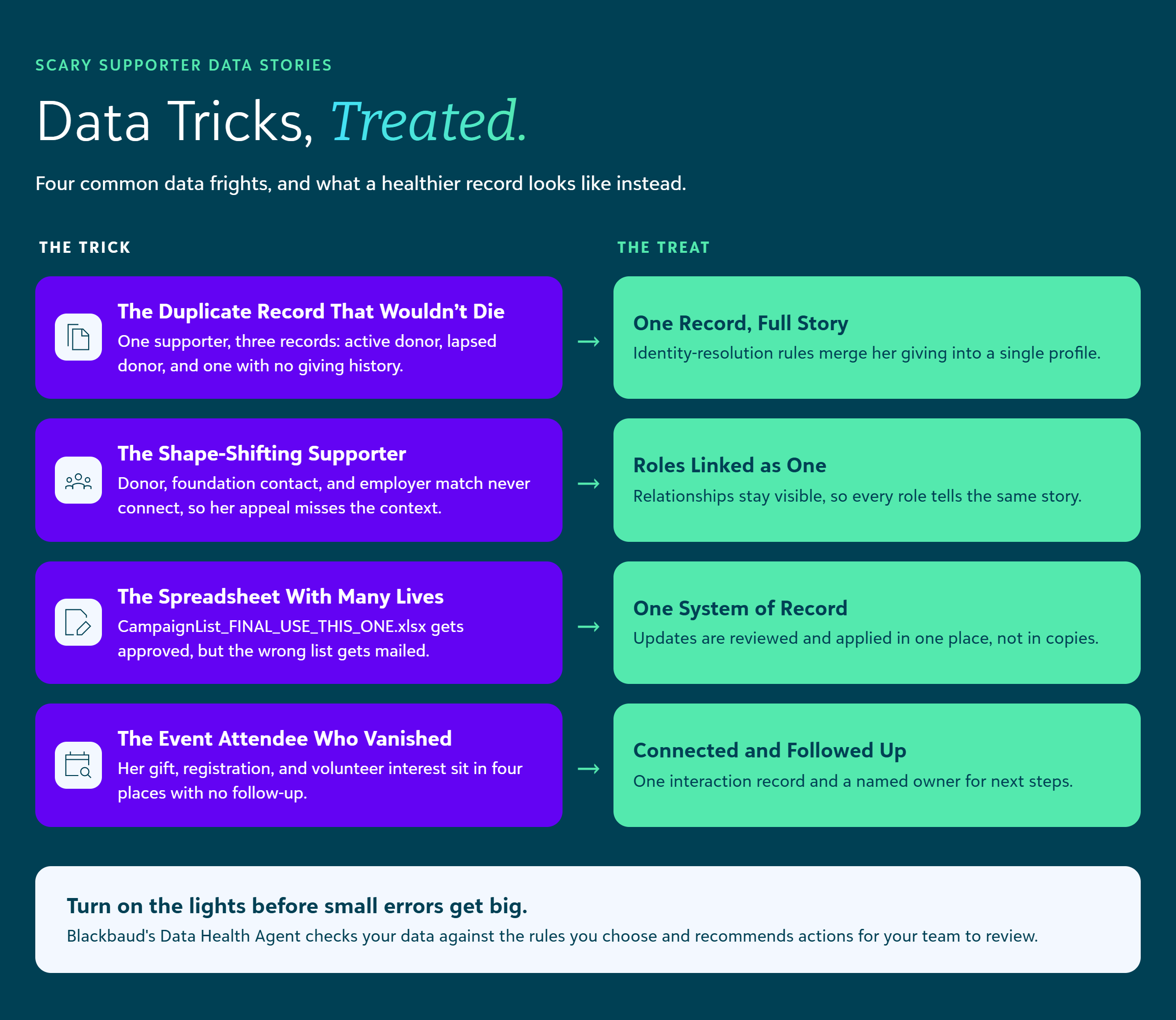
1. The Duplicate Record that Wouldn’t Die
A longtime supporter registers for an event using her personal email address. Later, she makes a gift with her work email. When she moves, someone updates one record, but the other remains unchanged.
Before long, she exists in your database three times. One record identifies her as an active donor. Another lists her as a lapsed donor. The third has her current address but none of her giving history. She receives duplicate appeals, conflicting messages, and two different versions of her name.
Meanwhile, your team can’t see the full story of her relationship with your mission. Her giving appears smaller than it actually is, and she may be excluded from the stewardship activities intended for your most committed supporters.
Duplicate records don’t arrive with an ominous soundtrack. They build slowly as people interact with your organization through different forms, events, campaigns, and channels. Without rules and processes for identity resolution, these zombie records can linger for years.
2. The Gift with a Secret Purpose
A donor makes a gift to support a specific program. The fundraising team records the donor’s intent in its system, but the information that reaches finance is less specific. The gift is entered under a broad revenue category, leaving the funding restriction trapped in an email or buried in a note field.
Everything appears normal until reporting begins. Fundraising sees a restricted gift associated with the program. Finance sees revenue without the same designation. Program staff members have yet another spreadsheet tracking what they believe is available to spend.
No one intentionally changed the donor’s wishes. But as information moved between disconnected systems and informal processes, the details were lost. When fundraising and finance cannot follow consistent gift information from the original commitment through acknowledgment, reconciliation, and reporting, a routine transaction can turn into a suspense story. Which record is correct? Where does the gift belong? And who will venture into the email archive to find out?
3. The Case of the Shape-Shifting Supporter
In one system, a constituent is an individual donor. In another, she is the primary contact for a family foundation. Elsewhere, her record is associated with her employer’s matching-gift program. Each entry is partly correct, but the relationships among them are missing or inconsistent.
Your team sends her an appeal without recognizing the recent foundation grant she helped facilitate. A development officer reviewing her history sees personal gifts but not her connection to the foundation. Another staff member creates a new organizational record because they cannot find the existing one.
People have complex relationships with the organizations they support. They may be donors, volunteers, board members, alumni, employees, grant contacts, or all the above. If your data cannot preserve those relationships, you’re left with fragments instead of a useful picture.
Of course your supporters have multiple roles. The frightening part is that your systems don’t recognize that they all belong to the same story.
4. The Address from Beyond the Grave
Your annual appeal is ready. The message is strong, the segmentation is complete, and the mail files are on their way. Then the returns begin.
Some supporters moved years ago. A few records lack key address details. Other households receive multiple copies because their records were never connected. Staff members discover that address updates collected by one team didn’t make it into the system used for the mailing.
Incorrect contact information costs more than postage. It can interrupt relationships and distort your understanding of who is reachable. If messages repeatedly disappear into the void, supporters may miss opportunities to give, attend, volunteer, or learn about the impact they helped create.
An outdated address may seem like a small error, but thousands of small errors can turn an important campaign into a costly guessing game.
5. The Spreadsheet with Many Lives
It begins innocently enough. A team exports a list to review before a campaign. One person corrects several names. Another adds phone numbers. A third removes people who should not receive the communication. Soon, the shared folder contains:
- CampaignList_Final.xlsx
- CampaignList_Final_Updated.xlsx
- CampaignList_Final_Updated2.xlsx
- CampaignList_FINAL_USE_THIS_ONE.xlsx
Unfortunately, someone uses an outdated list for the mailing. The wrong supporters receive the campaign. Recent updates never return to the system of record. When someone notices, the team must determine which spreadsheet contains the most reliable information and whether any of its changes conflict with newer updates.
Spreadsheets remain useful tools for organizations, but they become frightening when they sneak into the role of a database. Without a defined system of record and a clear process for reviewing and applying updates, each export can create a parallel version of your organization’s data.
6. The Event Attendee Who Vanished
A new supporter attends your signature event. She asks thoughtful questions, makes a gift, and tells a staff member she would like to learn more about volunteering. By the following morning, pieces of that interaction live in four places. Her registration is in the event platform. Her gift is in the fundraising system. Her volunteer interest sits in someone’s notes. A dietary preference is still on the seating spreadsheet.
But no single record captures the full interaction, and no follow-up responsibility is assigned. The supporter doesn’t receive the information she requested. Months later, she gets a generic acquisition appeal that treats her as though she has never interacted with your organization.
From her perspective, she expressed interest and heard nothing. From your team’s perspective, the information existed, but it was scattered across tools and never became actionable. The supporter didn’t vanish. The connection among your records did.
7. The Report that Changed when You Looked Away
Your leadership team is preparing for a board meeting. Fundraising runs a report showing one total for the campaign. Finance prepares a report showing another. Both teams review their numbers and explain how they arrived at them. Both reports are technically accurate according to the information and definitions used, but the numbers don’t match.
One report includes pledges. The other includes only received revenue. One uses the gift date, while another uses the posting date. A recently adjusted gift has been updated in one system but not the other.
The board wants a straightforward answer, but the conversation turns into an investigation. Staff members spend valuable time reconciling reports instead of discussing what the results mean for the mission.
Different reports can serve different purposes. The nightmare begins when people don’t realize they’re using different definitions, rules, or data sources. Shared terminology and documented processes help fundraising and finance explain their numbers with confidence, even when the numbers should not be identical. and documented processes help fundraising and finance explain their numbers with confidence, even when the numbers should not be identical.
Turn on the Lights Before Small Errors Become Big Problems
No villain caused these horror stories. A donor didn’t do something wrong by using a second email address. A fundraiser didn’t create disconnected systems. A finance team didn’t hide important information in a spreadsheet for fun. People were trying to move the work forward with the tools, time, and information available to them.
That’s why healthier data requires more than a heroic cleanup project once every few years. It takes consistent rules, clear ownership, and manageable ways to identify and address potential problems.
Blackbaud’s Data Health Agent uses the data rules you select to assess your data and identify instances that may require attention. It provides a prioritized list of potential issues and recommended actions for your team to review.
Duplicate records aren’t the only things lurking in your database. The agent’s recommendations can address areas such as addressability, contact-record relationships, gift tracking, and prospect management.
Your organization remains in control. You determine which rules to use, who can review recommendations, and whether the agent should take an approved action. If your team becomes confident in its recommendations, you can choose to grant more autonomy on a rule-by-rule basis. Corrections are tracked, and your team can review and reverse them.
Don’t wait for questionable data to come back to haunt you. See how the Data Health Agent can help you build healthier, more reliable fundraising data.