Best Practices for Succession Planning in Nonprofit Finance Departments

Here’s an uncomfortable fact: nonprofit turnover runs higher than anyone likes to admit, meaningfully higher than the private sector. If you run a five-person finance department, statistically, you should expect to lose someone almost every year. Even orgs that didn’t make cuts got leaner by attrition, because nobody’s in a rush to backfill in this funding environment.
So, what does that mean for the finance office? The math on succession planning has changed. It used to be a “nice to have” for whenever your longtime controller finally retired, or your AP clerk was promoted to a new role. Now intentional succession planning is what keeps your monthly close from blowing up when your one AP person takes another job, your CFO gets recruited away, or your finance director goes out on leave with no warning and no notes.
As you formalize a succession strategy for your finance team, there are three areas worth your attention: segregation of duties and cross-training, safeguarding your assets, and the ripple effects across the rest of the organization.
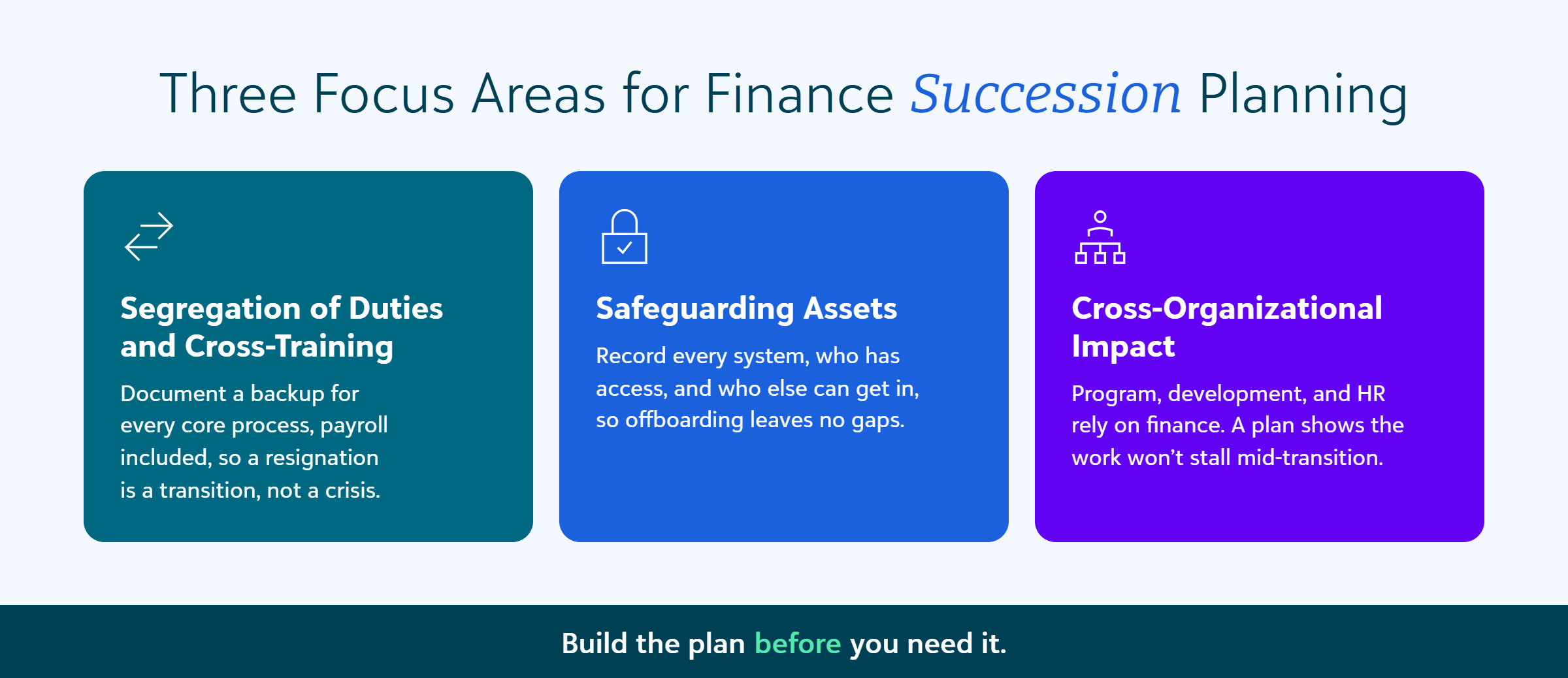
Segregation of Duties and Cross-Training
Small finance teams have a structural problem. It’s hard to properly separate who has physical access, who records transactions, and who authorizes them when there are only two or three people doing everything. That’s not a controls failure—it’s just math. We are accountants, after all. But it does mean you need a real plan for what happens when one of those two or three people leaves.
You probably have an internal controls manual that describes how things are supposed to work. What actually happens day to day is usually a little different. There are workarounds for old software, informal approvals, “just ask Maria, she knows how” institutional knowledge that never made it into any document. Before you build a succession plan, you need an honest inventory of what each person on your team does, not what their job description says.
Real cross-training means someone else can step into a role competently, not just cover email while a person is out. That means documented backups for every core process, and yes, that includes payroll, even though management tends to get twitchy about who sees compensation data. The alternative is one person who is burnt out and can never take a real vacation because nobody else knows how to run reconciliation, and a single resignation that turns into a genuine crisis instead of a two-week transition. Do this well and you get a nice side benefit. Your people actually get to use their PTO.
Cross-training is not only a fraud control, but it’s also what lets your team hit deadlines when someone’s out sick, on leave, or just needs a real week off without their inbox catching fire.
Safeguarding Assets
The second piece is protecting what your organization has, and that’s a lot more than cash in a drawer. It’s your process documentation, your recordkeeping, and increasingly, who has access to what system.
Most nonprofits are fully digital now, so the real risk during a staff transition isn’t someone walking out with petty cash. It’s someone walking out with the only working knowledge of your login credentials. If institutional knowledge isn’t documented, you might not find out until weeks later that a departed employee still has access to your grant portal, your state filing system, your bank, or your payroll processor. That’s not hypothetical. It’s one of the most common gaps I see when I walk into a finance department after a departure.
Before someone leaves—and ideally before you’re even worried about someone leaving—you need a current record of your process documentation. Document every system your finance function touches, who has access, and who else knows how to get in if that person is gone tomorrow. When a transition happens, that record is what lets you offboard the departing employee’s access cleanly instead of discovering gaps six months later.
Cross-Organizational Impact
The third piece is easy to overlook because it’s not really about finance at all. It’s how your team functions with everyone else in the organization.
Program staff, development, HR—they all depend on your team for something, and those working relationships are usually built person to person, not department to department. When someone leaves, those relationships go with them, right when you can least afford the friction. The reporting and information other departments need from finance doesn’t pause for a transition.
A real succession plan signals to the rest of the organization that finance won’t disappear mid-transition. That’s worth more than it sounds like. It tells program staff, your ED, and your board that the mechanisms are in place to keep things running, even when the org chart changes.
Build the Plan Before You Need It
How your organization handles a departure says a lot about how well it’s led. A team with a real succession plan makes transitions look boring, which is exactly the goal. No fire drills, no scrambling to figure out who has the password to the state unemployment portal, no three-week gap before anyone realizes invoices haven’t been paid.
When nonprofit finance teams are leaner and turnover is a matter of when, not if, this is one of the few controls you can put in place without spending a dollar. It just takes the discipline to do it before you need it.
Want to dig deeper into smart succession planning? It’s one of seven chapters in the Ultimate Guide for Nonprofit CFOs. Download the guide to learn more.