How to Scale Your Rapid Response Grants

When crisis strikes, communities can’t wait months for funding. Rapid response grants bridge that gap by helping organizations act quickly during emergencies, whether that’s a natural disaster, a sudden policy change, or unexpected community need. These programs are uniquely positioned to provide immediate relief, but they require thoughtful design, strong internal alignment, and smart use of technology to run well at scale.
This guide outlines how grantmakers can build or expand a rapid response model that is fast, fair, and rooted in trust, without losing sight of essential internal controls.
Why Rapid Response Grant Programs Are Different
Rapid response funding looks and feels very different from traditional grantmaking. It’s defined by four core traits:
- Speed: funds often need to be reviewed and distributed in days or weeks, not months.
- Flexibility: the program must adapt to unanticipated events rather than follow a predictable annual cycle.
- Trust‑based approach: reporting is intentionally lightweight, easing the burden on communities who may already be under stress.
- Immediate impact: the focus is on meeting urgent needs now, rather than long-term project outcomes.
Many organizations, whether they are responding to a wildfire affecting rural communities or a sudden shift in public benefits that threatens local families, find that a nimble rapid response program becomes one of the most meaningful ways they can show up for those they serve.
Here are four aspects of your rapid response grants that you need to keep in mind as you develop or scale your program.
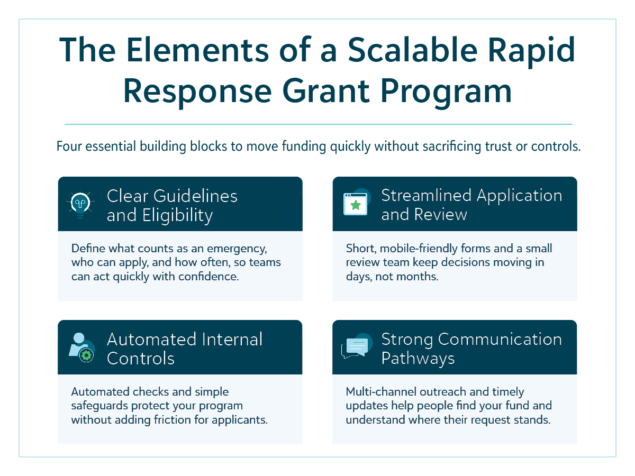
1. Set Clear Guidelines and Eligibility Requirements
Even though rapid response funds move quickly, they function best when grounded in clear, thoughtful guidelines. These guidelines act as guardrails, helping your team make decisions without needing to pause and interpret policies during moments where time is scarce.
This begins with defining what qualifies as an “emergency.” Some organizations align rapid response funds with specific triggers, such as a weather event affecting a geographic region or a policy change that disrupts access to basic needs. Others limit the fund to a specific impact area or community constituency.
From there, eligibility shapes the experience for both applicants and staff. Some grantmakers keep rapid response funds available only to current or previous grantees who already have organizational vetting in place. Others open the doors more widely, knowing that communities experiencing acute need may include new or emerging groups. Clear funding caps, limits on how often someone can apply, short application windows, and streamlined reporting expectations help applicants self-select and prevent confusion.
Define these guidelines internally and publish applicable parts on your website and social channels so potential grantees can easily find them. With these elements in place, teams can move confidently and consistently—even during chaotic moments—because everyone understands the boundaries and expectations from the start.
2. Design an Application and Review Process That Doesn’t Slow You Down
A rapid response grant should feel simple from the applicant’s perspective, and equally manageable for the staff reviewing it. That often starts with distilling the application to its essentials: a brief description of the need, planned use of funds, and the timeframe for the work. When a crisis displaces people or disrupts technology access, mobile-friendly forms become invaluable.
Shorter forms also make way for shorter reviews. Many organizations empower one or two program staff to make decisions based on the determined guidelines, rather than assembling large committees. The goal isn’t to reduce rigor, but you do want to remove barriers that slow down thoughtful, timely choices.
Incorporating an equity lens during review ensures that the communities most directly affected are centered in both the decision-making and the response, something that aligns with community-focused funders like Headwaters Foundation for Justice, whose public rubric emphasizes urgency, power-building, and proximity to impacted communities.
Taken together, these design choices create a process that functions almost like muscle memory: fast, consistent, and grounded in values.
3. Balance Speed with Necessary Internal Controls
Getting resources out quickly matters, but so does protecting your organization and the integrity of the fund. Build internal controls that function quietly in the background, without introducing friction for staff or applicants.
Tools like automated tax-status verification or watchlist screening help confirm organizational legitimacy without manual work. Simple safeguards, such as noticing duplicate applications tied to the same address or limiting how often someone can apply, add another layer of protection. Clear internal procedures also help teams address ambiguous situations, especially when balancing compassion with policy.
These controls don’t need to slow down the process. Instead, they act as an unobtrusive safety net, allowing program staff to focus on impact rather than administrative risk.
4. Build Communication Pathways That Reach People in the Moment
A rapid response program is only as effective as its communication strategy. When people need help urgently, they must be able to understand that funding is available and quickly learn how to access it.
That communication often needs to stretch beyond email. Some organizations find success through announcements to past grantees, social media updates, or outreach through trusted community partners. Others complement digital outreach with analog tactics—postcards, flyers, or QR codes in printed materials—which can be especially powerful among audiences who may not follow an organization online.
Once an application is submitted, it’s important to communicate clearly and regularly with the organization or individual. Automated emails or text updates can reassure applicants that their request was received, notify them if any additional information is needed, and confirm when a decision has been made. These small touchpoints reduce uncertainty and reinforce trust during stressful moments.
How Technology Makes Rapid Response Programs More Resilient
Modern grantmaking relies heavily on systems that help teams work smarter, not harder, especially during urgent funding cycles. A grant management system (GMS) can serve as a quiet but powerful anchor for a rapid response program.
Removing Friction for Applicants
Technology lets grantmakers design short, mobile-responsive applications and eligibility checks that adapt to the applicant’s answers. Conditional logic ensures that only the relevant questions appear, and ineligible applicants aren’t asked to complete unnecessary steps. When it’s time for reporting, progress forms can be pre-populated with the information applicants shared earlier, reducing their workload and maintaining program continuity.
Lightening the Load for Staff
Automation becomes invaluable as applications come in quickly. The system can send immediate confirmation emails, nudge applicants for missing information, or remind them of upcoming report deadlines. Internally, automated task reminders help staff stay organized, so no request gets lost in the urgency of the moment. And because risk checks happen in the background, reviewers can act swiftly without sacrificing compliance.
Creating Clarity Through Dashboards
Rapid response often involves monitoring many moving parts at once. Grantmaking dashboards offer at-a-glance visibility into pending applications, payment queues, overdue reports, or flagged records. View-only access allows leaders or board members to follow along without adding extra steps for the grants team. These tools keep the entire organization aligned, even when the volume is high and decisions need to be made quickly.
In short, technology helps a small or stretched team operate like a much larger one.
Strengthening Your Community Through Rapid Response Grantmaking
Emergency situations test the agility and values of a grantmaking organization. A well-designed rapid response program—supported by clear guidelines, a streamlined process, thoughtful internal controls, and a strong technology backbone—enables grantmakers to show up for their communities with clarity and compassion when it matters most.
These programs help communities stabilize, adapt, and recover—and reinforcing trust at moments when trust is needed most.
For more ideas on building modern, resilient funding programs, download the whitepaper, The Qualities of a Modern Grantmaker.