AI-Assisted, Human-Led: The Future of Higher Education Advancement

AI is rapidly removing friction from the day-to-day work of higher ed advancement—streamlining prospect research, prompting next steps, and keeping workflows moving in the CRM. Today’s platforms don’t just store data; they increasingly recommend actions, automate follow-through, and execute routine tasks, which makes it even more important to clarify what still requires a human—building trust, reading context, and adjusting outreach when institutional priorities, portfolios, or relationships shift.
Advancement teams live in their CRM—managing portfolios, spotting opportunities, and organizing outreach. Tools like Blackbaud Raiser’s Edge NXT and Blackbaud Enterprise Fundraising CRM now use AI to surface likely prospects, detect engagement shifts, and flag portfolio risk so teams can act faster. And with new AI agents initiating routine follow-ups and workflows under staff direction, you can scale the busywork—without losing the human side of fundraising.
If you’ve worked in advancement for any length of time, this moment probably feels familiar: new capabilities arrive, the volume of signals grows, and the pressure to act faster increases. In my years working at the intersection of advancement data, prospect research, and fundraising strategy, one thing has become clear: AI is an accelerator—not a replacement—for human expertise. The institutions that win with AI will be the ones that pair automation with people who can interpret nuance, translate insight into strategy, and pivot when circumstances shift. Here’s what that looks like in practice.
AI can interpret data. Humans still lead in prospect research.
AI tools are designed to analyze patterns—giving behavior, wealth indicators, engagement signals—across large datasets. Advancement teams can (and should) strengthen AI activity by training it on institutional context—campaign priorities, portfolio strategy, and relationship notes. But it still takes a human to understand the nuance that shapes philanthropy in higher education.
In other words: signal ≠ meaning—especially in moments like these:
- High wealth score ≠ mission alignment (or the right ask)
- Lapsed engagement ≠ weakened relationship
- Recommended prospect ≠ right fit for this campaign/initiative right now
This is where prospect researchers shine. They steer AI recommendations and agent-driven activity into institution-specific meaning—connecting scores and signals to campaign priorities, leadership goals, regional dynamics, alumni culture, and what’s worked (and failed) historically with similar prospects.
The most valuable fundraising intelligence isn’t always structured.
AI excels at structured, computable data—giving histories, demographics, engagement scores. But in major and principal gifts, the most decision-shaping intelligence may live outside the database—yet it’s often what should change, pause, or reroute an AI agent’s next step.
- A career inflection point that signals new capacity or philanthropic intent
- A long‑standing relationship with a dean, faculty member, or academic program
- A family legacy connection not formally captured in the database
- Giving patterns to peer institutions not yet visible in your CRM, or to your AI agent
AI can surface insights, reduce workloads, and help nurture relationships through personalized outreach. Prospect researchers synthesize qualitative intelligence alongside quantitative data, knowing when to dig deeper, which sources to consult, and how to connect donors to institutional priorities.

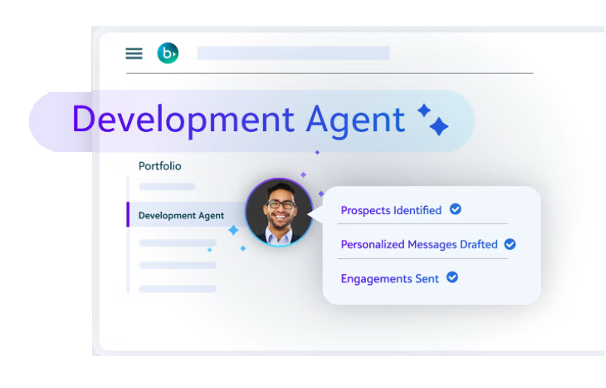
We’re using the Development Agent to accelerate donor connections and make those connections more impactful in a shorter period of time. This will help us accelerate fundraising across all giving levels.
Brian Otis
Vice President for University Advancement, University of New Haven
Agentic AI creates activity. Strategy still requires humans.
As capabilities mature, AI development agents do more than make recommendations. They take action: engaging donors at scale, running cultivation sequences, and optimizing outreach based on giving behavior. Some can even help grow giving by recommending the right amount to ask for and when to ask. But while an agent can initiate the next step, what it can’t own is strategy: priorities, relationship nuance, and the tradeoffs that shape fundraising.
Major donor fundraising in higher education is highly individualized—and often distributed across gift officers, deans, faculty, volunteers, and advancement leadership—which is exactly where agentic AI needs human direction. Even though an agent can recommend an ask amount and timing, the questions that move a prospect forward—why this initiative, why now, and through which relationship—still depend on human judgment shaped by institutional knowledge and frontline experience.
No platform—and no AI agent—holds the whole picture.
Even the most robust advancement platform represents only part of a prospect’s story, and agentic AI works with the data in that system. Effective prospect researchers draw from a broader ecosystem: foundation directories, public filings, business affiliations, philanthropic activity beyond your institution, and relationship history that may live outside any system of record that your AI can access.
Researchers act as curators and managers—validating automated signals, reconciling conflicting data, providing feedback to the AI agent, and pausing or rerouting next steps when something doesn’t add up—before it influences campaign strategy or portfolio decisions.
Technology only delivers ROI when someone owns the decisions.
This is where many institutions struggle. Organizations invest in platform enhancements, enable new capabilities, and generate dashboards—yet no one is clearly accountable for interpretation, decision-making, and governance.
- Recommendations go unreviewed
- Automations run unattended
- Exceptions pile up
- Outreach happens, but not always through the right relationship
The return on investment isn’t in the tool itself. It’s in what your team does with what the tool initiates. Prospect research is what turns AI activity into funded outcomes—adding context, defining guardrails, and redirecting efforts when necessary.
AI is the starting point. Institutional advancement is the finish line.
AI is already expanding human capacity, reducing manual effort, and surfacing patterns faster than ever before. Used well, it frees advancement teams to focus on higher‑value work: relationship building, strategic moves management, and philanthropic vision.
Used without human oversight, AI risks creating the illusion of progress—more activity, more touches, more tasks completed—without better decisions and outcomes.
The more useful question isn’t whether human expertise will still be needed as AI becomes more embedded in advancement platforms. It’s who will oversee, train, and manage the performance of the AI. That means designating an agent manager to provide feedback—just like you would for a new hire—and defining a specific, limited role for AI to start with so that the whole team (human and AI) can learn from each other.
When you pair AI with a skilled human partner, technology becomes a multiplier—and the work becomes more mission-centered, more focused, and more impactful.