Before the Big Ask: How to Use CRM Data to Find and Prioritize Major Gift Prospects

They say timing is everything, but a major gift rarely happens because a fundraiser simply asks at the right moment. It’s much more likely when you’ve done the work before the big ask: You’ve set the right goals, identified the right prospects, and used the right data to guide your next best action.
The good news is that you can do most of the pre-ask work in the CRM you use every day. Your donor database can be a practical decision-making tool that helps you focus your limited time on the people most likely to make a meaningful gift to your organization.
That matters because major gift fundraising is both personal and mathematical. It requires relationship-building, careful listening, and a compelling case for support. But it also requires knowing how many gifts you need, at what levels, from which prospects, and by what deadline.
Watch the Big Ask Workshop on demand
Before you dive into sorting names and building portfolios, let’s establish your starting point—the revenue goal.
Start with the Goal, Then Work Backward
How much does your organization need to raise? How much of that should come from major gifts? How many staff members can realistically manage major donor relationships?If major gifts account for a large share of contributed revenue for your organization, the top of the donor pyramid demands disciplined planning, not guesswork. A gift range chart can help you translate a revenue goal into the number of gifts and prospects needed at each level.
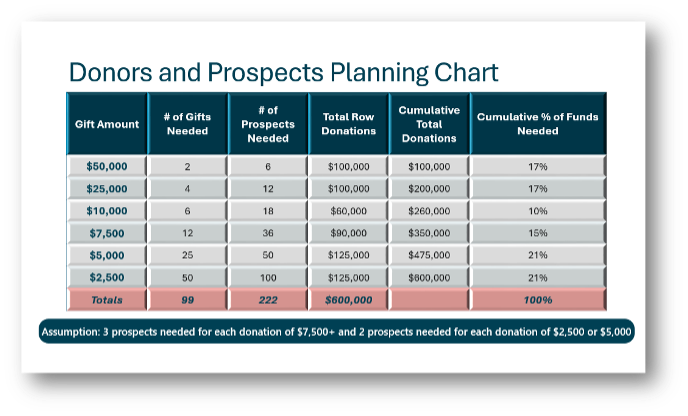
In this example, if your organization needs $600,000 from major gifts, you might identify gift levels from $2,500 to $50,000. From there, you can estimate how many gifts you need at each level and how many prospects you need to cultivate to secure those gifts. At the highest levels, you may need three prospects for every confirmed donor. At lower levels, a two-to-one ratio may be more realistic.
This exercise does three important things:
- It clarifies whether your goal is realistic based on your current prospect pool.
- It shows whether your fundraisers’ portfolios are aligned with the revenue you expect them to raise.
- It helps you spot gaps early so you have time to adjust.
If the math reveals that one fundraiser would need to manage nearly 200 prospects and close dozens of gifts, your plan is going to need some refinement. Consider a higher lead gift, a different portfolio split, additional staff capacity, or a more focused qualification process.
Use Data to Find the Right Major Gift Prospects
Once your goal is clear, begin prospect identification. This is where your CRM and supporting tools can help you move from “we need X number of major donors” to “these are the people most likely to be ready for a major gift conversation.”
The strongest prospect identification strategies combine internal data—what your organization already knows—with external data that adds context about capacity, philanthropy, and timing.
Internal Data: This Is What Your CRM Already Knows
Internal data is often overlooked because it can feel ordinary. But ordinary information becomes powerful when it’s consistently captured and reviewed.
Useful internal signals include:
- Giving behavior: consistency, upgrades over time, recent increases, gift designations, and areas of philanthropic interest
- Engagement: event attendance, volunteering, committee participation, and donor-initiated contact
- Relationship strength: board connections, staff connections, executive relationships, and links to programs or leaders
- Stage movement: documented outreach, past conversations, responses to invitations, next steps, and planned future actions
Giving history matters, but it should not be the only lens. If you rely only on frequency, recency, and monetary value, you may unintentionally exclude lapsed donors, new donors, volunteers, tribute donors, or non-donors who have strong affinity and capacity.
For example, a longtime volunteer who has not made a large gift may still be deeply connected to your mission. A recent event attendee may have come because a friend invited them—or because the mission speaks to them on a personal level. Your CRM should help you preserve those clues so fundraisers can ask better questions and build better relationships.
External Data: This Is What Adds Context
External data can fill in what your CRM can’t show on its own. Depending on your tools and vendors, this may include wealth indicators, philanthropic giving to other organizations, lifestyle signals, or predictive analytics scores.
Useful external signals include:
- Validated capacity: real estate holdings, estimated income, confirmed assets, or other indicators of financial capacity
- Liquidity context: securities holdings, business ownership or sale, retirement assets, or other non-real-estate assets
- Philanthropic behavior: giving to similar organizations, gift types, named gifts, planned gifts, endowments, scholarships, and giving club participation
- Life events and timing: retirement, changes in real estate, children graduating, business transitions, births, marriages, divorces, or deaths
- Donor personas or segmentation: models that help summarize likely motivations, financial profile, and philanthropic behavior
External data is most useful when it is connected back to your CRM. If screening information lives in a separate spreadsheet or research file that fundraisers rarely open, the insights may never translate into action. Your goal is a practical 360-degree view: what the person has done with your organization, what the data suggests they may be able to do, and where the relationship appears to be headed.
Do Not Mistake Wealth for Readiness
One of the most common portfolio mistakes is treating wealth as synonymous with readiness. They’re not the same thing. Capacity matters, but it is only one part of the major gift equation. Strong major gift prospects typically show three indicators:
- Propensity or affinity: They care about your mission, your work, or a related cause.
- Capacity: They have the financial ability to make a significant gift.
- Readiness: They are informed, engaged, open to conversation, and at a point where an ask would be appropriate.
A wealthy individual with no connection to your mission may not belong in an active major gift portfolio. A donor with capacity but no current engagement may need cultivation, not solicitation. A person who is deeply engaged but not ready for a major ask may require a different next step.
Some organizations create a simple readiness scorecard:
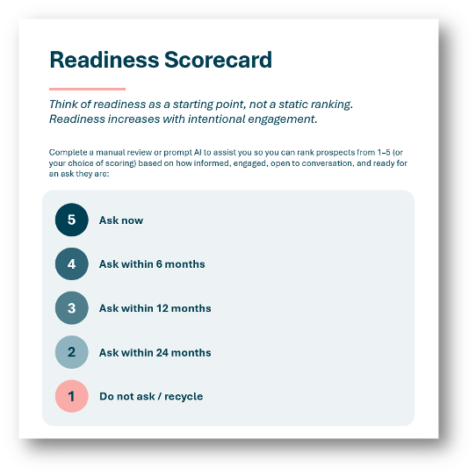
With readiness scoring, you’ll know if a prospect or current donor should be ready for a meaningful major gift conversation in the next three, six, or 12 months, or within two years.
Choose the Prospect Identification Method That Fits Your Team
The best method to identify major gift prospects depends on your CRM, your team capacity, your data maturity, and the tools available to you. Here are some excellent options.
1. Built-in CRM prospecting tools
Many donor management systems include prospecting tools, ratings, tags, or predictive insights that combine internal and external data. These tools can be especially helpful because they are always available and often integrated into fundraiser workflows.
The tradeoff is that the criteria may not be fully editable. That can be a strength if the model is based on robust analytics, but you still need to understand what the scores mean and how to act on them.
2. Self-directed queries and reporting
Teams can also build their own lists using queries, reports, and filters. This gives you control and allows you to move quickly. You can look for donors who have increased giving, attended events, responded to outreach, or shown interest in a specific program.
The risk is that self-selected criteria can be too narrow. If you only search for recent donors above a certain giving threshold, you may miss people with strong readiness indicators who do not fit that pattern.
3. Integrated third-party analytics
Some organizations use integrated third-party vendors that combine your internal data with external data and predictive modeling. These tools can be highly useful because they return scores, ratings, or recommendations directly into the CRM.
The downside is that analytics packages may return more data than your team can immediately absorb or use, so define in advance which fields will inform portfolio decisions, ask amounts, and next steps.
4. Stand-alone research or screening tools
Stand-alone tools can provide sophisticated screening and research, but they create extra work if the data doesn’t flow back into your CRM. When insights sit outside the system of record, fundraisers might miss them, duplicate effort, or overlook important relationship history.
Whatever method you choose, the goal is the same: identify prospects who have capacity, affinity, and readiness, then move them into an intentional plan.
Raise $101K in 3 weeks with LinkedIn data? See how it’s done –>
Turn Prospect Insights into an Action Plan
Identification is only useful if it leads to action. Once a prospect is qualified, document the details and action plan in your CRM:
- Assigned fundraiser or relationship owner
- Current stage in the donor journey
- Recommended ask amount or target gift range
- Target ask date
- Next meaningful action
- Key affinity, capacity, and readiness notes
- Recent interactions and donor responses
Dashboards and reports become essential at this stage. If you need 99 major gifts but only have 80 realistic opportunities in motion, you need to know that early enough to adjust. If too many prospects are stuck in cultivation, you need visibility. If your portfolio is full of donors who say yes to small gifts but never move toward major giving, you may need to release or reassign them.
Review your progress monthly or quarterly. The review should connect data to action:
- Are the right prospects assigned?
- Are ask amounts aligned with capacity and readiness?
- Are next steps documented?
- Are fundraisers spending time on the highest-likelihood opportunities?
- Do reports show progress toward the gift range chart?
See how Prospect Insights Pro gives major gift officers an edge: Read more–>
Don’t Overthink It
The most useful CRM records are not necessarily the longest. They simply capture the right information at the right time:
- What happened?
- What did the donor reveal about interests, timing, or concerns?
- What is the next step?
- Who owns it?
- When should it happen?
Uncomplicated, useful records really don’t need to do any more—or any less—than help you ask with confidence when the time is right.
Prep for the Big Ask Long Before the Big Ask
When you start with the goal, use data to identify the right people, assess readiness instead of wealth alone, and turn insights into documented action, the big ask becomes less of a leap and more of a natural next step. Following these steps can help you make better use of your time and raise more major gifts for your mission.
If you want to learn more about how AI can help you with the work leading to your next big ask, download the free infographic. It’s filled with around-the-clock fundraising tips specific to how major gift officers work every day.