5 Advantages of a True Total School Software Solution

Independent schools are under increasing pressure to do more with less—deliver exceptional academic experiences, ensure financial sustainability, deepen family engagement, and make confident, data‑driven decisions in a rapidly changing environment.
In response, many schools have added technology over time: one system for enrollment, separate SIS and LMS, a tuition payment portal, a fundraising CRM, and accounting software. Individually, these tools may work well. Collectively, they often create a patchwork that limits visibility, increases risk, and makes strategic leadership harder.
A true total school software solution takes a different approach—one that connects the entire school around shared data, shared workflows, and a strong financial foundation.
Here are five advantages of moving beyond a fragmented, patchwork environment to a truly unified system with intentional integrations that support every office and every person in your school community.
1. Financial Integrity, Compliance, and Trust—Built into the System
For independent schools, financial management isn’t just about efficiency—it’s about stewardship, compliance, and trust. Schools manage a complex mix of tuition revenue, financial aid, donations, endowment income, and restricted funds, all while meeting audit requirements and donor expectations.
In a fragmented system, financial data is often disconnected from enrollment and advancement, increasing the risk of inconsistencies, manual workarounds, and compliance gaps—especially when it comes to restricted gifts and fund-based reporting.
A true total school software solution includes robust financial and fundraising systems that strengthen the institution. Tuition collection, billing, fund accounting, restricted funds management, compliance reporting, and audit readiness are not bolted on—they are core capabilities. This allows schools to track how funds are raised, restricted, allocated, and spent with confidence, while maintaining the transparency required by boards, auditors, and donors. It also empowers schools with in-depth analytics across all revenue sources without having to merge reports.
Equally important is role-based access and data governance. In a connected school, everyone works from the same underlying data, but not everyone can change what another department relies upon. Consider that the business office may need to maintain a legal name for contracts, billing, and compliance, while educators or advancement teams may engage the same individual using a preferred name. Financial records tied to audits and reporting remain protected from accidental overrides.
This approach preserves a single source of truth while respecting the distinct responsibilities of each department—ensuring accuracy, accountability, and trust across the institution.
2. Schools Move from Managing Systems to Managing Strategy
Patchwork technology stacks demand constant attention: reconciling reports, managing integrations, troubleshooting data mismatches, and training staff on multiple platforms.
A total school solution reduces this operational burden by eliminating handoffs between systems. Data flows automatically across departments, reports reflect real-time information, and technology teams spend less time managing tools and vendors and more time focusing on outcomes. For example, if your SIS data flowed into your fundraising CRM, your advancement team would get new family information without manual imports and could more easily steward alumni as future donors.
For leadership teams, this shift is critical. When operational friction decreases, schools gain the capacity to focus on strategy—enrollment health, student success, donor engagement, and long‑term planning—rather than system maintenance.
3. Better Data Leads to Better Decisions—Across the Entire School
Fragmented systems make it difficult to answer essential questions about enrollment, finances, academics, and advancement—especially when data must be reconciled across platforms.
A true total school solution creates a single, trusted data foundation that connects your SIS and LMS with enrollment, advancement, billing, and finance. With consistent, shared data, leaders can move beyond anecdotal decision‑making and rely on insights that reflect the full student and family journey.
This holistic visibility is increasingly essential as schools navigate demographic shifts, geopolitical and economic uncertainty, tuition sensitivity, and rising expectations from families and boards.
4. Families Experience One School—With the Right Access for Everyone
From a family’s perspective, school software should feel simple, intuitive, and personal—even when family structures and financial responsibilities are complex.
A true total school software solution delivers a personalized, role‑based experience that reflects how families actually engage with a school. Each parent or guardian has their own secure login, with access tailored to their role and relationship to the student.
For example:
- Parents in different households can each view and manage their portion of tuition and billing, without seeing information that isn’t relevant to them.
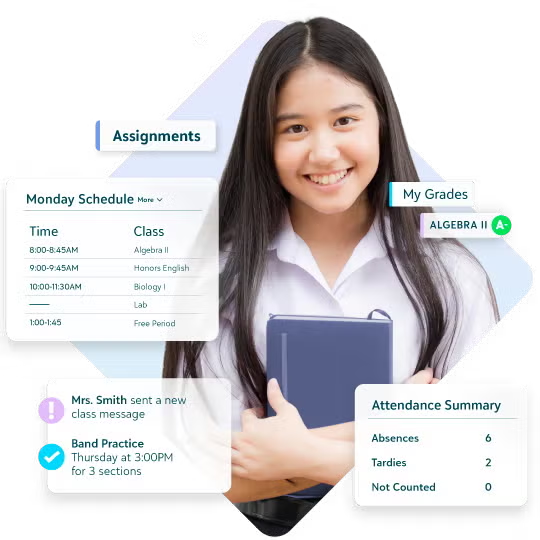
- Both can stay informed with access to grades, assignments, schedules, and school communications—based on permissions set by the school.
- Families with multiple children benefit from one login that brings together all their students’ information, providing a clear, consolidated view of academics, activities, calendars, and finances.
Behind the scenes, personalized dashboards and role‑based access ensure that everyone sees the same underlying data—but only what they are meant to see. The result is a family experience that feels cohesive and respectful, while protecting privacy, accuracy, and institutional integrity.
5. Schools Build for the Future, Not Just the Present
Schools must adapt. Programs expand, enrollment models change, and expectations around data security, transparency, and accountability continue to rise.
A true total school software solution is designed to grow with the institution, supporting new initiatives without introducing new silos. Because systems work together from the start—from enrollment and academics to financial and fundraising—schools gain flexibility without sacrificing control or clarity.
Instead of constantly re‑stitching systems together, leaders can focus on innovation, mission delivery, and long‑term sustainability.
What Makes a Total School Solution Truly “Total”
School technology, like schools themselves, evolves over time. What matters is whether your systems are intentionally designed to work together.
A true total school software solution connects academics, enrollment, advancement, and—most critically—your business office around shared data, clear governance, and defined roles. It delivers visibility without sacrificing control, and integration without compromising accuracy or accountability.
This distinction matters. Real connection isn’t about collapsing everything into one editable record—it’s about building a system that respects the responsibilities of each department while aligning the entire institution around common goals.
When technology is thoughtfully integrated and grounded in financial integrity, schools gain more than efficiency. They gain clarity, confidence, and the ability to lead with purpose—today and into the future.