Beyond the Audit: Best Practices to Build and Strengthen Your Relationship with Your Audit Firm

Transparency and communication between you and your auditor help ensure the financial integrity of your books and records, as well as regulatory compliance. By maintaining open communication with your auditor throughout the year—instead of only during the annual audit—you can support a more efficient audit process and better identify audit-related questions before they become issues.
Before making significant operational changes, consider discussing the potential audit implications with your auditor so your organization can identify related documentation, control, or compliance considerations early.
Why You Need a Year-Round Relationship with Your Auditor
Change management has not historically been an area where nonprofits consult their auditors, often modifying or overhauling their systems and controls without first discussing potential audit implications with their audit firm.
If the audit team is engaged only during the annual audit, audit teams may be caught off guard by these changes, unaware of newly implemented accounting systems, changes in the chart of accounts, or in processes and management roles. This often leads to additional time spent in discussions with management or in documenting their understanding of the changes.
Maintaining communication with your audit firm throughout the year is even more important with the speed of technological change. Most nonprofits are navigating new technologies, such as tools driven by artificial intelligence (AI), along with new cybersecurity risks. Other challenges are accelerating as well, including turnover in staff forcing revised workflows, increased remote work environments across different states, and even additional compliance requirements related to new funding sources. Any one of these changes or process modifications may have a significant impact on a nonprofit’s financial reporting, internal policies and controls, or its audit approach and readiness.
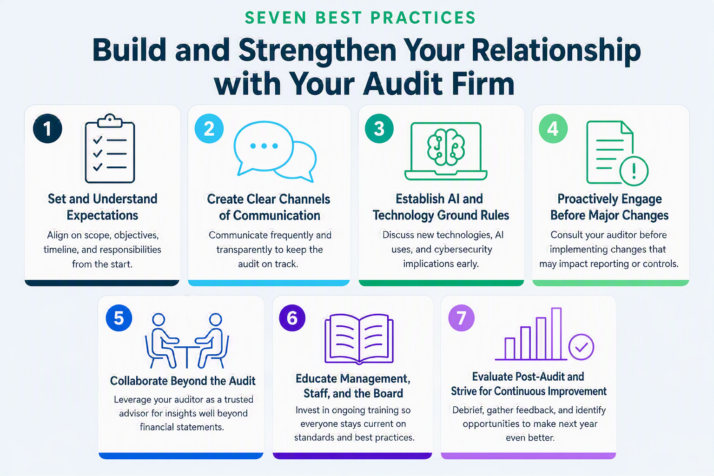
Seven Best Practices to Expand Your Audit Relationship
Nonprofits and audit firms need now, more than ever, to share and leverage their diverse experiences to better collaborate with one another. Below are seven best practices your nonprofit should adopt to increase collaboration and enhance the relationship with your audit firm, all to help strengthen your organization and fulfill its mission.
1. Set and Understand Expectations
At the outset, both your nonprofit and audit team should agree on the scope, objectives and timeline of the process, as well as who is responsible for each task. By setting expectations early, your organization and audit team can adequately prepare for, address, and streamline not just the audit process, but also any issues or questions that may arise during the year.
Items to note and discuss during your audit planning process include new or unusual transactions, changes in your control environment (including the adoption of AI-driven processes or uses), as well as newly issued accounting principles or regulatory changes.
For example, one nonprofit client continuously recorded its contributions incorrectly. To alleviate the need to adjust entries during the audit, we established a process for management to consult with the audit team on the accounting considerations for substantial contributions before year-end. After a handful of discussions, the client understood the mistakes and was eventually able to properly record the contributions on its own.
2. Create Clear Channels of Communication
Effective communication is the foundation of any successful relationship. With most audit work performed remotely or with a hybrid schedule, clear and frequent communication before and during the audit will help ensure that your audit will progress smoothly. Many nonprofits have shifted to regular monthly or weekly status check-ins with their auditor. This allows for smoother and more efficient audits.
And while remote meetings, secure portals, and virtual status updates can make the audit process more efficient, there is still value in having auditors spend time onsite for meetings with finance leadership, the board, or audit committee. In-person time can help an audit team better understand a nonprofit’s culture, operations, and control environment. It can also help newer members of management and the audit team build a stronger professional relationship that sometimes can be hard to develop through virtual engagements alone.
Weekly Check-Ins as a Catalyst for Collaboration
One nonprofit client was struggling to meet financial reporting deadlines, which caused its audit to fall behind the agreed-upon timeline. The executive director and audit partner discussed ways to improve the process and implemented weekly audit check-ins so both teams could collaborate toward timely completion. As a result, the audit was completed by deadline for the first time in years and the nonprofit has become more efficient.
Onsite Sessions to Strengthen Audit Understanding
We were newly engaged by a new nonprofit client during the pandemic, when all communication was virtual. Once travel restrictions were lifted, our audit team performed onsite work, which helped us better observe the organization’s operations, deepen our understanding of its control environment, and build a stronger working relationship. Over time, the nonprofit came to regard us less as a vendor for audit and tax services and more as a trusted advisor. That relationship also allowed us to connect the client with other members of the firm who specialize in state and local tax, cybersecurity, and enterprise risk management.
3. Establish AI and Technology Ground Rules
According to the Blackbaud Institute, 85% of the not-for-profit professionals surveyed use AI at work, and 50% of organizations are using AI more in 2026 than in the prior year.
Many nonprofits we serve use AI tools to draft communications, summarize documents, assist with grant applications, prepare board materials, or support routine finance functions. Without a doubt, these tools, if utilized properly, can create efficiencies within any organization. But their use can also raise important questions related to confidentiality of information, accuracy of outputs, and security around internal controls and data.
For these reasons, you should develop an AI usage policy that clearly defines how AI tools may be used—and where they should be restricted—for your nonprofit. Your auditor can be a valuable resource to help management think through the control implications of AI or even provide potential sample use policies for your organization to initiate.
To prevent unnecessary risk and maintain strong internal controls, discuss, early in the audit process, how your audit firm will use technology and AI during the audit. This should include what safeguards are in place to protect sensitive information and whether there are any expectations for how documents or schedules should be prepared and shared.
Also consider maintaining an inventory of AI tools used by employees and the purposes for their use. This is especially important when AI is used in connection with finance, grants, donor communications, human resources, board reporting, or compliance. The organization should be clear about when AI may and may not be used, what information may never be entered into an AI tool, and who is responsible for reviewing the output. AI should not replace management judgment, source documentation, or appropriate review.
Because AI tools are evolving at a rapid pace, your AI usage policy should be a living resource that management routinely revisits to determine whether approved tools, prohibited uses, review procedures, and data-security expectations remain appropriate.
4. Proactively Engage Before Major Changes
Auditors can be a great resource regarding system modifications, technology upgrades, or significant organizational changes. Proactively engaging with your auditor when your organization is considering a major change can help management consider potential audit implications, risks, and documentation needs that might not have been identified.
Here are some examples of critical times to seek guidance from your audit firm and why they are important:
Implementing New Accounting Systems
Implementing a new accounting system is an expensive decision for your nonprofit. Your auditor may be able to share observations from working with various systems and highlight audit-related considerations. Your new system should be right-sized and capable of providing all the reporting tools necessary to make important decisions.
Receiving New Funding
If your organization is considering a new funding stream or receives a larger award than usual, speak with your auditor about potential operational repercussions. Whether the funding comes from the federal government, a private foundation, or through a financial institution, it’s imperative to understand if there are new audit requirements, restrictions, or filing deadlines. Having conversations with your auditor in advance can help your organization be well-prepared for changes.
For example, a new executive director at one nonprofit client wanted to expand the organization’s revenue sources to include federal grants for the first time. Before applying, the executive director contacted us to discuss the opportunity and seek recommendations for any changes needed to the organization’s systems, software, and internal controls. That proactive communication helped the nonprofit prepare for federal funding requirements and avoid common surprises and roadblocks.
5. Collaborate Beyond the Audit
Audits are a team sport! Think of your auditors as teammates and partners highly trained to assist your organization in achieving its goals. Auditors possess valuable insights and expertise that can extend far beyond the presentation of your financial statements. You can use discussions with your auditors to better understand audit observations, control-related considerations, and potential risk areas identified during the audit process.
For example, many nonprofits have employees who continue to work remotely and, at times, move to a state where the nonprofit has not historically maintained a physical presence. This new arrangement may create issues for payroll and tax withholdings. Or an employee might fall victim to a cyberattack, such as a phishing scheme, and put your systems at risk.
While these matters may fall outside the financial statement audit, your auditor may be able to connect your organization with specialists who can assess their impact.
6. Educate Management, Staff, and the Board
Your nonprofit organization should invest in training and continuing education for staff members on a regular basis. This can help ensure that your nonprofit remains compliant with not just current or future accounting standards, but also with applicable regulatory requirements, such as:
- Donor restrictions on contributions
- Federal compliance with requirements imposed on grants provided by the federal government
- Updates to your fund accounting software that might change how you access reports or track your projects
- Implementation of AI and how nonprofits use and optimize it
Audit firms often offer educational workshops, seminars, webinars, and newsletters to help their clients and the nonprofit community gain clarity on their issues and opportunities. Nonprofits should also understand the training resources offered by their technology vendors, which can help them better use software features and functionality.
Because problems and solutions are constantly evolving, this training should be ongoing and not one-and-done. It should also not be limited to just the finance department. Development, program leaders, human resources, executive leadership, and others all play a role in an organization’s control environment and should stay current on changes within the nonprofit industry.
7. Evaluate Post-Audit and Strive for Continuous Improvement
Once your audit is complete, your nonprofit should conduct a post-audit evaluation, both internally and with your auditors. Use this evaluation to assess the effectiveness and efficiency of the audit, identify areas for improvement, and reflect on the audit process to better prepare for future audit engagements. Make sure to incorporate the following items in your post-audit review:
The Management Letter
Review and discuss the management letter issued by the audit firm, both internally and with the audit firm. This is especially important if there are significant audit findings. While this letter can sometimes be perceived as critical of a nonprofit’s management, the intent of the letter is to provide guidance and improve the organization’s control environment.
Address the findings with clear, concise, and documented corrective action plans. We have seen instances where management used the findings reported by auditors to corroborate their own concerns in discussions with the board.
A Look Forward
The post-audit evaluation should also be used to look ahead and obtain clarity around critical areas and answers to key questions:
- Were there challenges encountered by the organization gathering information?
- Were schedules reviewed and reconciled correctly?
- Did a new system implementation create reporting issues not previously encountered?
- Are there areas outside the financial audit, such as cybersecurity or vendor-risk matters, that should be discussed with the board?
Asking these types of questions and evaluating the audit results can turn the audit from an annual compliance exercise to a roadmap for continuous improvement and success.
Better Relationships Mean Better Business Decisions and Better Outcomes for Your Cause
Your nonprofit organization needs a strong auditor relationship, especially one built on trust and year-round continuity.
Nonprofits are being asked to do more with their resources than ever before, while managing new risks related to AI, remote working, tax compliance, and many other issues that are present throughout the year—not just during the annual audit.
Having an audit firm that not only understands how your organization operates but also understands its mission is key. Such an understanding will not only enhance the audit, but also allow the firm to share relevant insights and industry best practices that may help your nonprofit strengthen its operations. This relationship is an important component of success for any organization—and one that its audit firm would genuinely welcome.
Looking for more resources to help you set your organization up for audit success? Explore our audit toolkit with best practices and a checklist to help you use your technology to streamline your audit.