Building Trust in AI-Enabled Grantmaking: A Framework for Organizations

When used with clear ends and principles, AI has the power to become a true force multiplier for grantmakers looking to become more strategic and equitable with their grantmaking. It can help program officers synthesize hundreds of grantee reports, surface patterns across a portfolio, and uncover insights that would otherwise stay buried in spreadsheets and PDFs.
But realizing this promise in a high-stakes environment starts with earning and maintaining trust. Grantmaking boards and leadership teams are asking reasonable questions: How do we know AI’s recommendations are sound? What happens if the technology gets it wrong? And, perhaps most importantly, how do we maintain the human judgment and community relationships that make philanthropy effective in the first place?
These questions deserve serious answers.
After working with foundation leaders across the country, we’ve found that the organizations making real progress with AI aren’t the ones with the biggest technology budgets or the most ambitious deployments. They’re the ones who’ve thought carefully about trust and built the internal and external systems necessary to earn and maintain it.
Here’s a framework that can help your grantmaking organization do the same.
Lead with Principles, Not Tools
The most common mistake we see grantmaking organizations make is starting with a technology and then trying to figure out where to apply it. That gets the order backwards.
Before you evaluate any AI tool, get clear on the outcome you are trying to achieve, and what you can and can’t delegate to technology to achieve that outcome. Some tasks are genuinely enhanced by AI, such as synthesizing large volumes of grantee reports, drafting initial communications, and identifying patterns across your portfolio. Other decisions require human judgment that no algorithm should replace, like making decisions about an organization’s leadership, weighing community context, and making judgement calls on politically sensitive funding areas.
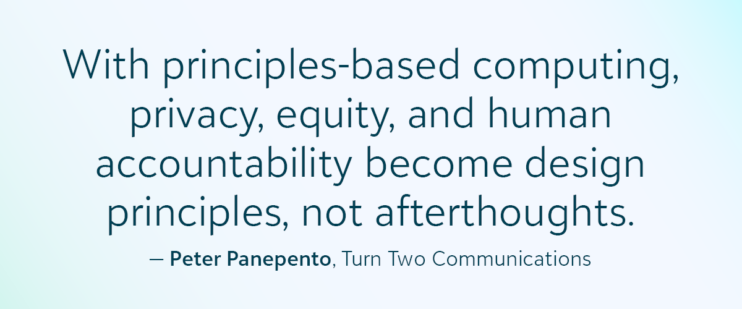
A growing number of grantmaking organizations are turning to an emerging approach known as principles-based computing developed by Brett Horvath and the team at empire to help draw these lines clearly. Rather than rolling out a tool first and bolting on guardrails later, principles-based computing starts with explicit agreements about what the technology should and should not do and embeds those choices into how staff actually use it. With principles-based computing, privacy, equity, and human accountability become design principles, not afterthoughts.
To do this well, organizations must treat AI as a capable assistant with real limitations rather than an oracle that removes the need for judgment.
Design for Transparency
Trust erodes quickly when people don’t understand how decisions are being made. That’s true for your staff, your board, and the grantees who depend on you.
For internal transparency, make AI use visible. If your team uses AI to evaluate applications, document your process in natural language so it is easy for everyone to understand. If AI-generated analysis informs a funding recommendation, note that in the write-up. While this may feel like you’re adding a layer of bureaucracy to the process, you’re actually preserving your ability to understand, question, and improve your processes over time.
External transparency matters, too. Grantees increasingly want to know how their applications are being reviewed. You don’t need to reveal proprietary methods, but being straightforward about AI’s role builds trust with the organizations you fund. It can go a long way to include a simple statement in your guidelines explaining that AI may assist with initial review while human program officers make all funding decisions.
By grounding all of this in natural language, you’re documenting the principles that govern your AI use in terms that are not only consistent with how your board and grantees understand information, but it’s also language that your AI tools can follow.
Some foundations worry that being open about AI use will invite criticism. In my experience, the opposite is true. Opacity invites suspicion. Clarity, even about imperfect processes, builds confidence.
Keep Humans at the Center
Here is a useful principle to keep in mind as you map your AI-assisted workflows: AI proposes, humans decide.
In practice, that means designing every workflow with explicit moments where a person reviews, validates, and takes responsibility for AI-assisted work. Not as a rubber stamp, but as a genuine decision point where judgment is applied.
Consider a typical grantmaking workflow. AI might help with initial eligibility screening, but a human confirms before any application is rejected. AI might summarize an organization’s track record, but a program officer reviews and refines it before it reaches the grants committee.
The goal isn’t to slow things down with unnecessary review. Instead, we must ensure efficiency gains don’t come at the cost of accountability. When something goes wrong—and eventually something will—you want to be able to trace what happened and who was responsible for the decision.
Watch for What AI Can’t See
AI tools are trained on historical data. They’re excellent at finding patterns in what has happened before. They’re far less capable of recognizing what’s missing from the data, or what should be weighted differently going forward.
This matters enormously for equity in grantmaking. If your historical funding patterns underrepresent certain communities or types of organizations, AI trained on that data may quietly perpetuate those patterns.
Without intentional effort, it may not flag the gap. It will simply optimize for what it learned.
Human judgment is essential for asking the kinds of questions an algorithm won’t ask on its own:
- Who isn’t in this data?
- Whose applications might look different from our historical “successful” grantees, not because they’re weaker, but because they represent communities we haven’t adequately served?
- What context is this analysis missing?
Build regular equity reviews into your AI-assisted processes. Look at outcomes by community, organization size, and geography. If patterns emerge that concern you, adjust. And remember that AI won’t do this work for you. You need to guide it.
Invest in Your People
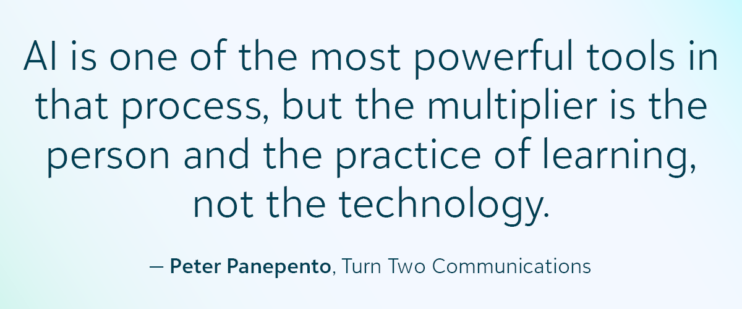
The best leaders we work with are intentionally building what we think of as “learning multiplier” cultures—environments where staff are developing the skills and habits to learn faster, apply what they learn to real work, and share what they discover with their colleagues. When a program officer figures out a better way to analyze grantee reports and teaches three teammates to do the same, that’s a learning multiplier in action. AI is one of the most powerful tools in that process, but the multiplier is the person and the practice of learning, not the technology.
This requires investment. Staff need training on how to use new tools, how to evaluate AI outputs critically, and how to share what they’ve learned with peers and even grantees. They need time to experiment and learn. And they need the psychological safety to flag when something doesn’t look right, even if an algorithm produced it. This is at the heart of the model for the Community Foundation Alliance Infrastructure Fund, a project we’re developing in partnership with empire to help community foundations co-develop principles-based AI.
The ultimate goal is to help teams treat AI as a powerful extension of their capabilities and not a black box they defer to.
Help your team build confidence with formal training. Sign up for the free AI for Social Impact certification to build practical skills tailored to nonprofits and social impact organizations. This platform-agnostic course is an initiative of the AI for Social Impact Coalition.
The Stakes Are Real
Grantmaking organizations exist to serve communities. The decisions you make, such as who gets funded, who doesn’t, and how resources flow, have real consequences for real people.
AI can help your foundation make better decisions, surface insights you’d otherwise miss, and free up time for the relationship-centered work that matters most. But this happens only if you’re thoughtful about building trust at every level: with your board, your staff, your grantees, and the communities you serve.
The foundations that get this right will be the ones who adopt AI-powered tools most thoughtfully—with principles, transparency, human judgment, and accountability built into every step.
That’s the opportunity in front of us. And it’s worth getting right.
Continue the conversation around trust and AI-enabled grantmaking with the webinar, AI in Grantmaking: Building Trust While Driving Impact.