How Connected Fundraising and Finance Systems Simplify Nonprofit Reconciliation

Who doesn’t love the last-minute scramble to locate missing invoices or track down uncashed checks so you can finish your month-end close?
A good reconciliation process keeps your financial records accurate and up to date. But without the right systems, this process can be mind-numbingly time-consuming and prone to errors.
Connected fundraising and finance systems help reduce the manual work between gift entry and financial reporting. Instead of asking development and finance teams to translate data between systems, connected systems help information move more consistently from the fundraising record to the accounting record, giving teams a clearer path from contribution to close.
Why Nonprofit Reconciliation Gets So Complicated
Reconciliation is the process of matching financial records from different sources, such as gift records, invoices, and bank feeds, to ensure consistency and accuracy. And it sounds straightforward on paper. You confirm that transactions, gifts, invoices, and bank records all tell the same story.
In practice, the process often spans multiple systems, teams, and reporting requirements. A single gift may need to be recorded in a fundraising platform, reflected accurately in the general ledger, aligned with donor restrictions, and verified against bank activity. Every handoff introduces another opportunity for delays, duplicate work, or mistakes.
Finance teams have processes for these steps. But those processes were developed around disconnected systems. Staff export data, reformat spreadsheets, double-check balances, and repeat the same validation steps month after month simply to maintain confidence in the numbers.
For organizations managing restricted funds, grants, scholarships, endowments, or multiple programs, the stakes are even higher. Accurate reconciliation should demonstrate accountability and show that resources are being used as intended—not just check the box that you’ve closed the books.
Common Reconciliation Challenges for Nonprofit Finance Teams
Reconciliation should help teams confirm accuracy and maintain confidence in their financial records. When a large portion of the effort goes toward locating, transferring, and validating information, the work becomes harder to scale and more difficult to manage consistently.
Too much time spent moving data
Every time information is entered, exported, reformatted, or uploaded into another system, staff spend time managing data instead of analyzing it. Reentering information creates additional review work because teams must verify that records remain consistent across systems.
Spreadsheets become critical infrastructure
Spreadsheets are useful tools. But they shouldn’t be the bridge between your fundraising and financial systems. When they are, staff must maintain formulas, track versions, and confirm that exported data still aligns with source records. As reporting requirements grow, those manual processes become harder to sustain and more difficult to audit.
Audit trails become harder to follow
During your annual audits or month-end review, finance teams need to trace transactions back to their source.
When information passes through multiple files, exports, and manual adjustments, reconstructing that history takes additional effort. Even when everything is accurate, proving that accuracy can consume valuable time.
Month-end close takes longer than it should
Closing the books requires confidence that records are complete and accurate. When reconciliation depends on gathering information from several systems, finance teams often spend part of the close process locating data, validating balances, and resolving discrepancies before they can focus on analysis and reporting.
How Connected Systems Support Better Reconciliation
A connected fundraising and fund accounting ecosystem creates a more direct path between fundraising activity and financial reporting. Instead of requiring teams to recreate information in multiple places, connected systems help maintain continuity between the gift record, the fund, and the financial transaction.
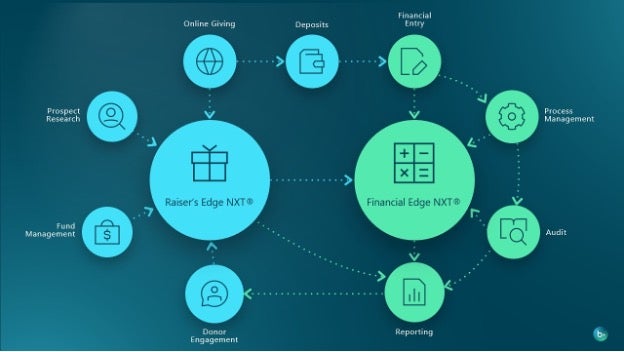
That continuity can improve reconciliation in several important ways.
A more consistent flow of information
When fundraising and finance systems share information, teams spend less time preparing data for transfer and more time reviewing results. Information remains connected to its source, making it easier to understand where transactions originated and how they should be reported.
Greater confidence in financial records
Reconciliation works best when teams can trace activity without relying on personal workarounds or institutional knowledge. Connected systems help establish consistency by reducing the number of manual steps between gift entry and financial reporting. That consistency supports stronger controls and more reliable reporting.
Better visibility across teams
Development and finance teams often need different information, but they rely on many of the same underlying transactions. Connected systems help create a shared understanding of those transactions so teams can resolve questions more quickly and spend less time validating information that already exists elsewhere.
Clearer audit readiness
When records remain connected throughout the process, organizations have an easier time demonstrating how funds were received, recorded, and used. That visibility supports not only audits but also board reporting, grant reporting, donor stewardship, and internal oversight.
What a Connected Reconciliation Process Looks Like
Consider a gift designated for a specific program. In a disconnected environment, staff may need to record the contribution in one system, export information for finance, translate coding structures, and manually verify that everything lands in the correct place.
In a connected environment, the same contribution follows a more direct path. Information entered by development remains linked to the corresponding financial records, giving finance teams greater visibility into how funds should be tracked and reported.
At the Polytechnic School, for example, the advancement and finance teams work in a connected ecosystem on Blackbaud Raiser’s Edge NXT and Blackbaud Financial Edge NXT. The fact that the data moves seamlessly from one system to another has increased collaboration and decreased administrative burden. “Technology can greatly streamline efficiency,” said John Yen, the Director of Technology at Polytechnic School. “Shifting from administrative tasks to meaningful connections with people fosters relationships and integrates staff more deeply into a school’s culture.”
What’s Next for Reconciliation
Connected systems remove many of today’s most time-consuming reconciliation challenges. The next wave of innovation focuses on reducing the effort required to review and resolve exceptions.
For example, Blackbaud’s product roadmap for Financial Edge NXT includes a reconciliation assistant tool designed to match transactions and suggest clears, helping finance teams spend less time manually reconciling activity.
If reconciliation at your organization still depends on manual exports, spreadsheet workarounds, or duplicate data entry, examining how information moves between your fundraising and financial systems is a practical place to start.
Read our guide, “Why Your Fundraising and Finance Systems Are Telling Different Stories and How to Fix It,“ to explore strategies for creating a more connected approach to financial management.