Show Your Auditors Some Love: How to Stay Audit-Ready All Year Long

If you work in nonprofit finance, you know the annual financial audit can bring a flurry of requests, late-night document searches, and last-minute reconciliations. Shifting into “audit mode” once a year, scrambling to pull together what auditors need while trying to keep daily operations moving, is nothing short of stressful.
But it doesn’t have to be this way. A smooth audit starts with the habits you follow every month. When you build audit‑readiness into your month-end close, you remove the stress, strengthen your internal controls, and gain more confidence in your financial information all year long.
Read on to learn why audit readiness matters, what auditors look for, and how your month-end process can become your most valuable tool for audit preparation.
Why Audit Readiness Matters More Than You Think
An annual financial audit gives your stakeholders confidence. Funders, lenders, boards, and donors rely on audited financial statements to understand your organization’s financial health and stewardship. Even if your audit is required by law or by a grant agreement, it can also bring insight into your accounting processes and internal controls.
When you stay audit-ready throughout the year, you position your organization for success. You gain:
- Cleaner, more reliable financial information
- Better decision-making supported by accurate data
- A faster, more efficient audit
- Fewer disruptions to your team
- Increased trust from funders and your board
But the risks increase when you are unprepared. You may experience:
- Material audit adjustments
- Delays in report issuance or Form 990 preparation
- Findings that highlight weaknesses
- Higher audit fees
- Strained auditor relationships
- In serious cases, delayed or jeopardized funding
With stakes this high, it helps to understand how auditors work. Knowing what auditors look for is the first step toward proactive preparation.
What Auditors Look For: How You Can Prepare Ahead of Time
Auditors begin by understanding your organization. They ask questions, assess risk, and determine what areas may need deeper testing. During fieldwork, they test your internal controls and review transactions to ensure your financial statements are fairly presented.
Here are the procedures you can expect, and how to prepare for them in advance:
Bank reconciliations: Auditors test your bank accounts to verify the accuracy of your reported cash. Keep your reconciliations current and attach supporting documents.
Fixed assets: They review whether you have properly accounted for assets, improvements, and repairs. Maintain a schedule of additions, improvements, and disposals and retain all invoices.
Receivables: Auditors may confirm amounts with donors, customers, or grantors to assess collectability and whether you need an allowance. Track pledges and discuss collectability regularly.
Unrecorded liabilities: This test ensures your payables are complete. Review subsequent disbursements and unpaid invoices each month.
These are the same activities you perform during your month-end close. Completing them consistently helps you avoid surprises and slowdowns during audit fieldwork.
Your Month-End Close: The Engine of Audit Readiness
Your month-end close is the foundation of audit-ready financials. Following specific steps every month helps you create a complete audit trail and build the documentation auditors need.
A strong month-end close includes three parts:
1. Record transactions
Capture all activity for the month, including:
- Bills and payments
- Credit card charges
- Payroll
- Revenue, pledges, and grant activity
- Journal entries for recurring adjustments
Accurate coding and timely entry give you reliable data and reduce the number of audit adjustments.
2. Reconcile accounts
Reconciliations are the heart of audit readiness. Each month, reconcile:
- Bank, investment, and credit card accounts
- Donor databases and payment platforms
- Grants and major contracts
- Payroll accruals
- Any high-risk or high‑volume accounts
Some schedules, like prepaid expenses or depreciation, may not need monthly reconciliation, but build them into your quarterly or semi-annual process.
3. Prepare reports
After you record and reconcile, prepare:
- A preliminary and adjusted trial balance
- Balance sheet and income statement
- Board or management reports
- Notes or variance explanations
Save everything in a consistent folder structure. Over time, you build a complete record that mirrors what auditors request.
Some nonprofits may find they lack the in-house expertise for a strong month-end close. Outsourced accounting services and training are flexible, affordable solutions if you are in this position.
How to Turn Your Month-End Close into an Audit-Ready System
Aligning your monthly tasks with your auditors’ expectations puts you ahead of the game for audit season. Here are a few additional habits to add to your existing process:
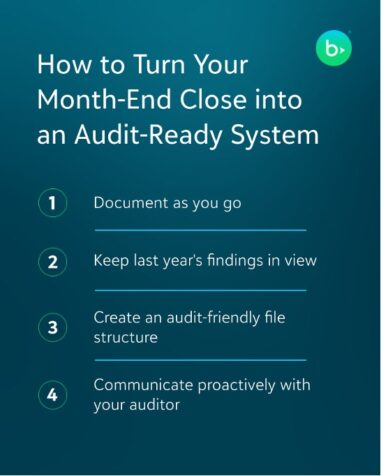
Document as you go
Attach support to material revenue and expense transactions, and update schedules for all your balance sheet accounts during the month.
Keep last year’s findings in view
If auditors identified issues last year that can be strengthened through monthly discipline, fix those items in your current month-end checklist. This shows your auditors that you are monitoring and improving the area consistently.
Create an audit-friendly file structure
Use a centralized folder where you store:
- Monthly bank reconciliations
- Financial statements
- Balance sheet schedules
- Major contracts and agreements
- Board minutes
- Grant documentation
A consistent system saves hours during audit season.
Communicate proactively
Let your auditors know about major changes throughout the year, such as new debt, new systems, unusual transactions, or leadership transitions. This helps them plan the audit appropriately and become your partners in strengthening your organization.
Why Year-Round Audit Readiness Pays Off
When you stay audit-ready all year, you gain more than a smooth audit. You build a stronger finance function. You also get reliable, timely information that supports internal decision-making.
The ongoing practice of audit readiness demonstrates professionalism and shows you take financial stewardship seriously, and the key to audit readiness is a strong month-end close. Take stock of your current process. Are you recording, reconciling, and reporting in accordance with best practices? Could you level up your documentation, file organization, or auditor communications? When your month-end close is strong, your audit becomes confirmation of good work, not an examination of weaknesses.
Most importantly, staying audit-ready supports your mission. It ensures your financial information is accurate, trustworthy, and ready to guide the decisions that matter most.
If you want to learn more about keeping your financial processes audit-ready throughout the year, check out the webinar, Show Your Auditors Some Love! Stay Audit Ready All Year-Round.
_________________________________________________________________________________
Blackbaud Financial Edge NXT® helps nonprofits, foundations, and educational institutions manage their restricted funds to improve stewardship, reduce risk, and make better data-driven decisions.