Solving the Quiet Problem: Turning Your CHC’s New Financial Infrastructure into True Cost Intelligence

You wisely used Rural Health Transformation Program dollars to build a modern data warehouse and business intelligence layer for your community health center. That was a smart, forward-thinking move. You now have the infrastructure to pull data from your fund accounting system, your EHR, payroll, grants, and every other system.
But the harder part that catches most CHC finance teams off guard is actually using that infrastructure to understand, control and report on your true costs. This is the quiet problem many organizations face after the warehouse goes live.
The Data Problem Is Bigger Than the Software Problem
You already know this pattern. You have modern systems—Blackbaud, current-generation EHRs, claims platforms. The software is no longer the main limitation.
The real issue is what’s flowing into those systems and what you can actually get back out. Multiple EHRs, HRIS platforms, separate timekeeping and payroll systems, home-grown datasets, and endless Excel files all feeding incomplete or inconsistent data. Even when the technology is current, the underlying data quality, integration and ongoing stewardship often remain broken.
This is why so many CHCs still cannot answer basic but critical questions with confidence: What does it actually cost us to deliver this service? Which service lines or locations are truly profitable? Where are we leaking money on the expense side?
What Decision Support Really Means for CHCs
Decision Support is the ongoing financial analysis layer that turns raw data into actionable intelligence. It is the work of experienced financial analysts who use your new infrastructure to build precise, discrete-level insights and then roll them up into whatever view leadership needs.
Decision Support starts with cost accounting—defining the actual cost of service at the most discrete levels possible. From there, you add revenue components, which allows your organization to build a mini-income statement at the service code level. You start with gross revenue, subtract contractual allowances and bad debt to arrive at net revenue, layer in expenses across any number of cost accounting buckets, and finally calculate true profitability at the most granular service level. From there you roll it up into service-line, location, or organization-wide views.
Just as important is knowing not only what your costs are, but what they should be. In a world of cost-based reimbursements, alternative payment models, and complex cost reports, this dual view is essential for maximizing allowable reimbursements and defending your position with payers and regulators.
As part of the Decision Support process, you create accurate net revenue forecasts, set meaningful benchmarks and performance metrics, build robust volume-based budgets, and calculate breakeven and ROI on major decisions. This also helps model and negotiate payor contracts with Blue Cross, Aetna or even MCO’s, so you understand the real bottom-line impact. Most importantly, this analysis answers the tough day-to-day questions every CHC leader faces, including whether you should buy this piece of equipment, open or close that clinic, hire that physician, or pay cash or finance.
You can finally tell the real story hidden in the numbers so leadership can act with confidence instead of gut feeling.
What One CHC Gained in Our Pilot
In our recent Ledger & Oak pilot with a rural health organization already running Blackbaud Financial Edge NXT®, we didn’t stop at building the data warehouse. We layered contracted decision support on top of it, bringing experienced financial analysts who treat the GL, chart of accounts, cost accounting structure, and data flows as true engineered infrastructure.
The results were immediate and measurable:
- Granular mini-income statements at the service code level, showing true profitability after contractual allowances, bad debt, and detailed expenses
- Clear views of both actual costs and benchmark “should-be” costs to strengthen reimbursement claims
- Precise revenue integrity findings paired with expense optimization opportunities
- Accurate, volume-based budgets and net revenue forecasts
- Faster, more confident answers to equipment purchases, clinic expansions, staffing, and payor contract decisions
- Dramatic reduction in time spent on manual reporting and cost report preparation
The contracted decision support model gave them enterprise-level expertise without adding full-time headcount or overhead. Once the infrastructure and decision support layer were in place, the real fun began. We started automating what used to be painful manual processes. In one recent Texas behavioral health community center engagement, for example, the finance team cut manual cost-report effort from two full weeks to less than 10 seconds while improving accuracy and compliance.
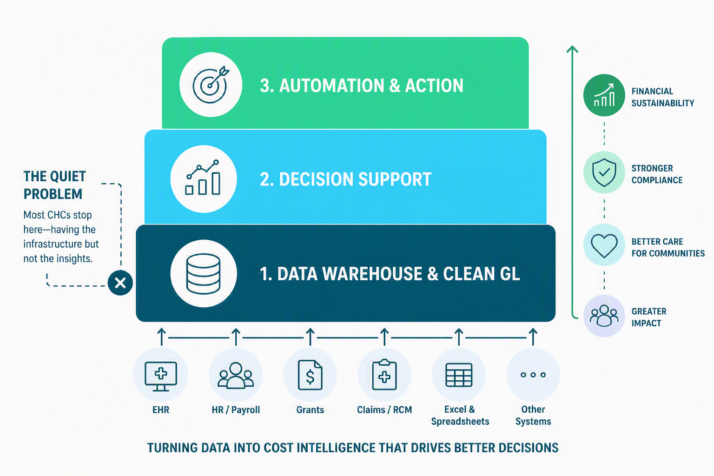
Your Three-Move Playbook for the Expense Side
Here is how you can turn your new infrastructure into real cost intelligence this year.
Move 1: Engineer Clean, Defensible Cost Foundations.
Use the warehouse to integrate and clean data from every source. Get the general ledger, chart of accounts, and cost allocation methodology right, which even easier when using a purpose-built fund accounting system with the flexibility to handle complex grant and project-based tracking. This is infrastructure work, not a one-time project.
Move 2: Add Contracted or Dedicated Decision Support.
Bring in experienced analysts (internally or through a contracted partner) who can build the discrete-level mini-income statements, actual-vs-should-be cost views, forecasts, benchmarks, and ROI models that your leadership needs. This is the multiplier that turns good data into great decisions.
Move 3: Automate and Operationalize.
Move from retrospective cost reports to automated, real-time processes. Use today’s numbers to guide equipment purchases, service-line strategy, staffing, and other high-stakes decisions.
Strong Foundations Aren’t Accidental
Revenue optimization and expense control must work together. When your CHC treats financial infrastructure, including the warehouse, the GL, the cost accounting foundation and the decision support layer, as something that must be deliberately engineered, you will emerge far stronger on both sides of the P&L.
Ready for a healthcare fund accounting system that can support your community health center’s growth and sustainability? Learn more about how Financial Edge NXT gives you the visibility into your complex revenue and expenses, so you can focus on improving health outcomes for your community.