Budget vs. Forecast for Nonprofits: Why You Need Both

You have a budget. It felt right when you built it. It was approved with buy-in from across your organization.
But now a grant payout is delayed. One of your reliable fundraising campaigns underperforms. A hiring decision needs to happen sooner than expected. And suddenly, the numbers that once felt solid don’t reflect what’s actually happening.
The problem isn’t your budget. It’s that you’re expecting your budget to act like a forecast. In a recent webinar, Stephanie Skryzowski, nonprofit CFO and founder of 100 Degrees Consulting, broke down the differences between a forecast and budget, and how to build a forecast that helps you reduce risk and make better decisions.
Why Your Budget and Forecast Should Be Separate
A budget and a forecast can look similar. They both deal with revenue, expenses, and financial expectations. But they serve completely different roles. And when they’re treated as interchangeable, your finance and leadership teams lose visibility right when they need it most.
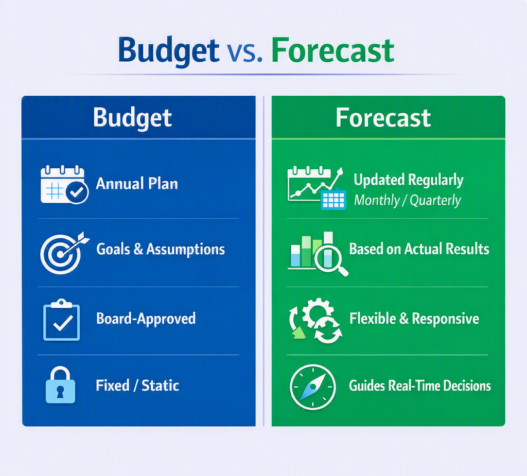
Your nonprofit budget tells you the plan, but your forecast tells you what’s actually happening and where you are headed. Your budget helps you set the direction of your organization. It’s created once a year based on the goals and assumptions you have for that year. It gets approved by the board and it’s designed to stay fixed.
A forecast, on the other hand, is designed to evolve. It should be updated monthly—or quarterly if your revenue and expenses are stable—based on actual results and changing conditions. Your forecast should be flexible and responsive because it is built to guide decisions in real time.
This is a functional distinction. A budget creates alignment at the start of the year while a forecast creates clarity throughout the year.
Where Nonprofits Get Stuck: Treating a Forecast Like a Second Budget
If the distinction is so clear, why do so many organizations struggle to maintain a forecast?
Because it often feels like doing the same work twice.
You’ve already built a budget. You’ve already gathered inputs, aligned stakeholders, and locked in assumptions. From a practical standpoint, forecasting can feel like reopening a finished project without a clear sense of what you’ll get in return.
So, one of two things tends to happen for many organizations. Either they deprioritize the forecast altogether, or they create the forecast once and then it is left untouched for the rest of the year. In both cases, the forecast quietly starts to behave like a second budget—static, outdated, and disconnected from what’s happening month-to-month.
But a forecast is a living tool that helps leadership teams understand what’s changing, what’s at risk, and what decisions need to happen next. And that shift—from document to decision-making tool—is where your organization will see real value.
How to Turn Your Budget into a Working Forecast
A forecast doesn’t replace your budget. It builds from it. Here’s how that works in practice.
Start with Your Budget as the Foundation
Your budget reflects the goals and assumptions your team aligned on at the start of the year. That makes it the best starting point because your budget represents the best information you had at a specific moment in time. Your forecast will build on that foundation as conditions change.
Layer in Your Actuals
Next, replace assumptions with reality. Pull in your year-to-date revenue and expenses for the months that have already happened. Now you can see where you’re already off plan and any gaps that need attention.
Update Your Assumptions Based on What You Know Now
You already know a grant you budgeted for was declined, but you’ve seen a boost from your peer-to-peer fundraising, and you are already planning to push back a new hire until later in the year. Instead of carrying forward outdated assumptions, you adjust based on those changes.
You don’t have to know every future assumption to the penny. Understanding the broad strokes helps you see potential issues down the road.
Project Forward and Extend Your Visibility
With updated assumptions in place, you then project forward. Many organizations extend this into a rolling 12-month view to maintain visibility beyond the current fiscal year. This working forecast helps you answer questions such as:
- When does cash get tight?
- How far in advance can you see a potential gap?
- What can you change now to avoid a problem later?
The further out you look, the more approximate your assumptions will be. But it will get you asking the right questions that can prepare you for most scenarios.
Make it a Habit, Not a One-Time Exercise
A forecast only works if it stays current. That means updating it regularly, adding actuals, adjusting assumptions, and reviewing what’s ahead. Without that discipline, a forecast becomes another static document. An unmaintained forecast can create false confidence.
With it, your team can move earlier, act with more context, and make decisions before issues escalate.
Start with Strong Budgets and Real-Time Data
A forecast is only as strong as the information behind it. That starts with a solid budget and access to real-time actuals.
In a fund accounting system, those pieces are already connected. Your budget lives in the same place as your revenue and expenses. You can see performance by fund, program, or department without rebuilding reports or stitching together spreadsheets.
That foundation makes forecasting easier to act on. You’re not chasing down numbers or reconciling exports. You’re starting with structured budgets, pulling in current actuals, and making decisions based on what’s happening now.
For many organizations, that still means working in Excel® to extend projections or model different scenarios. But the heavy lift—building the budget, tracking performance, and keeping your data aligned—doesn’t have to happen outside your system.
Tools like Blackbaud Financial Edge NXT® support that foundation. Teams can build and manage budgets, access up-to-date actuals, and export the data they need when they are ready to project forward.
When your budget is clear and your actuals are accessible, forecasting simply uses what you already have so you can stay ahead of any curves in your financial roadmap.If you want to see how nonprofit leaders are applying this in practice, watch the on-demand webinar, Building a Cash Flow Forecast That Drives Real Impact