Building Resilient Funding Models: Essential Tips for Nonprofit Finance Professionals

Nonprofit finance has evolved far beyond simply balancing budgets and producing reports. Today, finance leaders play a critical role in helping organizations make smarter decisions about growth, sustainability, and impact.
That puts finance in a unique position to lead conversations about revenue diversification. By bringing together colleagues across development, programs, and leadership, finance teams can evaluate opportunities, assess risk, measure ROI, and identify which revenue streams are most likely to support the organization’s long-term goals based on data, not assumptions.
While revenue diversification can reduce reliance on any single funding source, it does more than help you manage risk. A diverse mix of revenue streams can create flexibility, uncover new opportunities, and help organizations invest in their mission with greater confidence.
In this post, you’ll learn why revenue diversification matters, how finance leaders can help drive the conversation, and practical ideas for building a more resilient funding model.
Why Funding Diversity Matters (and What Finance Can Do to Support It)
Let’s talk about why having diverse funding is so critical. When your organization expands your revenue sources, you:
Build Resilience
A broader funding base means your organization is less likely to face a financial crisis if one revenue stream dips. Your team becomes more agile, and easily able to pivot and double down on another area when one falters.
The finance team can track the performance of each stream to help identify which ones are the most resilient.
Unlock Growth Opportunities
Having a more diverse and flexible revenue portfolio may enable your organization to grow faster or find funding opportunities for previously underfunded work.
Finance teams can help analyze which revenue sources offer the highest ROI and where to direct further investment.
Ensure Long-Term Sustainability
When your organization only has a couple of revenue streams, you limit your growth potential. But several revenue options will help build a longer-term, more sustainable strategy.
Finance professionals can create models to forecast future revenue, allowing you to anticipate growth potential across various streams.
Diversifying funding doesn’t have to be a massive overhaul. You need good data and a little creativity. From there, start small, test options, and scale what works, while keeping finance front and center.
How to Assess Your Current Funding Model
Before exploring new funding streams, take a close look at the ones you already have. One of the simplest ways to start is by reviewing your statement of activities and breaking revenue into categories such as individual giving, grants, corporate partnerships, events, earned income, and government funding. Once you understand where your revenue comes from, calculate what percentage each source contributes to the overall picture.
You aren’t looking for a perfect formula or to reach a specific benchmark. Instead, try to find patterns. Does a single funder, grant program, or revenue category make up a significant portion of your budget? If that source changed tomorrow, how would it affect your ability to deliver on your mission?
Just as important, look beyond the numbers and evaluate what’s working. Which revenue streams consistently produce strong results? Which ones require significant staff time, resources, or investment but generate little return? Some activities may be worth continuing because they support strategic goals, while others may reveal opportunities to shift resources toward higher-impact efforts.
This kind of analysis gives finance leaders a clear, data-informed view of where the organization stands today and where opportunities for growth and resilience may exist tomorrow.
Want a quick way to see if a revenue stream is really serving you? Check out A Framework for Evaluating Nonprofit Revenue Streams and Expenses.
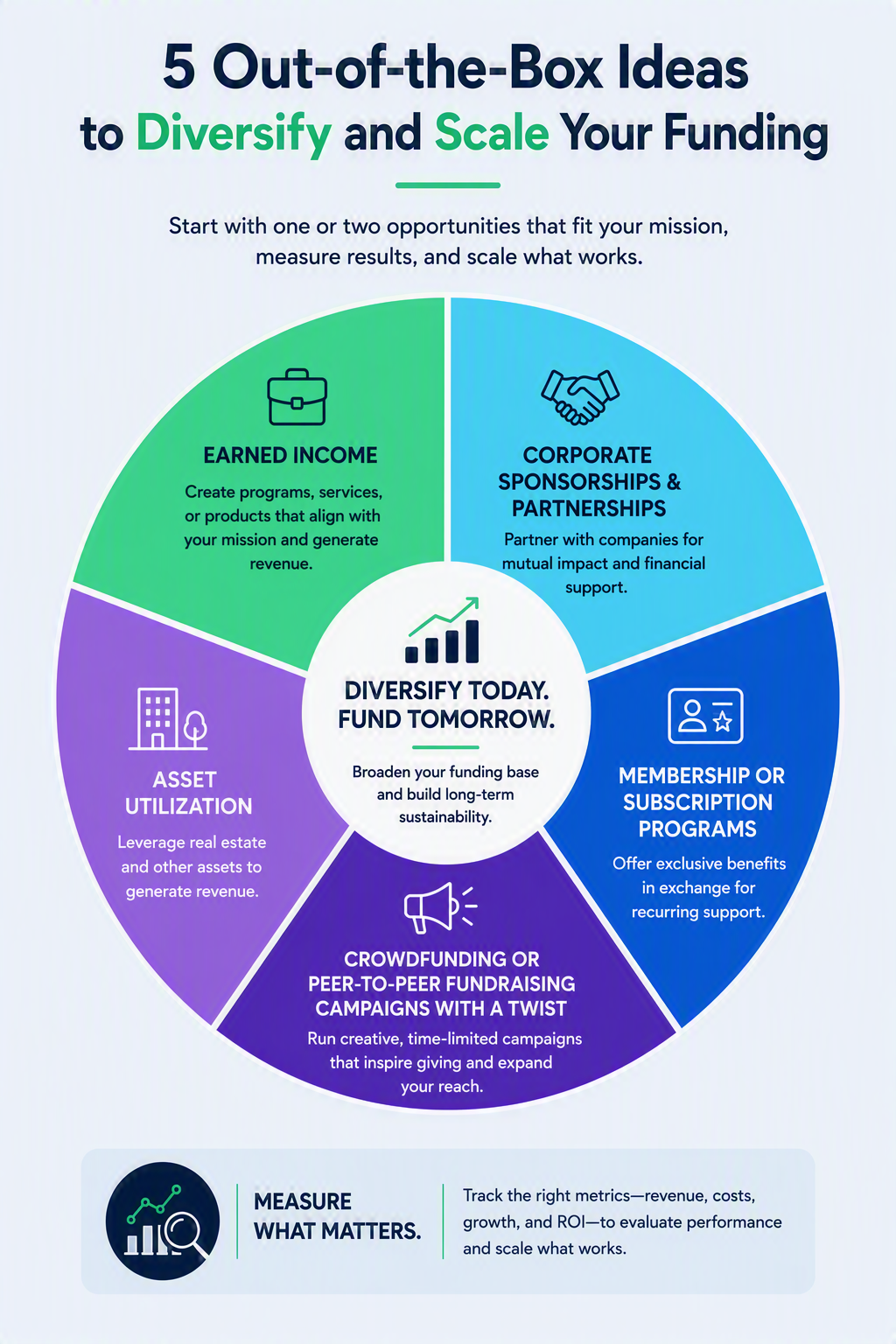
5 Out-of-the-Box Ideas to Diversify and Scale Your Funding
When your cash forecast shows an upcoming gap, it’s tempting to launch 15 new revenues streams. Instead, start with one or two opportunities that fit your mission, evaluate the return, and scale what works. To get started, here are five ideas that can broaden your organization’s funding base and boost its sustainability:
1. Earned Income
You don’t have to be a for-profit business to generate revenue through earned income. Nonprofits, healthcare organizations, and schools can create programs, services, or products that align with their mission while also generating funds. For example, a school could sell their exclusive curriculum to other schools.
How to Start: Think about your intellectual property, or the skills or services your team excels at that could be marketable. Not only does this create a new revenue stream, but it also adds a layer of financial independence to your organization and has the potential to scale by selling one to many.
How to Measure: Track revenue generated, expenses incurred, and profit margins for each earned income initiative. Set performance benchmarks (e.g., cost per unit or attendee) and use financial data to assess scalability.
2. Corporate Sponsorships and Partnerships
Companies often look for ways to engage with the community and enhance their brand reputation, making corporate sponsorships a win-win for both parties. A youth nonprofit could partner with a local tech company to fund a coding camp, while giving the company visibility in marketing materials and on social media, for example. Or an airline could donate frequent flier miles to cover an organization’s travel expenses.
How to Start: Create a compelling sponsorship package that outlines clear benefits for potential partners. This could include event sponsorship, volunteer opportunities for employees, or matching gift campaigns.
How to Measure: Use metrics like sponsorship revenue growth, cost of acquisition, and renewal rates to evaluate which partnerships are delivering the best financial returns.
3. Membership or Subscription Programs
A membership program offers exclusive benefits to supporters in exchange for monthly or annual dues. This model isn’t just for gyms or museums—it can work for advocacy groups, community organizations, and more. For example, an environmental nonprofit could offer members access to exclusive webinars or behind-the-scenes updates on conservation efforts.
How to Start: Create a tiered membership program with different levels of access or perks. For example, members might receive a quarterly impact report, special event invites, or exclusive content.
How to Measure: Track metrics like monthly recurring revenue (MRR), member retention rates, and customer lifetime value to reveal the effectiveness of different membership levels and pricing strategies.
4. Crowdfunding or Peer-to-Peer Fundraising Campaigns with a Twist
These are more than just another appeal—they can be exciting, creative events that quickly expand and engage a brand new donor base for exponential reach. Host a “24-Hour Giving Blitz,” for example, where each donation unlocks a surprise or milestone.
How to Start: Create a time-limited campaign with a unique theme, challenge, or match goal. Tell a compelling story that pulls at the heartstrings.
How to Measure: Evaluate cost per dollar raised, donor acquisition costs, and conversion rates. Finance should monitor how campaigns impact overall revenue growth and donor retention over time.
5. Asset Utilization
If your organization owns real estate or other valuable assets like vehicles, consider leveraging them to generate revenue. For example, a community center could rent out its event space for corporate meetings, while a nonprofit with a kitchen could offer cooking classes.
How to Start: Assess your assets—do you have an unused meeting space, a kitchen, or even outdoor space that could be rented out?
How to Measure: Calculate return on assets (ROA) to determine the efficiency of asset utilization. Analyze revenue against any associated costs (e.g., maintenance, insurance) to ensure profitability.
How to Build a Funding Diversification Plan
Ready to start diversifying? Begin by taking stock of where you are today. Review your existing revenue streams and identify whether you’re overly reliant on a single funding source or category. From there, establish realistic diversification goals based on your organization’s financial needs, growth plans, and capacity. Finance leaders are uniquely positioned to help set measurable targets and create a clear picture of what success looks like.
As you evaluate potential opportunities, resist the temptation to pursue every new idea at once. Instead, consider the practical implications of the one or two most mission-aligned. How much staff capacity will the new initiative require? What upfront investment is needed to get it off the ground? Will it generate revenue once or create a reliable, repeatable stream of support? And, perhaps most importantly, does it advance your mission in a meaningful way?
Once you’ve identified a promising opportunity, create an action plan with clear financial metrics and checkpoints for success. Regularly review performance with your development and leadership teams to understand what’s working, what isn’t, and where it makes sense to invest further. The goal isn’t to diversify for diversification’s sake. It’s to build a funding portfolio that strengthens your organization’s resilience and supports sustainable growth over time.
Quick Funding Diversification Checklist
Before moving forward with a new revenue stream, make sure you can answer “yes” to most of these questions:
- Do we understand our current funding mix and any areas of over-reliance?
- Have we established clear goals for what this new revenue stream should achieve?
- Does this opportunity align with our mission and strategic priorities?
- Do we have the staff capacity and resources to pursue it successfully?
- Have we considered the upfront investment required?
- Is the revenue stream scalable if it proves successful?
- Is it repeatable, or is it likely to be a one-time source of funding?
- Have we identified how we’ll measure success and ROI?
- Do we have a plan to regularly review performance and make adjustments as needed?
Driving the Diversification Conversation
Diversifying and scaling your funding streams doesn’t have to be daunting. It’s a strategic journey where finance plays a pivotal role, by ensuring that each new revenue stream is not only implemented effectively but also measured, analyzed, and optimized for maximum impact. Finance can develop a clear financial roadmap that identifies the most promising opportunities, assesses risk, and tracks performance.
Ultimately, diversification isn’t just about increasing revenue; it’s about building a resilient and financially sustainable organization positioned for growth and long-term success. When finance drives the diversification conversation, your organization is better equipped to thrive, fulfill its mission, and expand its impact.To learn more about assessing program performance, optimizing resources, and expanding funding sources to scale your organization’s impact, join us for the webinar Growing Smarter: Strategies for Scaling and Sustaining Long-term Success at Your Organization.