The Nuances of Cost in Federal Grants Management

Managing federal grant costs sounds simple enough. You receive the award, follow the approved budget, and spend the money on the project.
But anyone who has managed a federal grant knows that nothing ever goes as planned. Internal and external factors affect whether grant project objectives can be met, and whether those shifts change how funds are spent throughout the award period.
Questions can emerge such as, “Can you charge a staff member’s salary to the grant?” “What about travel to a conference?” “Is software a direct cost or an indirect cost?” “What documentation is enough to support an expense?” And perhaps the most common question of all: “Just because something is in the approved budget, does that automatically mean it is allowable?”
Federal grant cost compliance requires more than checking whether money is available in a budget category. Recipients and subrecipients—and contractors—need to understand the federal cost principles, the terms and conditions of their award, and the reasoning behind how costs are assigned to a federal program.
Here are four areas to consider when assessing whether to charge an expense to a federal grant, ideally before an award is issued.
1. Start With Allowability
Allowability is the foundation of federal grant cost management. The Uniform Guidance establishes the basic factors affecting whether a cost can be charged to a federal award. Under 2 CFR § 200.403, costs generally must meet several requirements.
A cost should be:
- Necessary and reasonable for carrying out the federal award
- Allocable to the award
- Consistent with applicable policies and procedures
- Treated consistently as either a direct or indirect cost—across the organization/agency and not just the current grant
- In accordance with the Uniform Guidance and the award’s terms and conditions
- Adequately documented
A helpful way to simplify this is to ask: Should we charge it? Can we charge it? How much should we charge? Can we prove it?
For example, an organization purchases a $1,500 laptop for an employee working on a federal program. The employee’s grant work does not automatically make the laptop allowable.
The organization should consider whether the laptop is necessary for the project, whether the price is reasonable, how much the employee uses it for the federal award, whether the organization’s policies support the purchase, whether the award includes additional restrictions, and whether sufficient documentation supports the charge.
Key Takeaway: Allowability is rarely determined by a single question.
2. Direct vs. Indirect: It Depends on the Benefit
Another common source of confusion is determining whether a cost should be charged directly or indirectly to a federal award. A direct cost is one that can be specifically identified with a particular federal award, project, program, or other cost objective.
Examples may include:
- Salary for an employee working specifically on the grant
- Supplies purchased specifically for a grant-funded activity
- Travel necessary to carry out the project
- Equipment used specifically for the program
- A consultant hired to perform work for the federal award
Indirect costs, on the other hand, generally support multiple activities or programs and cannot easily or efficiently be assigned to one specific project. Examples might include organization-wide accounting, human resources, general administrative support, utilities, or shared office expenses. Some entities have a Negotiated Indirect Cost Rate Agreement (NICRA) with a cognizant federal agency, while others use a de minimis indirect cost rate (15%) included in 2 CFR § 200.414.
But the name of the expense does not automatically determine whether it is direct or indirect. Accounting costs, for example, may normally be treated as indirect. However, specialized accounting work required solely because ofone particular award could potentially be directly identifiable with that award, depending on the circumstances and applicable requirements.
Consistency is critical. Organizations generally should not treat the same type of cost as indirect on one federal award and direct on another simply because one grant has more available funding.
Key Takeaway: The question is not simply, “What type of expense is this?” The better question is, “What does this cost benefit, and how does our organization consistently treat similar costs?”
3. Documentation Is Part of Allowability
One of the most important concepts in federal grants is also one of the easiest to overlook. An otherwise allowable cost can become a compliance problem if you cannot adequately document that it happened.
A credit card statement or canceled check may show that your organization paid for an item, but it does not necessarily explain why the expense was appropriate for the federal award. Robust cost documentation should help answer questions such as:
- What was purchased
- Who purchased it
- Why was it necessary
- Which award benefited
- How was the amount charged to the award determined
- Was the purchase properly authorized, and by whom
Depending on the expense, documentation might include invoices, receipts, purchase orders, contracts, payroll records, travel documentation, procurement records, or other supporting materials.
For personnel costs, records should accurately reflect the work performed, usually through personnel activity reports or time-and-effort logs. For these costs, organizations should retain documentation showing how they calculated the expenditure and justified the expense.
This is where organizations sometimes get into trouble. The expense itself may make perfect sense to the person who approved it at the time. Two years later, however, an auditor may only have the documentation in the file.
Key Takeaway: A good rule of thumb is that your documentation should tell the story of the cost without requiring someone to remember what happened.
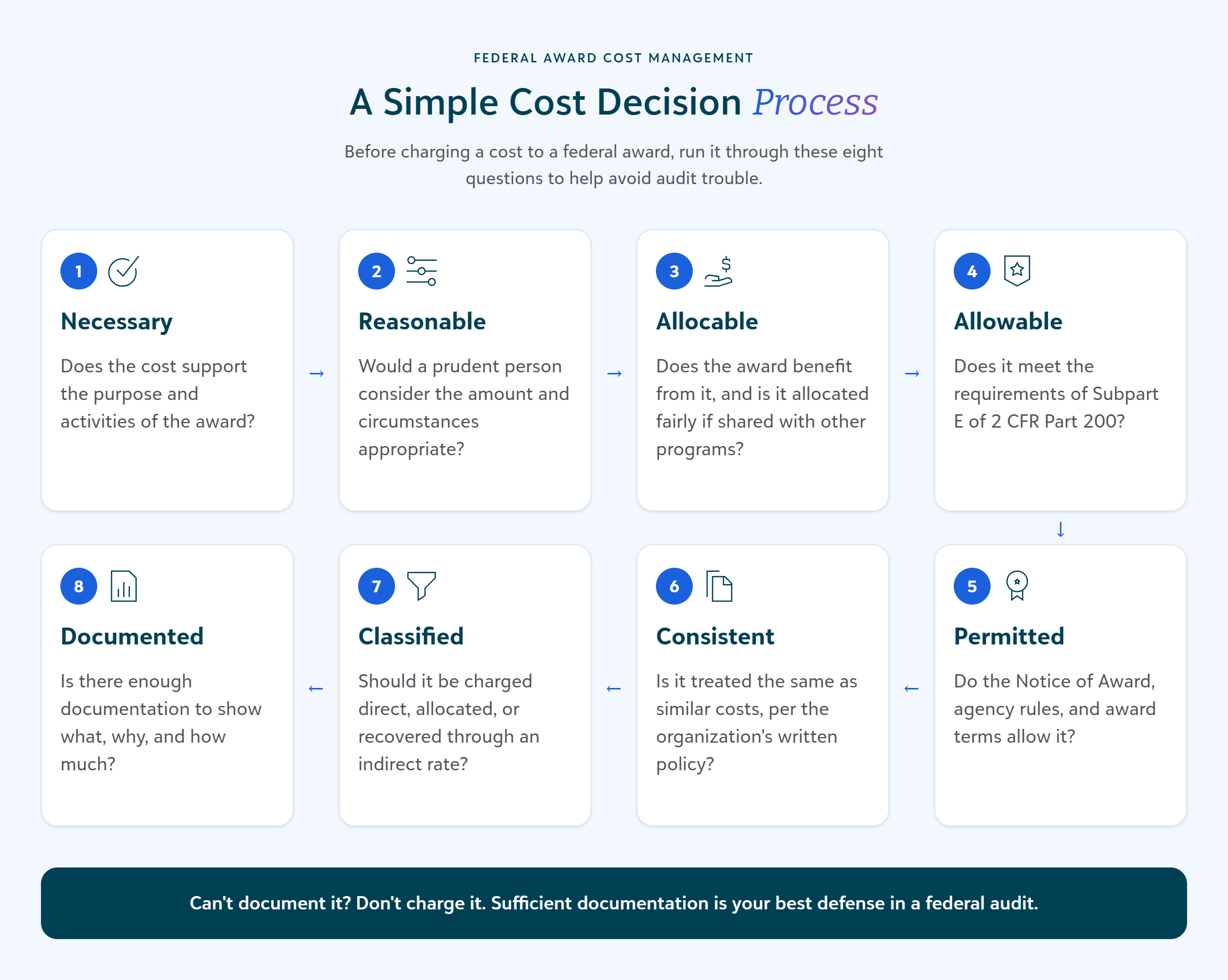
4. Use a Simple Cost Decision Process
Federal cost rules can feel complicated because they involve multiple layers. Instead of memorizing every possible scenario, organizations can establish a consistent process for reviewing costs. Following your allowable cost policy is a good start, and here is a simple workflow for evaluating costs to help you avoid audit trouble.
- Is it necessary? Does the cost support the purpose and activities of the federal award?
- Is it reasonable? Would a prudent person consider the amount and circumstances appropriate?
- Is it allocable? Does the award benefit from the expense? If multiple programs benefit, has the cost been allocated appropriately?
- Is it allowable under the Uniform Guidance? Some costs have specific restrictions or requirements under Subpart E of 2 CFR Part 200.
- Is it permitted by the award? The Notice of Award, agency regulations, program requirements, and award terms and conditions may be more restrictive than the general Uniform Guidance.
- Is it treated consistently? Does the organization’s treatment of the cost align with its written policies and how it treats similar costs?
- Is it properly classified? Should the expense be charged directly to the award, allocated among multiple activities, or recovered through an indirect cost rate?
- Can we document it? Is there sufficient documentation to show what was purchased, why it was necessary, how the amount was determined, and why it was charged to the federal award?
Key Takeaway: A clear process incorporated into organizational policies will help it withstand audit and reporting scrutiny.
Why Cost Management Is a Major Compliance Problem
Federal cost compliance is not simply a finance function. It involves everyone who touches grant administrative functions, and they must work together. That is why your organization should not wait until reimbursement, reporting, or audit time to ask whether an expense was appropriate. Build cost principles into purchasing, budgeting, payroll, travel, procurement, approvals, and documentation from the beginning to strengthen internal controls.
If you can confidently assure the funder and properly document that costs are allowable, you are well on your way to stronger federal cost management.
For a deeper dive into how your organization can better manage the costs associated with federal awards, check out the on-demand webinar, The Nuances of Cost for Federal Grants.
 Free Resource