Build It Now: A Financial Resilience Framework for Nonprofit Leaders

Picture this moment. You open your email on a Tuesday morning, coffee still hot, and there it is: the notice that your largest government contract is on hold, effective immediately, with no timeline for resolution. Your stomach drops and you start doing the math in your head before you have even finished reading the message. Payroll is in nine days. The program that contract funds serves 300 families.
For some organizations, what happens next is a plan. The executive director pulls up the cash flow forecast, sees exactly how many months the organization can operate, calls an emergency meeting with a board that already knows the financial position, and walks into the meeting with three scenarios and a recommendation.
For others, what happens next is a scramble. Digging through bank statements, calling the bookkeeper, trying to figure out frantically if there will be enough for payroll, and delivering bad news to a board that is hearing about financial vulnerability for the first time.
The difference between those two organizations and their reactions to both speedbumps and crises has nothing to do with the size of the organization, tenure of the executive director, or luck. To navigate disruption with clarity and ease, you need to build strong systems and processes before you need them. With the possibility of frozen or delayed government funding, constantly shifting foundation priorities, and increased demand for services, the pressure is real. The Center for Effective Philanthropy’s State of Nonprofits 2026 report found that two thirds of nonprofit leaders are concerned about their organization’s financial stability. The time to create or strengthen these systems and processes is now.
Financial resilience for nonprofits happens in four parts: visibility, liquidity, flexibility, and narrative.
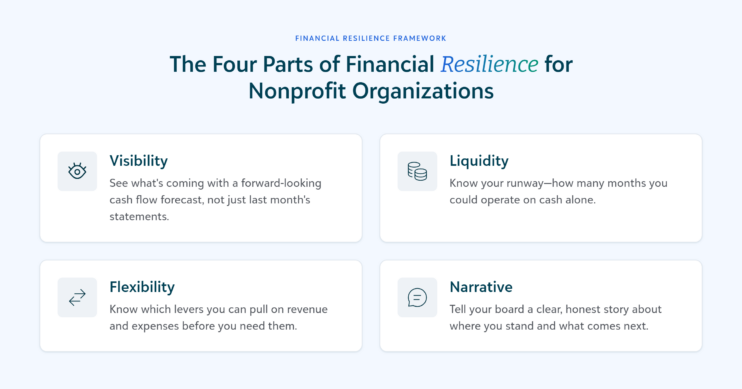
Visibility: Can you see what is coming?
Most nonprofit leaders are fully focused on the financial statements, rather than on a forecast. The financial statements tell you what already happened, and while important to understand and interpret, the income statement won’t tell you about an impending cash crunch three months from now. Only looking at the financials is akin to driving down the highway while looking in the rearview mirror.
Visibility means three things: books that are current and closed monthly, a regular rhythm for reviewing them, and a cash flow forecast that looks forward instead of back. The forecast is your early warning system that tells you, months in advance, that grant reimbursement timing and a seasonal revenue dip are about to collide with a three-payroll month, leaving your cash balance in the red.
Many nonprofit leaders avoid forecasting entirely because they could not predict every number with precision, but a forecast does not have to be perfect to be powerful. Reviewing a rough forecast monthly is infinitely better than not having one at all. A simple rolling 12-month forecast, updated monthly, helps leaders stop reacting to the finances and start anticipating them.
Liquidity: How much time do you have?
Once you can see what is coming, the next question is how much time you have to respond. Liquidity is all about time. It’s the runway between when something changes and when you run out of options.
Months of cash on hand is perhaps the most important number to know as a nonprofit leader. This number represents how many months your organization could operate—paying your staff, running your programs, keeping the lights on—if not another dollar came in the door. To calculate this, take your current available cash balance and divide it by your average monthly expenses. This number tells you whether a delayed payment will be an inconvenience or a crisis.
One frequently asked question about liquidity is whether or not operating reserves should be included in this calculation. Reserves you cannot touch are not liquid. This includes restricted funds, board-designated reserves, or money tied up in receivables because this cash will not help you make payroll in nine days. When you calculate your months of cash on hand, only count what you have available to use right now. A line of credit from your bank can be a useful tool, and it’s best to get one before you need it. But it is a cash flow bridge, not a permanent solution.
Flexibility: What moves can you make?
Once you can see into the future and know how much time you have, flexibility is about understanding clearly the changes that you can make on both sides of the income statement to pivot in times of challenge.
On the revenue side, the first thing to understand is concentration. What percentage of your revenue comes from your top two sources? If the answer is more than half, then you may consider building or growing one additional revenue stream. If your revenue is highly concentrated with a few sources, you don’t necessarily need to walk away from a major funder, but knowing your revenue mix and strategizing with your board on growing it will give you more options.
On the expense side, flexibility means knowing the difference between fixed and variable costs. There is almost always more room for shifting the timing of expenses or cutting unnecessary expenses entirely than most leaders think. The goal is to think through the hard decisions during calm times, so that if disruption comes, you know exactly the moves to make. That way, you are executing a plan you already made instead of making the hardest decisions of your career under pressure and in a panic.
Narrative: Can you tell the story?
Telling the story of your finances does not feel like a financial system, but how you talk about your financial position shapes what your board, your funders, and your staff do next.
Imagine two versions of the same organization facing the same challenge. The first tells its board, “We are fine” until the day the cash runs out. The second says, here is where we are, here is what we are watching, and here is our plan. The first version sounds reassuring but ends in chaos. The second sounds honest and builds trust you can draw on when you need it most. Funders extend grace and flexibility to organizations that can explain their position clearly, because clarity signals competence.
A three-to-five sentence financial narrative for your board, updated regularly, can be enough. Tell them what the numbers say, what you are keeping an eye on, and what your plan is. Then create a simpler version for your staff, because transparency inside your organization builds a team that sticks together during hard seasons instead of leaving.
Where to start this week
Building this financial resilience framework doesn’t need to be a complete overhaul. Each dimension starts with one small action that takes less than an hour:
- Build (or dust off) a simple twelve-month cash flow forecast
- Calculate your current months of cash on hand
- Look at what percentage of revenue comes from your top two sources and identify the expense line items you would shift if needed
- Write three sentences about your financial position for your board
Resilience is a set of consistent actions that are best done now, when your organization is not under stress. The stronger your systems and processes, the more impactful your programs will be to those you serve.
Dig deeper into financial resiliency for your organization with the webinar, Build It Now: A Financial Resilience Framework for Nonprofit Leaders.