Return on Mission: A Framework to Measure Success at Philanthropic Organizations

Our board was debating a large purchase and struggling to balance the ROI of its costs with how it was going to support the mission.
Our staff explained, passionately, how it would help them do their jobs better and more efficiently. The business-minded board members heard only cost. Our struggle was how to reconcile those factors together to make a decision.
It’s an ageless nonprofit dilemma—how much goes to performing the mission versus supporting it. Is there a magic percentage that proves good stewardship? How much can you scrimp on staff resources before it hinders the mission itself? Because our purpose is the mission, every expense gets scrutinized by donors, watchdogs, and board members. That scrutiny builds trust, but it can also keep organizations from fully delivering on their promise.
Translating Expenses into Mission Terms
The people in that board meeting—seasoned business owners and veteran nonprofit staffers—wanted the same outcome but talked past each other. What we needed was a translator, a way to quantify the intangible so both sides could see the same issue through one lens. That’s where Return on Mission came in.
I didn’t announce a new framework. I just asked questions that translated the expense into mission terms and specific value propositions, then mapped those onto Return on Investment, a metric every businessperson understands instinctively.
That day, we found a shared language bridging program and expense, overhead and revenue, budget and mission. We stopped talking past each other, using borrowed terms to communicate mission success, and reached a decision that served every goal of the organization.
In my 2024 book, “Return on Mission: Translating Investment Into Mission Impact”, I describe the five diverse motives that drive nonprofit, healthcare, higher education, and other institutions to purchase:
- Mission alignment
- Operation efficiency
- Quality and reliability
- Social and environmental responsibility
- Cost Considerations
These motives encompass so much more of the actual complexity that exists in an organization, compared to what the old-school program vs. overhead ratio measurement can capture. If we continue trying to measure social change by financial criteria alone, we’ll never have a full view of the inputs and processes necessary to create lasting impact. The solution for organizations is to look to a new formula that changes the discussion around these investments. That’s where Return on Mission comes in.
How Did We Get Here?
There are undoubtedly for-profit business practices that we in the charity world use every day for the benefit of our employees and missions. However, we shouldn’t rely on for-profit output measures to paint a complete picture of nonprofit success.
For instance, the corporate profit-and-loss statement isn’t the same as our nonprofit budget-to-actuals report, and it falls short of providing the information necessary to effectively assess whether we need to course correct throughout the year.
To better understand the shortcomings of for-profit metrics as a true measure of nonprofit success, let’s look at how return on investment (ROI) is calculated.
ROI for Nonprofits
ROI measures financial gain or savings from an investment. Here is the formula:
ROI = (Gain from Investment – Cost of Investment / Cost of Investment) × 100
Sophisticated versions weigh tangible items, like revenue and hard costs, alongside intangibles, like brand awareness and satisfaction, against cost. This formula shows up often in nonprofit boardrooms, but alone, it can’t connect financial metrics to social impact. I once had to explain the word “nonprofit” to a board member who wanted the ROI on a free program for people who couldn’t afford treatment. We found common ground, but it took him time to shift from a for-profit mindset to mission outcomes.
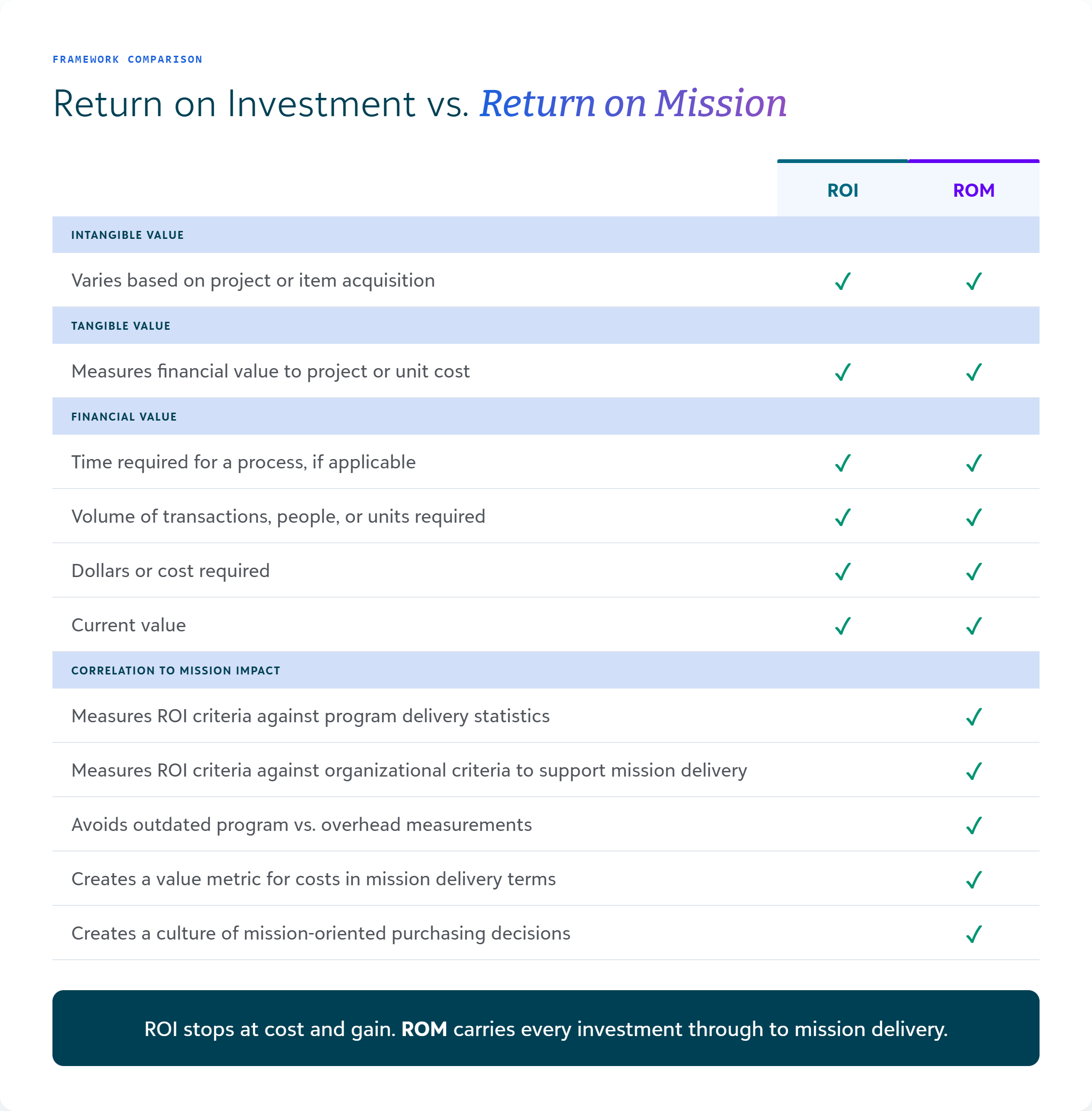
That’s why I’ve long advocated extending ROI into a truly mission-focused measure: return on mission (ROM). It shares the same DNA as ROI but adds one final step—correlating the outcome to mission impact.
Transitioning from Return on Investment to Return on Mission®
The concept of ROM is that the real measure of a nonprofit’s success is not in how high the return is on an ‘investment,’ but rather how much that investment impacts the mission itself. That, then, is the bridge that connects overhead and mission costs.
A simple way to think of ROM is in this formula:
ROM = ROI Measurement / Proportionate Mission Cost
Food banks, for example, track cost per meal delivered so they know what it costs to deliver on that portion of their mission, but why not extend that to the systems supporting the mission? Could a new financial management solution improve meal delivery efficiency?
A general ledger doesn’t make meals, but it helps to drive the supply chain, pay the kitchen staff, and keep the lights on. If a new financial system saves $5,000 a year, that savings can be attributed to mission delivery. Divide it by your meal statistic, and you get a ROM tied directly to impact.
This reframes what counts as programmatic delivery. An expense or purchasing solution absolutely qualifies if the mission can’t run optimally without it. Real-world numbers won’t be this clean, but the goal is to shift the conversation around the investment.
I truly love the immediate head nods of recognition I see when I talk to someone about the meaning of “Return on Mission”. There is a wonderful light bulb moment of understanding I can see in their eyes…It’s a simple realization in that the changing of one word changes everything about the term. A one-word change to a familiar tune changes the whole song. It is changed in a way that make the new song quick and easy to understand by people from many walks of life and experience.
ROM provides accessible means to help put a term to how many, if not most, in our sector approach their work. It also provides a familiar means to highlight the differences in how our sector approaches our work compared to for-profit businesses.
From board discussions to setting organizational or departmental goals and more, I have heard firsthand how this simple change has focused discussions toward positive ends, short circuited many unhelpful conversations, and united teams in their purpose for projects.
Bringing Return on Mission Home
Organizations using ROM are better able to discuss, justify, and feel confident in their decisions to their staff, board members, funders, and other stakeholders. In doing so, you will be creating your own shared dictionary of mission criteria that you can judge decisions against. You will have the elements to translate between and marry the business metrics that ROI measured and your mission impact criteria.
As you consider your next project, you, your internal project team, and your potential vendors all need to ask, “What’s the Return on Mission for this project?” If you can establish a positive ROM, then you have a project worth pushing forward. With ROM, we are measuring our mission’s work not by the outdated metrics of overhead/program or by for-profit business standards, but by the success of the mission delivery itself.
To learn more about why nonprofits need an accounting system designed for nonprofits to help them measure and track their return on mission, check out our white paper, Why Nonprofits Need Nonprofit Accounting Software.