Accounting Methods for Nonprofits: Cash vs. Accrual and How to Choose

There comes a point when an accounting method that worked well for your nonprofit no longer gives you the information you need to make confident decisions.
As your organization adds grants, multiyear pledges, major donor commitments, and other sources of restricted funding, the timing of cash moving in and out tells only part of the financial story. Finance leaders also need visibility into revenue they expect to receive, expenses they’ve incurred but haven’t paid, and resources designated for specific purposes.
That’s often when the limitations of cash-basis accounting become clear. Accrual-basis accounting provides a more complete picture of your organization’s financial position by recognizing revenue and expenses when they are earned or incurred, rather than simply when cash changes hands.
Understanding the difference between cash and accrual accounting can help you recognize when your current approach is creating blind spots, and when it may be time to build a stronger accounting foundation for your organization’s next stage of growth.
Cash vs. Accrual Accounting for Nonprofits: The Short Answer
Cash-basis accounting records revenue when cash arrives and expenses when cash leaves. Accrual-basis accounting records revenue when it is earned or recognized and expenses when they are incurred, even if the cash hasn’t moved yet.
A nonprofit may use a cash basis while its transactions and reporting needs remain simple. Accrual accounting becomes more useful as the organization adds receivables, payables, multiyear grants, pledges, fixed assets, debt, or audited financial statements.
How Cash and Accrual Accounting Differ
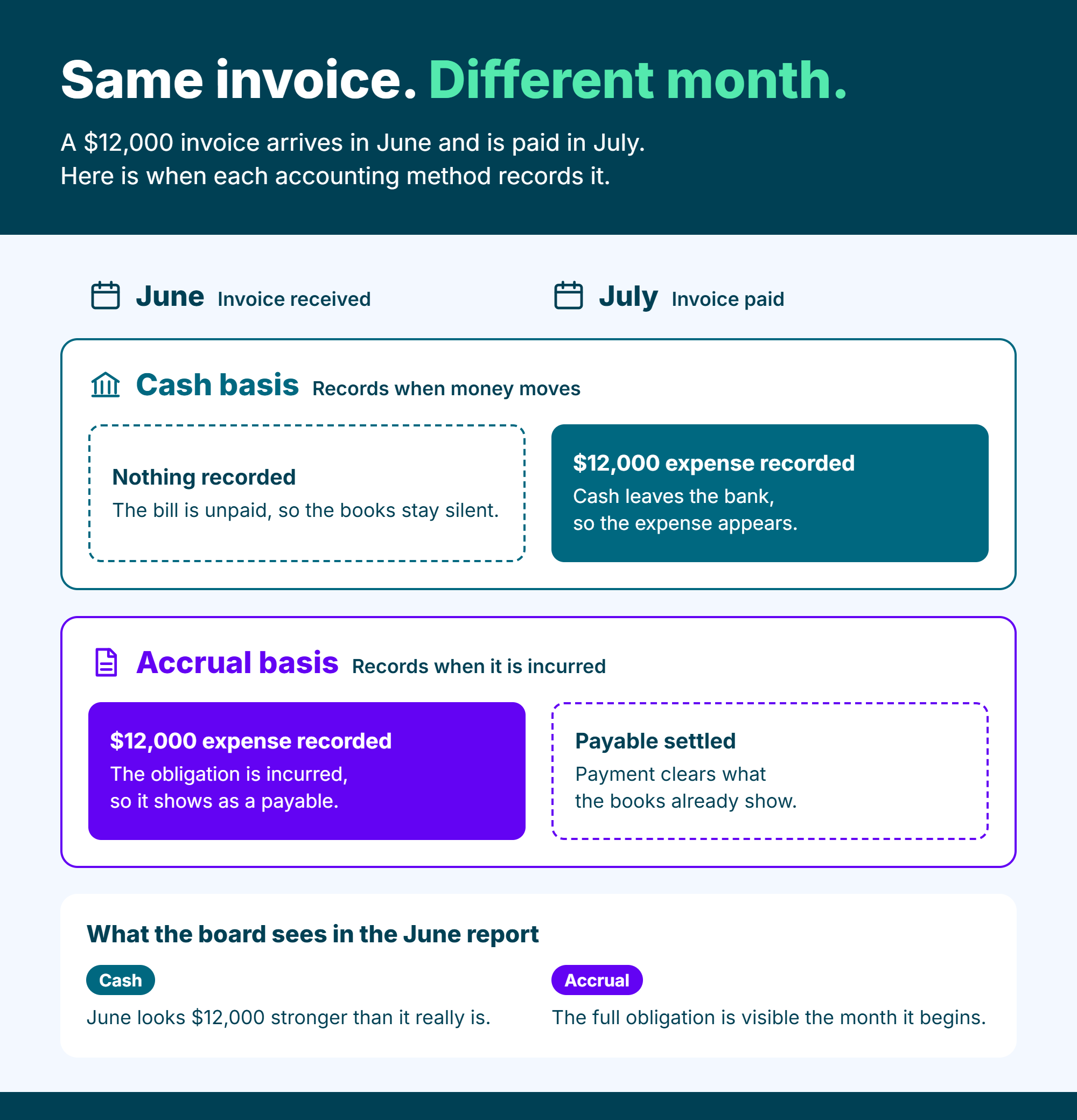
Imagine your organization receives a $12,000 invoice in June but pays it in July. Under cash-basis accounting, the expense generally appears in July, when the payment leaves your bank account. Under accrual accounting, the organization records the expense and corresponding payable in June, when it incurs the obligation.
That timing difference can materially change what a board member sees in a monthly report.
| Area | Cash basis | Accrual basis |
| Revenue | Recorded when cash is received | Recorded when earned or recognized under the applicable rules |
| Expenses | Recorded when cash is paid | Recorded when the obligation is incurred |
| Receivables | Generally not recorded | Recorded when appropriate |
| Payables | Generally not recorded | Recorded when expenses have been incurred but not paid |
| Cash visibility | Closely reflects recorded activity | Requires separate attention to cash flow and liquidity |
| Obligations | May not show unpaid bills or other liabilities | Shows qualifying obligations before payment |
| Complexity | Simpler to maintain | Requires more accounting knowledge and stronger processes |
| GAAP reporting | Not GAAP compliant | Used for GAAP-basis financial statements |
| Best fit | Straightforward activity and limited external reporting | More complex funding, obligations, assets, or reporting needs |
Cash-basis reports can offer a clear view of money entering and leaving the bank. But those reports may provide an incomplete picture when cash timing and economic activity fall in different periods.
An organization may appear to have a strong month because it received a large grant payment, even though those funds support work that will occur over the next year. Or it may appear to have fewer expenses because several vendor invoices haven’t been paid. Accrual reporting captures more of those obligations and timing differences.
That added visibility becomes increasingly important when finance leaders must explain why cash on hand doesn’t match the revenue or expenses shown in financial statements.
When Cash-Basis Accounting May Still Work for a Nonprofit
A nonprofit can use cash-basis accounting in some circumstances. The practical question is whether the method gives leadership, the board, funders, and other stakeholders the information they need.
Cash basis may remain workable when your organization has:
- Straightforward sources of revenue and expenses
- Few outstanding receivables or unpaid bills
- Limited pledges or grants that span reporting periods
- No current need for GAAP-basis financial statements
Avoid reducing this decision to “small nonprofit equals cash basis.” Operational complexity matters more than a single revenue threshold. A lean organization managing reimbursable grants, restricted contributions, or multiple programs may outgrow cash-basis reporting sooner than its budget suggests.
Cash basis also doesn’t remove the need to track donor restrictions, grant obligations, or supporting documentation. If the general ledger doesn’t carry that detail, the finance team may depend on spreadsheets and manual reconciliations to fill the gaps, which can increase errors.
When Accrual Accounting Becomes More Useful
Accrual accounting becomes more useful when the timing of cash no longer tells the full financial story. Here are some of the common reasons an organization make need to make the shift to accrual accounting:
- Material receivables or payables: Leaders need to see money owed to the organization and bills the organization has incurred but hasn’t paid.
- Reimbursable grants: The organization may incur eligible expenses before receiving reimbursement.
- Multiperiod commitments: Grants, contracts, leases, or other agreements cross fiscal or reporting periods.
- Conditional and unconditional contributions: Finance teams need to evaluate the donor agreement rather than assume every pledge receives the same accounting treatment.
- Fixed assets, debt, or prepaid expenses: The timing of purchase, payment, use, and expense recognition may differ.
- Audited GAAP financial statements: External financial statements prepared under U.S. generally accepted accounting principles (GAAP) use accrual accounting.
- Funder, lender, or state requirements: An agreement or applicable requirement may call for a specific form of financial reporting.
Nonprofit-specific U.S. GAAP guidance includes standards affecting financial statements, grants, contracts, and contributions. The IRS separately allows an organization to identify its accounting method on Form 990 and expects it to apply that method consistently. Your auditor or nonprofit CPA can help distinguish what is formally required from what is operationally advisable.
The presence of one item doesn’t automatically settle the decision. A growing collection of timing differences, manual adjustments, and reporting exceptions provides a stronger signal that your organization should use the accrual accounting method. If your finance team must routinely reconstruct your organization’s obligations outside the accounting system, the simpler method may no longer be producing simpler work.
Why Some Organizations Use a Modified Cash Basis
Modified cash basis falls between pure cash-basis and full accrual accounting, but exactly what that means can vary by organization. Some nonprofits, including private K–12 schools, may describe their accounting as modified accrual even though many of their day-to-day processes resemble cash accounting, or vice versa.
For example, a school might record invoices in accounts payable but pay them quickly, while waiting until year-end to make certain adjustments for accruals, prepaid expenses, or deferred revenue. In practice, the organization may operate much closer to accrual accounting than the term “modified cash” suggests.
This approach can simplify accounting throughout the year. But as grants, pledges, restricted gifts, endowments, and other financial activity become more complex, relying on year-end adjustments can make it harder for leaders to see a complete financial picture when making decisions. Education organizations, in particular, may need to account for endowments, restricted scholarships, and auxiliary funds.
If your organization uses modified cash basis, work with your accountant or auditor to understand which transactions receive accrual treatment and whether your internal reporting provides enough visibility between year-end adjustments.
When to Consider Switching from Cash to Accrual
A transition makes sense when your current method no longer supports accurate reporting or efficient decision-making. Start with the problem you’re trying to solve rather than treating accrual accounting as an automatic milestone.
Use these questions to assess readiness:
- Why are you considering the switch? Identify the recurring reporting gap, compliance need, or process problem.
- Which opening balances will you need to establish, including receivables, payables, prepaid expenses, fixed assets, debt, payroll liabilities, or other applicable balances?
- Will you convert prior-period records, or will you begin using the new method on a defined date?
- What does the board need to understand about cash, operating results, restrictions, and obligations?
- What will your auditor, funders, lenders, or state regulators require?
- Can your current accounting system retain source documentation and preserve the fund, grant, program, or restriction detail behind each balance?
- Does the finance team have the capacity to maintain accrual processes consistently after the conversion?
A switch may also expose weaknesses that were easy to overlook under a cash-basis accounting method. Missing grant documentation, inconsistent cutoff practices, and disconnected spreadsheets become much harder to manage when the team must establish reliable receivable, payable, and deferred balances.
Bring your accountant or auditor into the planning process early. They can help define the conversion date, identify necessary adjustments, and determine how the change affects external statements and tax reporting.
How Fund Accounting Supports Your Accounting Method
Accounting basis and fund accounting principles answer different questions. Your accounting basis determines when you recognize transactions. Fund accounting determines how you separate and track resources by purpose or restriction. And reporting requirements determine which rules and outputs apply.
A nonprofit can use fund accounting principles with either cash- or accrual-basis books. As the organization’s funding and reporting grow more complex, however, accrual accounting and purpose-built fund accounting software often work together to provide a more complete view.
A fund accounting system can help your team:
- Track multiyear grants and their related activity
- Manage restricted and unrestricted resources in one system
- Organize complex revenue streams without relying on an unwieldy chart of accounts
- Produce reports at the fund, grant, program, department, or organization level
- Maintain the detail needed to explain financial results to the board and other stakeholders
This distinction becomes especially important for organizations outgrowing commercial accounting software. A system may record accrual transactions correctly while still forcing the finance team to use classes, duplicated accounts, or spreadsheets to report by fund. That friction signals a system-design problem, not necessarily an accounting-method problem.
Build a Finance Foundation that Can Grow with Your Mission
Your accounting method should reflect the financial reality your leaders need to see. Cash basis may serve an organization with straightforward transactions and limited reporting demands. Accrual accounting becomes more valuable as obligations, funding arrangements, assets, and external requirements grow more complicated.
The bigger question is whether your accounting processes and software can keep pace. If your team spends each month rebuilding fund reports in spreadsheets, reconciling disconnected grant records, or explaining why the books don’t match the board’s expectations, it may be time to strengthen the foundation.
Explore the white paper, Why Nonprofits Need Fund Accounting Software, to learn how purpose-built technology can support clearer reporting and more complex financial management.